1,267 posters, 47 videos, 13 topics, 4 sessions, 853 authors
ePostersLive by SciGen Technologies S.A. All rights reserved.
SOHO 2026 Annual Meeting
September 9 - 12, 2026 | George R. Brown Convention Center, Houston, Texas

CT - 680
Outcomes of Eculizumab Treatment in Adults with High-Risk Transplant Associated Thrombotic Microangiopathy
Poster Presenter
Authors
Part of Topic
Cellular Therapy (CT)
Background
High-Risk Transplant Associated Thrombotic Microangiopathy (TA-TMA) is an underrecognized complication of Allogeneic Stem Cell Transplantation (SCT) and represents a significant cause of mortality. Complement blockade represents a potential therapeutic strategy.
Methods
Retrospective study evaluating adult patients undergoing SCT at UAB between 2023 and 2025, including 238 patients. TA-TMA was confirmed using ASTCT Harmonization Criteria and response was evaluated using the ASTCT Response Criteria.
Results
31 (13.02%) patients were diagnosed with TA-TMA and received Eculizumab. Median age was 66(36-73), and median HCT-CI was 3 (0-12). 54.8% were female, 74.2% were NHW and 22.6% were NHB. AML (38.7%) and MDS (29%) were the most common indications; 58.1% had Matched Donor, 77.4% received RIC, 54.83% received PTCY. Median time to TA-TMA was 90 (13-414), from diagnosis to eculizumab initiation was 20 (5-175) and median doses administered were 7 (1-27).
74.2% patients were RBC and PLT transfusion dependent, 93.5% had elevated LDH, 100% had schistocytes, 83.9% had elevated sC5b-9, median of 370 ng/mL (141-1044), 58.1% had AKI, with 22.6% requiring dialysis, 93.5% had proteinuria >1g, 54.8% had HTN, 16.1% had pHTN, 48.4% had AHRF, 83.9% had serositis, 32.3% had GI and 58.1% had CNS involvement. Hematologic/Biochemical Response Rate was 45.2% (3 CR, 11 PR) and Organ Response Rate was 51.6% (7 CR, 9 PR), ORR was 45.2% (3 CR, 11 PR); median time to best ORR from eculizumab was 109 days (0-308).
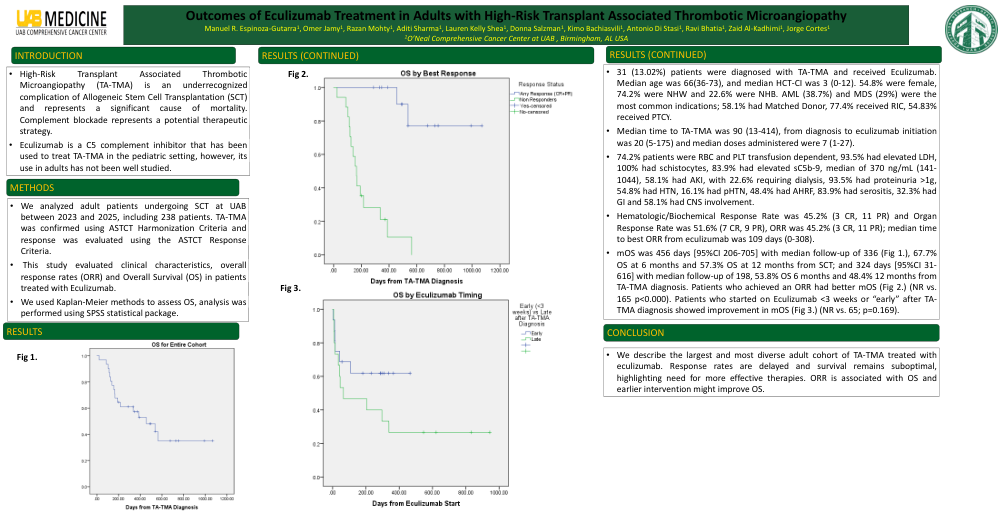
mOS was 456 days [95%CI 206-705] with median follow-up of 336, 67.7% OS 6 months and 57.3% OS 12 months from SCT; and 324 days [95%CI 31-616] with median follow-up of 198, 53.8% OS 6 months and 48.4% 12 months from TA-TMA. Patients who achieved an ORR had better mOS (NR vs. 165 p<0.000). Patients who started on Eculizumab <3 weeks or “early” after TA-TMA diagnosis showed improvement in mOS (NR vs. 65; p=0.169)
Conclusions
We describe the largest and most diverse adult cohort of TA-TMA treated with eculizumab. Response rates are delayed and survival remains suboptimal, highlighting need for more effective therapies. ORR is associated with OS and earlier intervention might improve OS.