1,267 posters, 47 videos, 13 topics, 4 sessions, 853 authors
ePostersLive by SciGen Technologies S.A. All rights reserved.
SOHO 2026 Annual Meeting
September 9 - 12, 2026 | George R. Brown Convention Center, Houston, Texas

MCL - 668
Infectious Complications in Patients With Mantle Cell Lymphoma Treated With CAR-T Therapy: A Real-World TriNetX Analysis
Poster Presenter
Authors
Part of Topic
Mantle Cell Lymphoma (MCL)
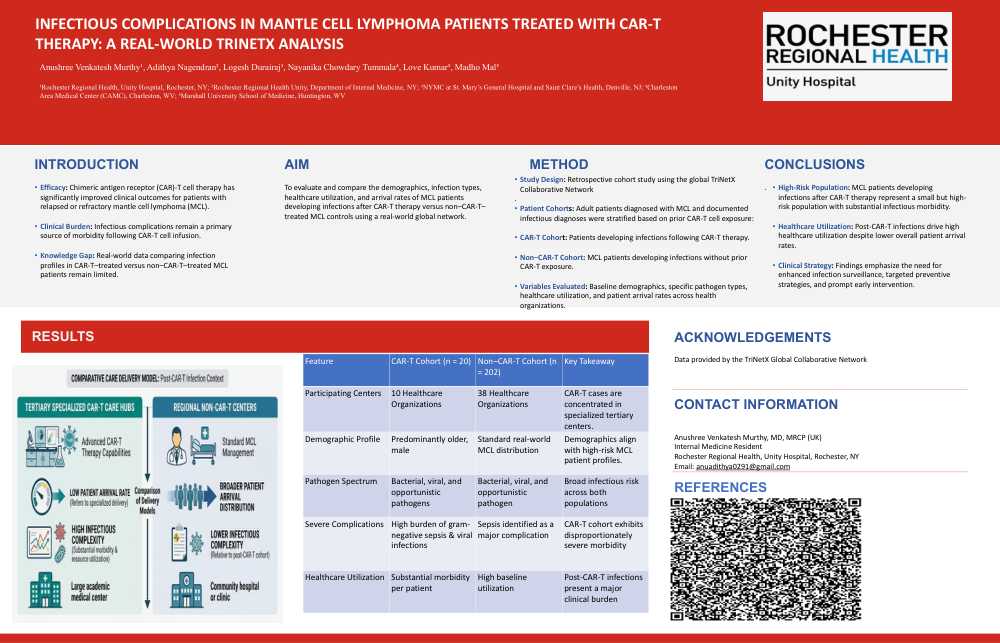
Title : Infectious complications in mantle cell lymphoma patients treated with CAR-T therapy: A real-world TriNetX analysis.
Background:
Chimeric antigen receptor T-cell therapy has significantly improved outcomes for patients with relapsed or refractory mantle cell lymphoma. However, infectious complications remain a major source of morbidity following CAR-T therapy. Real-world data comparing infections in CAR-T–treated versus non–CAR-T–treated mantle cell lymphoma patients remain limited
Methods:
We conducted a retrospective cohort study using the TriNetX Global Collaborative Network. Adult patients with mantle cell lymphoma and documented infectious diagnoses were identified and stratified based on prior CAR-T exposure. Two cohorts were analyzed: patients who developed infections after CAR-T therapy and patients with mantle cell lymphoma who developed infections without CAR-T exposure. Demographics, infection types, healthcare utilization, and patient arrival rates across healthcare organizations were evaluated.
Results:
The CAR-T–associated infection cohort included 20 patients from 10 healthcare organizations, while the non–CAR-T infection cohort included 202 patients from 38 healthcare organizations. Patients in the CAR-T cohort were predominantly older and male. Infections across both groups included bacterial, viral, and opportunistic pathogens, with sepsis representing a common and clinically significant complication. Although the CAR-T cohort was smaller, it exhibited a high burden of severe infections, including gram-negative sepsis and viral infections. Patient arrival rates were lower in the CAR-T cohort, reflecting the specialized nature of CAR-T therapy delivery.
Conclusions:
In this real-world analysis, mantle cell lymphoma patients who developed infections following CAR-T therapy represented a small but high-risk population with substantial infectious morbidity and healthcare utilization. These findings highlight the need for enhanced infection
surveillance, preventive strategies, and early intervention in CAR-T–treated mantle cell lymphoma patients.