1,267 posters, 47 videos, 13 topics, 4 sessions, 853 authors
ePostersLive by SciGen Technologies S.A. All rights reserved.
SOHO 2026 Annual Meeting
September 9 - 12, 2026 | George R. Brown Convention Center, Houston, Texas

MM - 605
Post-BCMA Sequencing in Relapsed/Refractory Multiple Myeloma: BCMA Re-Targeting Versus Non-BCMA T-Cell Redirection
Poster Presenter
Authors
Part of Topic
Multiple Myeloma (MM)
Abstract
Background
The best treatment approach after B-cell maturation antigen (BCMA)-directed therapy in relapsed/refractory
multiple myeloma (MM) remains unclear. This question is becoming increasingly important as BCMA-directed
chimeric antigen receptor (CAR) T-cell therapy, bispecific antibodies, and antibody-drug conjugates (ADCs) are
used earlier in the disease course. We reviewed the available data on subsequent T cell–redirecting therapy after
prior BCMA exposure and compared outcomes with BCMA retargeting vs switching to a non-BCMA target.
Methods
We searched PubMed and major hematology/oncology meeting abstracts, including ASH, ASCO, EHA/HemaSphere,
and SOHO, from 2022 to 2025 for studies of relapsed/refractory MM reporting outcomes following prior
BCMA-directed therapy. Eligible studies included patients who received subsequent T cell–redirecting therapy
and reported extractable outcomes for the prior-BCMA-exposed subgroup. Reviews, trial-in-progress abstracts,
preclinical studies, biomarker-only reports, ADC-only studies, and reports without extractable post-BCMA outcomes
were excluded. When overlapping cohorts were identified, the latest, most complete, or full-publication
source was used. Crude pooled objective response rates (ORRs) were calculated by sequencing strategy.
Results
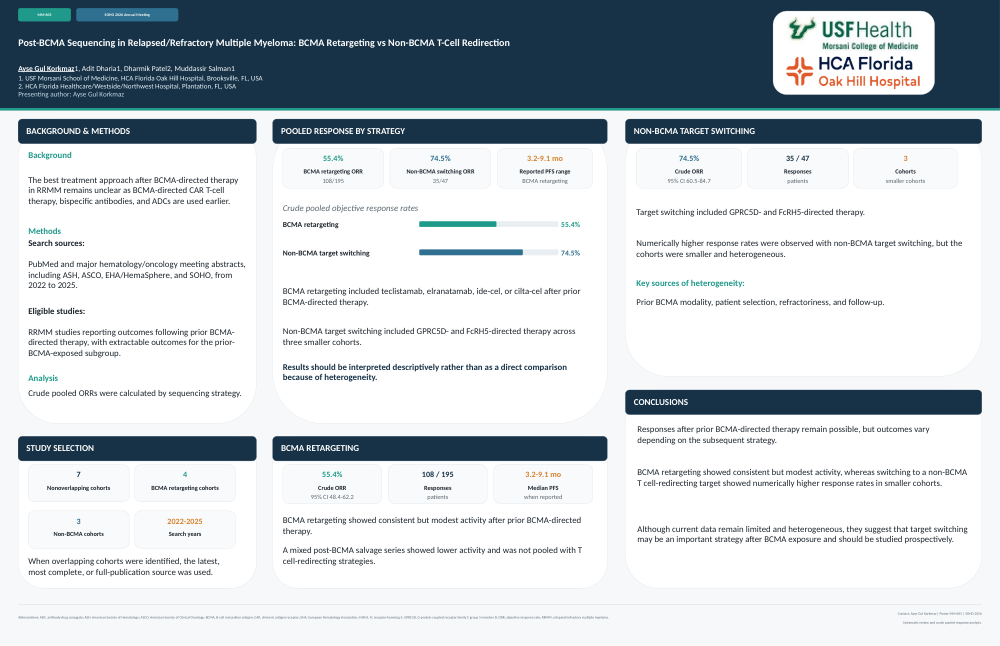
Seven nonoverlapping cohorts were included. BCMA retargeting included teclistamab, elranatamab, ide-cel, or
cilta-cel after prior BCMA-directed therapy. Across four primary BCMA retargeting cohorts, crude ORR was
55.4% (108 of 195; 95% Wilson CI, 48.4%–62.2%). Median progression-free survival, when reported, ranged
from 3.2 to 9.1 months. Non-BCMA target switching, including GPRC5D- and FcRH5-directed therapy, showed
a crude ORR of 74.5% (35 of 47; 95% Wilson CI, 60.5%–84.7%) across three smaller cohorts. Because of
differences in prior BCMA modality, patient selection, refractoriness, and follow-up, these results should be
interpreted descriptively rather than as a direct comparison. A mixed post-BCMA salvage series showed lower
activity and was not pooled with T cell–redirecting strategies.
Conclusions
Responses after prior BCMA-directed therapy remain possible, but outcomes vary depending on the subsequent
strategy. BCMA retargeting showed consistent but modest activity, whereas switching to a non-BCMA T cell–
redirecting target showed numerically higher response rates in smaller cohorts. Although current data remain
limited and heterogeneous, they suggest that target switching may be an important strategy after BCMA exposure
and should be studied prospectively.
ASH: American Society of Hematology, ASCO: American Society of Clinical Oncology, cilta-cel: ciltacabtagene
autoleucel, EHA: European Hematology Association, FcRH5: Fc receptor-homolog 5, GPRC5D: G-protein coupled
receptor family C group 5 member D, ide-cel: idecabtagene vicleucel, SOHO: Society of Hematologic Oncology
Keywords
MM, relapsed/refractory, BCMA, post-BCMA sequencing, T-cell redirection