1,267 posters, 47 videos, 13 topics, 4 sessions, 853 authors
ePostersLive by SciGen Technologies S.A. All rights reserved.
SOHO 2026 Annual Meeting
September 9 - 12, 2026 | George R. Brown Convention Center, Houston, Texas

AML - 592
Clinical Predictors of In-Hospital Mortality Among Patients Hospitalized With Acute Myeloid Leukemia: A National Inpatient Sample Analysis (2018-2023)
Poster Presenter
Authors
Part of Topic
Acute Myeloid Leukemia (AML)
-
Acute myeloid leukemia (AML) is an aggressive hematologic malignancy associated with substantial inpatient morbidity and mortality.
-
Hospitalized AML patients frequently have multiple medical comorbidities and are at increased risk for infectious complications that adversely affect outcomes.
-
Contemporary nationwide data identifying independent predictors of inpatient mortality remain limited.
-
We evaluated demographic and clinical predictors of in-hospital mortality among AML hospitalizations using a nationally representative U.S. database.
-
Design: Retrospective cohort study using the National Inpatient Sample Analysis (2018-2023)
-
Population: Adult hospitalizations (age > 18 years old) with AML (C92.0),
-
Primary Outcome: In-Hospital Mortality
-
Survey-weighted multivariate logistic regression adjusted for demographics, age, sex, heart failure, chronic kidney disease, diabetes mellitus, hypertension, obesity, COPD, liver disease, stroke/TIA, coronary artery disease.myocardial infarction, peripheral disease, and sepsis.
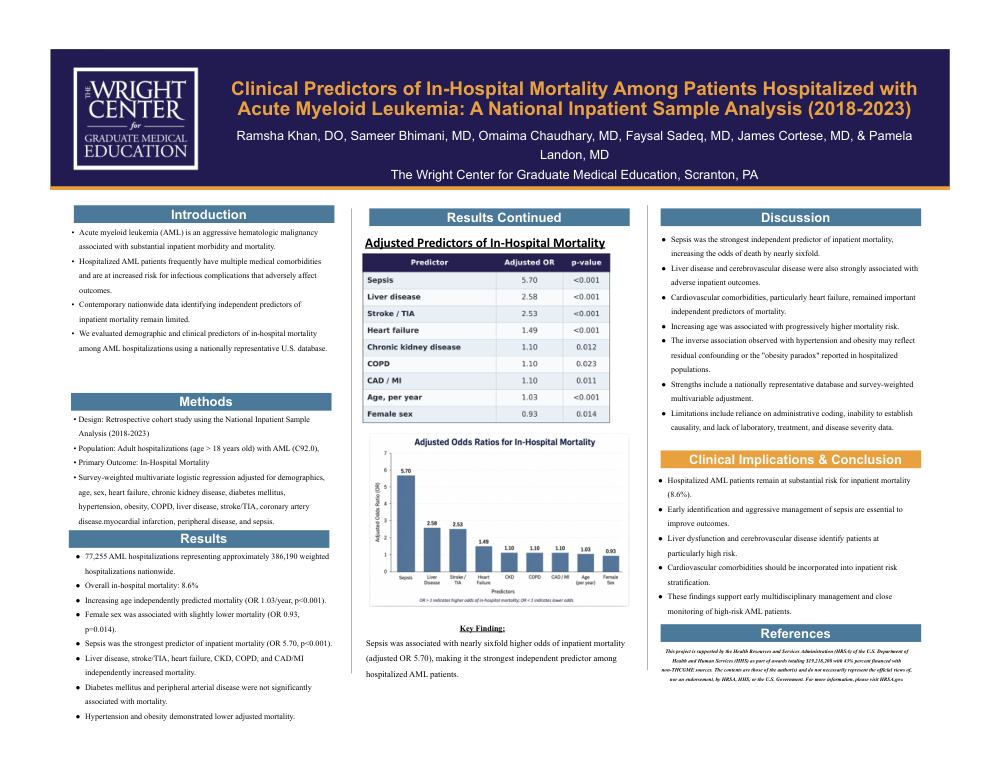
77,255 AML hospitalizations representing approximately 386,190 weighted hospitalizations nationwide.
Overall in-hospital mortality: 8.6%
Increasing age independently predicted mortality (OR 1.03/year, p<0.001).
Female sex was associated with slightly lower mortality (OR 0.93, p=0.014).
Sepsis was the strongest predictor of inpatient mortality (OR 5.70, p<0.001).
Liver disease, stroke/TIA, heart failure, CKD, COPD, and CAD/MI independently increased mortality.
Diabetes mellitus and peripheral arterial disease were not significantly associated with mortality.
Hypertension and obesity demonstrated lower adjusted mortality.
Sepsis was the strongest independent predictor of inpatient mortality, increasing the odds of death by nearly sixfold.
Liver disease and cerebrovascular disease were also strongly associated with adverse inpatient outcomes.
Cardiovascular comorbidities, particularly heart failure, remained important independent predictors of mortality.
Increasing age was associated with progressively higher mortality risk.
The inverse association observed with hypertension and obesity may reflect residual confounding or the "obesity paradox" reported in hospitalized populations.
Strengths include a nationally representative database and survey-weighted multivariable adjustment.
Limitations include reliance on administrative coding, inability to establish causality, and lack of laboratory, treatment, and disease severity data.
Hospitalized AML patients remain at substantial risk for inpatient mortality (8.6%).
Early identification and aggressive management of sepsis are essential to improve outcomes.
Liver dysfunction and cerebrovascular disease identify patients at particularly high risk.
Cardiovascular comorbidities should be incorporated into inpatient risk stratification.
These findings support early multidisciplinary management and close monitoring of high-risk AML patients.