1,267 posters, 47 videos, 13 topics, 4 sessions, 853 authors
ePostersLive by SciGen Technologies S.A. All rights reserved.
SOHO 2026 Annual Meeting
September 9 - 12, 2026 | George R. Brown Convention Center, Houston, Texas

MM - 574
Reducing Hospitalization During Bispecific Antibody Initiation in Relapsed/Refractory Multiple Myeloma: A Systematic Review and Pooled Analysis of Outpatient, Step-Up, and CRS-Mitigation Strategies
Poster Presenter
Authors
Part of Topic
Multiple Myeloma (MM)
Abstract
Background
Bispecific antibody initiation in relapsed/refractory MM (RRMM) is commonly associated with hospitalization
because of CRS, ICANS, and step-up dosing logistics. Emerging strategies, including outpatient or hybrid
initiation, condensed step-up schedules, and prophylactic toxicity-mitigation approaches, may reduce inpatient
burden, but evidence remains fragmented.
Methods
We systematically searched PubMed/MEDLINE, ClinicalTrials.gov, and major hematology/oncology conference
proceedings, including ASH, ASCO, EHA/HemaSphere, and SOHO, for studies evaluating strategies to reduce
hospitalization during bispecific antibody initiation in RRMM. Core strategy studies included outpatient or
hybrid initiation models, condensed or accelerated inpatient step-up schedules, and prophylactic CRS-mitigation
approaches. Supportive initiation-toxicity studies were reviewed to contextualize early adverse event timing.
Primary outcomes were hospitalization, inpatient transition or readmission, LOS, CRS, and ICANS. Pooled
descriptive estimates were generated for outpatient core cohorts.
Results
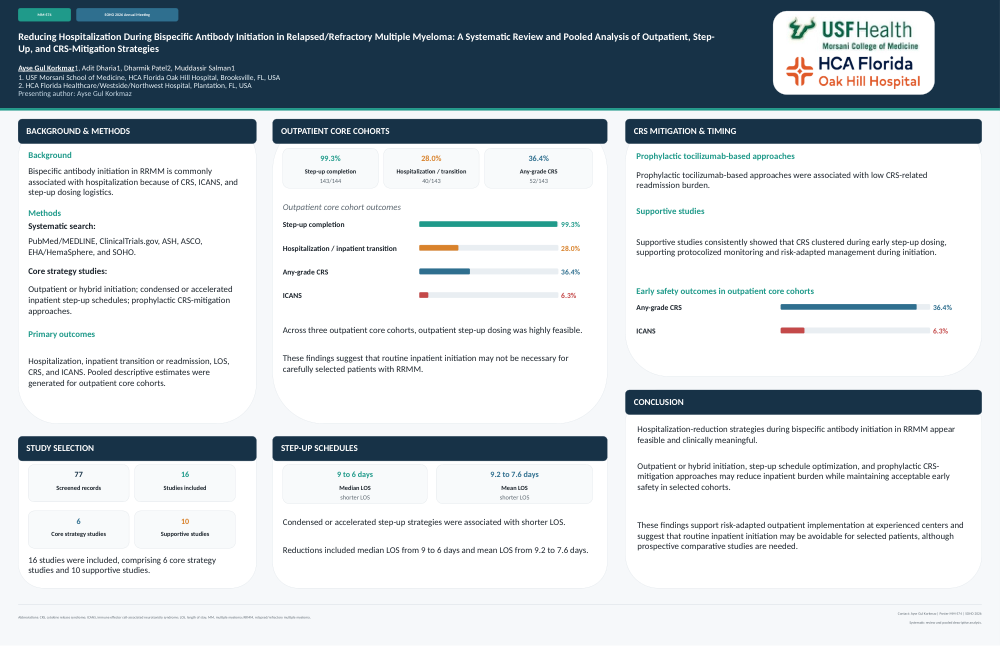
Among 77 screened records, 16 studies were included, comprising 6 core strategy studies and 10 supportive
studies. Across three outpatient core cohorts, outpatient step-up dosing was highly feasible, with step-up
completion in 99.3% (143/144); hospitalization or inpatient transition occurred in 28.0% (40/143), while any-grade
CRS and ICANS occurred in 36.4% (52/143) and 6.3% (9/143), respectively. These findings suggest that routine
inpatient initiation may not be necessary for carefully selected patients with RRMM. Condensed or accelerated
step-up strategies were associated with shorter LOS, including reductions in median LOS from 9 to 6 days and
in mean LOS from 9.2 to 7.6 days. Prophylactic tocilizumab-based approaches were associated with low CRS-
related readmission burden. Supportive studies consistently showed that CRS clustered during early step-up
dosing, supporting protocolized monitoring and risk-adapted management during initiation.
Conclusion
Hospitalization-reduction strategies during bispecific antibody initiation in RRMM appear feasible and clinically
meaningful. Outpatient or hybrid initiation, step-up schedule optimization, and prophylactic CRS-mitigation
approaches may reduce inpatient burden while maintaining acceptable early safety in selected cohorts. These
findings support risk-adapted outpatient implementation at experienced centers and suggest that routine inpatient
initiation may be avoidable for selected patients, although prospective comparative studies are needed.
ASCO: American Society of Clinical Oncology, ASH: American Society of Hematology, EHA: European Hematology
Association, CRS: cytokine release syndrome; ICANS: immune effector cell-associated neurotoxicity
syndrome, LOS: length of stay, MM: multiple myeloma, SOHO: Society of Hematologic Oncology
Keywords
MM, bispecific antibodies, outpatient initiation, step-up dosing, hospitalization