1,267 posters, 47 videos, 13 topics, 4 sessions, 853 authors
ePostersLive by SciGen Technologies S.A. All rights reserved.
SOHO 2026 Annual Meeting
September 9 - 12, 2026 | George R. Brown Convention Center, Houston, Texas

CT - 544
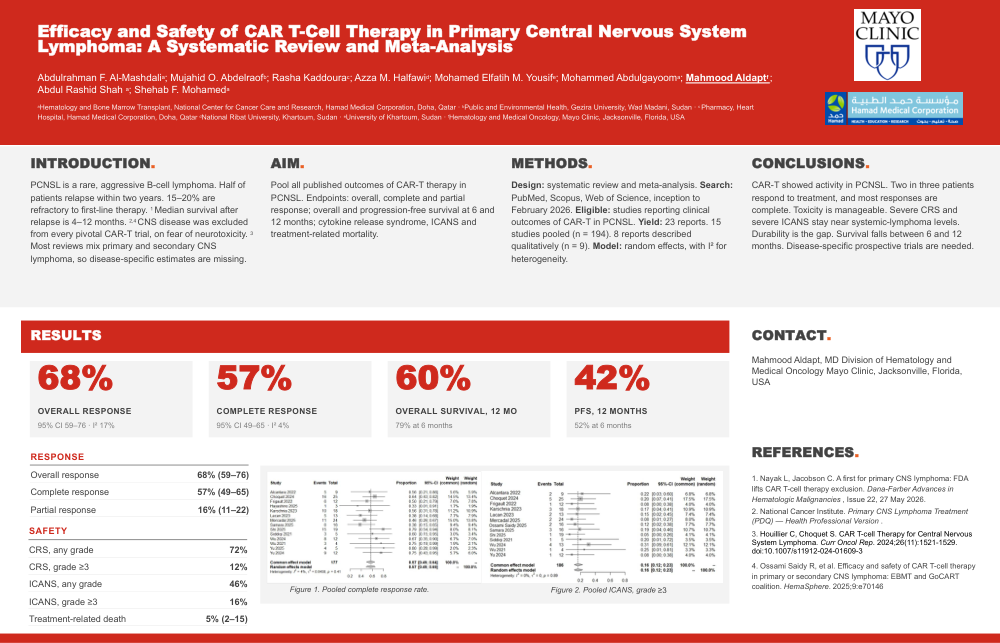
Efficacy and Safety of Chimeric Antigen Receptor T-Cell Therapy in Primary Central Nervous System Lymphoma: A Systematic Review and Meta-Analysis
Poster Presenter
Authors
Part of Topic
Cellular Therapy (CT)
Efficacy and Safety of CAR T-Cell Therapy in Primary Central Nervous System Lymphoma: A Systematic Review and Meta-Analysis
Abdulrahman F. Al-Mashdalia; Mujahid O. Abdelraofb; Rasha Kaddourac; Azza M. Halfawid; Mohamed Elfatih M. Yousife; Mohammed Abdulgayooma; Mahmood Aldaptf; Abdul Rashid Shah a; Shehab F. Mohameda
aHematology and Bone Marrow Transplant, National Center for Cancer Care and Research, Hamad Medical Corporation, Doha, Qatar · bPublic and Environmental Health, Gezira University, Wad Madani, Sudan · c Pharmacy, Heart Hospital, Hamad Medical Corporation, Doha, Qatar dNational Ribat University, Khartoum, Sudan · eUniversity of Khartoum, Sudan · fHematology and Medical Oncology, Mayo Clinic, Jacksonville, Florida, USA
INTRODUCTION
PCNSL is a rare, aggressive B-cell lymphoma. Half of patients relapse within two years. 15–20% are refractory to first-line therapy. 1 Median survival after relapse is 4–12 months. 2,4 CNS disease was excluded from every pivotal CAR-T trial, on fear of neurotoxicity. 3 Most reviews mix primary and secondary CNS lymphoma, so disease-specific estimates are missing.
AIM
Pool all published outcomes of CAR-T therapy in PCNSL. Endpoints: overall, complete and partial response; overall and progression-free survival at 6 and 12 months; cytokine release syndrome, ICANS and treatment-related mortality.
METHODS
Design: systematic review and meta-analysis. Search: PubMed, Scopus, Web of Science, inception to February 2026. Eligible: studies reporting clinical outcomes of CAR-T in PCNSL. Yield: 23 reports. 15 studies pooled (n = 194). 8 reports described qualitatively (n = 9). Model: random effects, with I² for heterogeneity.
RESULTS
See the Figures in the poster..
CONCLUSIONS
CAR-T showed activity in PCNSL. Two in three patients respond to treatment, and most responses are complete. Toxicity is manageable. Severe CRS and severe ICANS stay near systemic-lymphoma levels. Durability is the gap. Survival falls between 6 and 12 months. Disease-specific prospective trials are needed.