1,267 posters, 47 videos, 13 topics, 4 sessions, 853 authors
ePostersLive by SciGen Technologies S.A. All rights reserved.
SOHO 2026 Annual Meeting
September 9 - 12, 2026 | George R. Brown Convention Center, Houston, Texas

MCL - 524
Comparative Cardiac Safety of Covalent and Non-Covalent Bruton Tyrosine Kinase Inhibitors in Mantle Cell Lymphoma- A Multi-Center Retrospective Cohort Study
Poster Presenter
Authors
Part of Topic
Mantle Cell Lymphoma (MCL)
Comparative Cardiac Safety of Covalent and Non-Covalent Bruton Tyrosine Kinase Inhibitors in Mantle Cell Lymphoma – A Multi-Center Retrospective Cohort Study
A Anand¹; S Biswas²; K Anmol³; S Sapkota⁴; Y Srivastava²
¹ Jacobi Medical Center / Albert Einstein College of Medicine, Bronx, NY, USA
² Ivano-Frankivsk National Medical University, Ivano-Frankivsk, Ukraine
³ University of Michigan Health Sparrow, Lansing, MI, USA
⁴ Baptist Memorial Hospital–North Mississippi, Oxford, MS, USA
Second-generation BTK inhibitors (BTKi), including acalabrutinib and zanubrutinib, and the non-covalent BTKi pirtobrutinib are increasingly used in mantle cell lymphoma (MCL). Much of their safety data has been extrapolated from trials in other B-cell malignancies, including ELEVATE-RR, ALPINE, and ASPEN. We evaluated the comparative cardiovascular, infectious, and bleeding risks of BTKi therapy in patients with MCL in a real-world setting.
To compare the 1-year risks of cardiac, infectious, and major bleeding events among different BTKi regimens in patients with MCL.
Design: Multicenter retrospective cohort study using the TriNetX Global Collaborative Network.
Population: Adults with MCL diagnosed between 2018 and 2025.
Exposure: Patients were stratified by first BTKi exposure with no prior exposure to an alternative BTKi agent within 1 year before the index date.
Comparisons following 1:1 PSM:
-
Acalabrutinib vs ibrutinib
-
Zanubrutinib vs ibrutinib
-
Acalabrutinib vs zanubrutinib
-
Pirtobrutinib vs pooled second-generation BTKi
PSM factors: Demographics, comorbidities, and prior medication use.
Primary outcome: Composite of atrial fibrillation, hypertension, heart failure, and ventricular arrhythmia.
Secondary outcomes: Infections (sepsis, invasive fungal infection, herpes zoster) and major bleeding (intracranial hemorrhage, gastrointestinal bleeding) within 1 year of BTKi initiation.
Post-PSM matched cohort sizes (per comparison):
-
Acalabrutinib vs ibrutinib: 531 vs 531
-
Zanubrutinib vs ibrutinib: 254 vs 254
-
Acalabrutinib vs zanubrutinib: 475 vs 475
-
Pirtobrutinib vs pooled second-generation BTKi: 190 vs 190
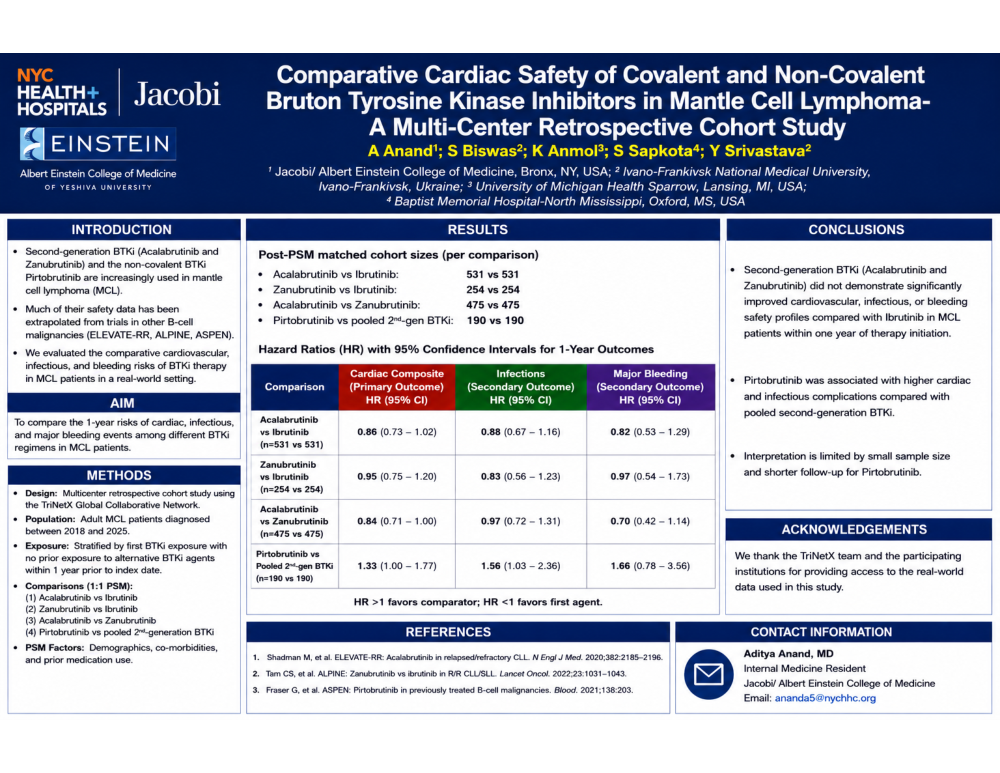
| Comparison | Cardiac composite HR (95% CI) | Infections HR (95% CI) | Major bleeding HR (95% CI) |
|---|---|---|---|
| Acalabrutinib vs ibrutinib | 0.86 (0.73–1.02) | 0.88 (0.67–1.16) | 0.82 (0.53–1.29) |
| Zanubrutinib vs ibrutinib | 0.95 (0.75–1.20) | 0.83 (0.56–1.23) | 0.97 (0.54–1.73) |
| Acalabrutinib vs zanubrutinib | 0.84 (0.71–1.00) | 0.97 (0.72–1.31) | 0.70 (0.42–1.14) |
| Pirtobrutinib vs pooled 2nd-generation BTKi | 1.33 (1.00–1.77) | 1.56 (1.03–2.36) | 1.66 (0.78–3.56) |
HR >1 favors the comparator; HR <1 favors the first agent.
Acalabrutinib vs ibrutinib: No significant differences in cardiac, infectious, or major bleeding outcomes.
Zanubrutinib vs ibrutinib: No significant differences in cardiac, infectious, or major bleeding outcomes.
Acalabrutinib vs zanubrutinib: No significant differences in cardiac, infectious, or major bleeding outcomes.
Pirtobrutinib vs pooled second-generation BTKi: Higher infections (HR 1.56, 95% CI 1.03–2.36) and borderline increased cardiac outcomes (HR 1.33, 95% CI 1.00–1.77), without a significant difference in major bleeding (HR 1.66, 95% CI 0.78–3.56).
Second-generation BTKi did not demonstrate significantly improved cardiovascular, infectious, or bleeding safety profiles compared with ibrutinib in patients with MCL within 1 year of therapy initiation.
Pirtobrutinib was associated with higher cardiac and infectious complications compared with pooled second-generation BTKi, although interpretation is limited by the smaller sample size and shorter follow-up.
We thank the TriNetX team and participating institutions for providing access to the real-world data used in this study.
-
Shadman M, et al. ELEVATE-RR: Acalabrutinib in relapsed/refractory CLL. N Engl J Med. 2020;382:2185–2196.
-
Tam CS, et al. ALPINE: Zanubrutinib vs ibrutinib in R/R CLL/SLL. Lancet Oncol. 2022;23:1031–1043.
-
Fraser G, et al. ASPEN: Pirtobrutinib in previously treated B-cell malignancies. Blood. 2021;138:203.
Aditya Anand, MD
Internal Medicine Resident
Jacobi Medical Center / Albert Einstein College of Medicine
Email: ananda5@nychhc.org