1,267 posters, 47 videos, 13 topics, 4 sessions, 853 authors
ePostersLive by SciGen Technologies S.A. All rights reserved.
SOHO 2026 Annual Meeting
September 9 - 12, 2026 | George R. Brown Convention Center, Houston, Texas

CML - 523
Trends in Leukemia -related Renal Failure: Longitudinal Insights from CDC Wonder Data(1999-2024)
Poster Presenter
Authors
Part of Topic
Chronic Myeloid Leukemia (CML)
CML-523 Publication and Poster presentation Trends in Leukemia-Related Renal Failure: Longitudinal Insights From CDC WONDER Data (1999–2024)
Abstract
Background
Leukemia and renal failure are among the major global health challenges, with leukemia causing disruption in bone marrow function and renal failure leading to progressive kidney damage. Analyzing mortality trends is crucial for shaping public health policies and refining prevention strategies.
Methods
This retrospective study used national health datasets from the CDC WONDER database to identify individuals aged ≥25 years diagnosed with leukemia (C91–96) and renal failure (N17–19) in the US from 1999 to 2024. We applied Joinpoint regression to calculate both annual percent change and average annual percent change (AAPC) in mortality trends. Data were analyzed based on demographics, census region, sex, place of death, age, race, and level of urbanization.
Results
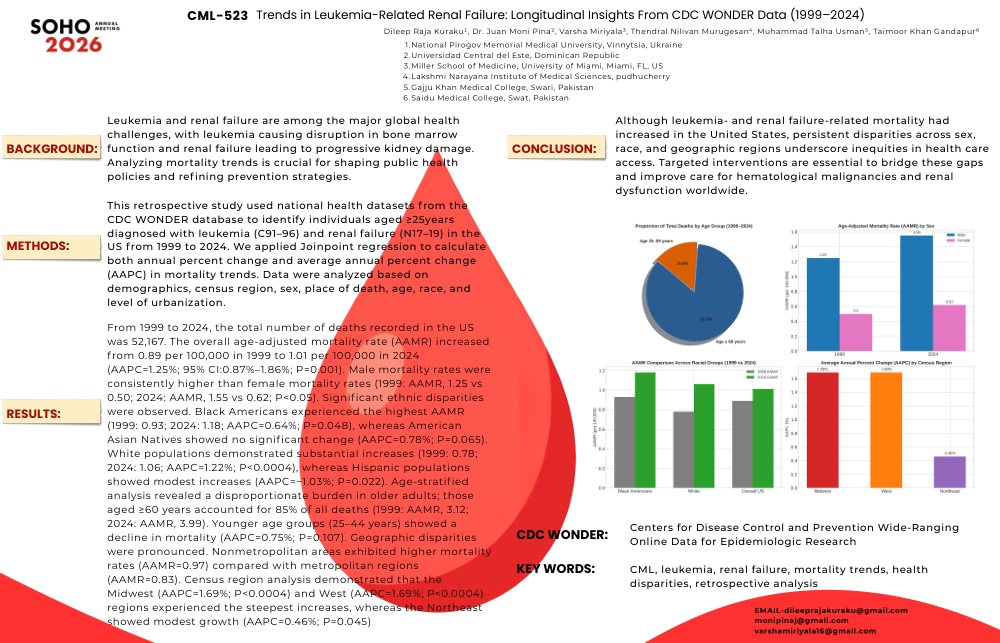
From 1999 to 2024, the total number of deaths recorded in the US was 52167. The overall age-adjusted mortality rate (AAMR) increased from 0.89 per 100000 in 1999 to 1.01 per 100000 in 2024 (AAPC, 1.25%; 95% CI, 0.87% 1.86%; P =0.001). Male mortality rates were consistently higher than female mortality rates (1999: AAMR, 1.25 vs 0.50; 2024: AAMR, 1.55 vs 0.62; P <0.05). Significant ethnic disparities were observed. Black Americans experi enced the highest AAMR (1999: 0.93; 2024: 1.18; AAPC, 0.64%; P =0.048), whereas American Asian Natives showed no significant change (AAPC, 0.78%; P =0.065). White populations demonstrated substantial increases (1999: 0.78; 2024: 1.06; AAPC, 1.22%; P <0.0004), whereas Hispanic populations showed modest increases (AAPC, −1.03%; P =0.022). Age-stratified analysis revealed a disproportionate burden in older adults; those aged ≥60 years accounted for 85% of all deaths (1999: AAMR, 3.12; 2024: AAMR, 3.99). Younger age groups (25 44 years) showed a decline in mortality (AAPC, 0.75%; P =0.107). Geographic disparities were pronounced. Nonmetropolitan areas exhibited higher mortality rates (AAMR, 0.97) compared with metropolitan regions (AAMR, 0.83). Census region analysis demonstrated that the Midwest (AAPC, 1.69%; P <0.0004) and West (AAPC, 1.69%; P <0.0004) regions experienced the steepest increases, whereas the Northeast showed modest growth (AAPC, 0.46%; P =0.045).
Conclusion
Although leukemia- and renal failure–related mortality had increased in the United States, persistent disparities across sex, race, and geographic regions underscore inequities in health care access. Targeted interventions are essential to bridge these gaps and improve care for hematological malignancies and renal dysfunction worldwide. CDC WONDER: Centers for Disease Control and Prevention Wide-Ranging Online Data for Epidemiologic Research Keywords CML, leukemia, renal failure, mortality trends, health disparities, retrospective analysi