1,267 posters, 47 videos, 13 topics, 4 sessions, 853 authors
ePostersLive by SciGen Technologies S.A. All rights reserved.
SOHO 2026 Annual Meeting
September 9 - 12, 2026 | George R. Brown Convention Center, Houston, Texas

CML - 1023
Efficacy and Safety of a Pakistan-Manufactured Generic Imatinib in Newly Diagnosed Chronic-Phase Chronic Myeloid Leukemia: A Multicenter Phase 4 Study
Part of Topic
Chronic Myeloid Leukemia (CML)
Efficacy and Safety of a Pakistan-Manufactured Generic Imatinib in Newly Diagnosed Chronic-Phase Chronic Myeloid Leukemia: A Multicenter Phase IV Study
Hafsa Naseer1, Tahir Bashir2, Qasim Buttar3, Zeeshan Khan Niazi4, Zeba Aziz5
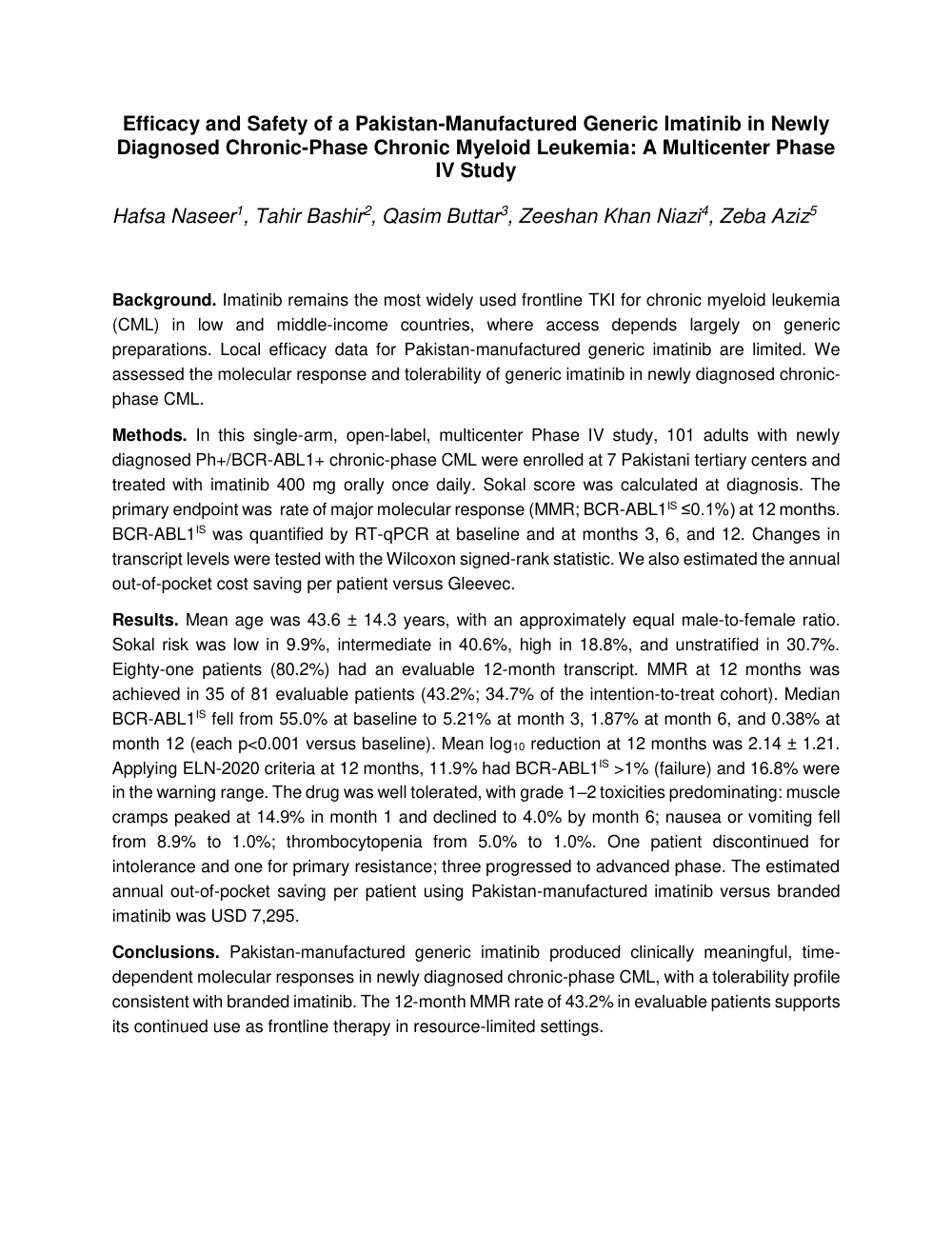
Background. Imatinib remains the most widely used frontline TKI for chronic myeloid leukemia (CML) in low and middle-income countries, where access depends largely on generic preparations. Local efficacy data for Pakistan-manufactured generic imatinib are limited. We assessed the molecular response and tolerability of generic imatinib in newly diagnosed chronic-phase CML.
Methods. In this single-arm, open-label, multicenter Phase IV study, 101 adults with newly diagnosed Ph+/BCR-ABL1+ chronic-phase CML were enrolled at 7 Pakistani tertiary centers and treated with imatinib 400 mg orally once daily. Sokal score was calculated at diagnosis. The primary endpoint was rate of major molecular response (MMR; BCR-ABL1IS ≤0.1%) at 12 months. BCR-ABL1IS was quantified by RT-qPCR at baseline and at months 3, 6, and 12. Changes in transcript levels were tested with the Wilcoxon signed-rank statistic. We also estimated the annual out-of-pocket cost saving per patient versus Gleevec.
Results. Mean age was 43.6 ± 14.3 years, with an approximately equal male-to-female ratio. Sokal risk was low in 9.9%, intermediate in 40.6%, high in 18.8%, and unstratified in 30.7%. Eighty-one patients (80.2%) had an evaluable 12-month transcript. MMR at 12 months was achieved in 35 of 81 evaluable patients (43.2%; 34.7% of the intention-to-treat cohort). Median BCR-ABL1IS fell from 55.0% at baseline to 5.21% at month 3, 1.87% at month 6, and 0.38% at month 12 (each p<0.001 versus baseline). Mean log10 reduction at 12 months was 2.14 ± 1.21. Applying ELN-2020 criteria at 12 months, 11.9% had BCR-ABL1IS >1% (failure) and 16.8% were in the warning range. The drug was well tolerated, with grade 1–2 toxicities predominating: muscle cramps peaked at 14.9% in month 1 and declined to 4.0% by month 6; nausea or vomiting fell from 8.9% to 1.0%; thrombocytopenia from 5.0% to 1.0%. One patient discontinued for intolerance and one for primary resistance; three progressed to advanced phase. The estimated annual out-of-pocket saving per patient using Pakistan-manufactured imatinib versus branded imatinib was USD 7,295.
Conclusions. Pakistan-manufactured generic imatinib produced clinically meaningful, time-dependent molecular responses in newly diagnosed chronic-phase CML, with a tolerability profile consistent with branded imatinib. The 12-month MMR rate of 43.2% in evaluable patients supports its continued use as frontline therapy in resource-limited settings.