1,267 posters, 47 videos, 13 topics, 4 sessions, 853 authors
ePostersLive by SciGen Technologies S.A. All rights reserved.
SOHO 2026 Annual Meeting
September 9 - 12, 2026 | George R. Brown Convention Center, Houston, Texas

MCL - 522
Frontline BTK Inhibitor Strategies in Mantle Cell Lymphoma: A Phase 3 Network Meta-Analysis With Cross-Trial Synthesis Across Transplant-Eligible and -Ineligible Populations
Poster Presenter
Authors
Part of Topic
Mantle Cell Lymphoma (MCL)
Introduction: Frontline treatment of mantle cell lymphoma (MCL) remains heterogeneous with no universal standard. Bruton tyrosine kinase inhibitors (BTKis) have been integrated into chemoimmunotherapy, chemotherapy-free, and transplant-based approaches, but their comparative efficacy across patient populations is unclear. We performed a systematic review and network meta-analysis (NMA) of phase 3 trials evaluating BTKi-containing regimens in previously untreated MCL.
Methods: We systematically reviewed phase 3 randomized trials of frontline BTKi-containing regimens in MCL. A frequentist random-effects NMA was conducted for trials sharing a common comparator, with progression-free survival (PFS) expressed as hazard ratios (HRs) and treatment ranking by P-scores. Trials without network connectivity were evaluated via structured cross-trial synthesis.
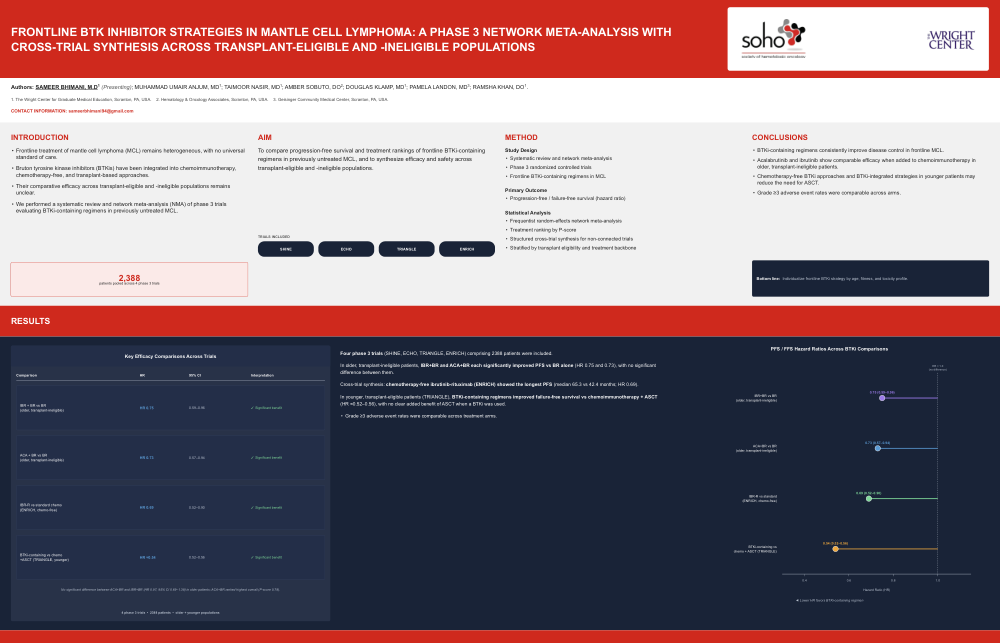
Results: were interpreted in the context of the patient population (older/transplant-ineligible vs younger/transplant-eligible) and treatment backbone. Results Four phase 3 trials (SHINE, ECHO, TRIANGLE, ENRICH) comprising 2388 patients were included. In the NMA for older, transplant-ineligible patients, both ibrutinib + bendamustine-rituximab (IBR+BR) and acalabrutinib + BR (ACA+BR) significantly improved PFS vs BR alone (HR, 0.75 [95% CI, 0.59–0.96] and HR, 0.73 [95% CI, 0.57–0.94], respectively), with no significant difference between ACA+BR and IBR+BR (HR, 0.97 [95% CI, 0.69–1.38]; ACA+BR ranked highest with a P-score of 0.78). In cross-trial synthesis, the chemotherapy-free ibrutinib-rituximab regimen (ENRICH) showed the longest PFS (median, 65.3 vs 42.4 months; HR, 0.69 [95% CI, 0.52–0.90]). In younger, transplant-eligible patients (TRIANGLE), ibrutinib-containing regimens improved failure-free survival vs standard chemoimmunotherapy + autologous stem cell transplantation (ASCT; HR, approximately 0.52–0.56), with no clear additional benefit of ASCT when a BTKi was used. Grade ≥3 adverse event rates were comparable across arms.
Conclusions: BTKi-containing regimens consistently improve disease control in frontline MCL. Acalabrutinib and ibrutinib show comparable efficacy when added to chemoimmunotherapy in older patients, whereas chemotherapy-free BTKi approaches and BTKi-integrated strategies in younger patients may reduce the need for ASCT. Treatment selection should be individualized according to age, fitness, and toxicity profile