1,267 posters, 47 videos, 13 topics, 4 sessions, 853 authors
ePostersLive by SciGen Technologies S.A. All rights reserved.
SOHO 2026 Annual Meeting
September 9 - 12, 2026 | George R. Brown Convention Center, Houston, Texas

MM - 461
From BCMA to GPRC5D: Sequencing T-Cell Redirecting Therapies in Relapsed/Refractory Multiple Myeloma
Poster Presenter
Authors
Part of Topic
Multiple Myeloma (MM)
Background
B-cell maturation antigen (BCMA)-directed chimeric antigen receptor T-cell (CAR-T) therapies and bispecific antibodies have transformed the treatment landscape of relapsed/refractory multiple myeloma (RRMM). However, optimal sequencing strategies following prior BCMA exposure or T cell–redirecting therapy remain poorly defined. We performed a systematic review and pooled comparative analysis of outcomes with sequential BCMA- and G protein-coupled receptor class C group 5 member D (GPRC5D)-directed therapies.
Methods
We systematically reviewed prospective trials and real-world cohorts evaluating BCMA- and GPRC5D-directed therapies in RRMM. The primary outcome was objective response rate (ORR). Secondary outcomes included cytokine release syndrome (CRS). Cohorts were stratified into BCMA-naïve, BCMA-exposed, and prior T-cell–redirection groups. Random-effects proportional meta-analyses were performed using logit-transformed pooled proportions.
Results
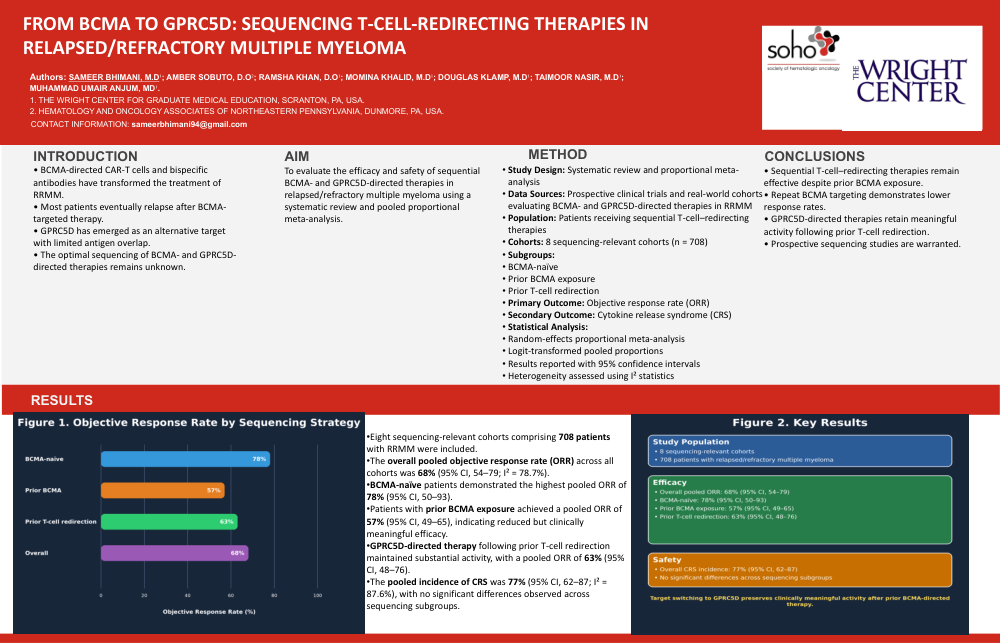
Eight sequencing-relevant cohorts comprising 708 patients were included. The pooled ORR across all cohorts was 68% (95% confidence interval [CI], 54–79; I2=78.7%). BCMA-naïve cohorts achieved the highest ORR (78%; 95% CI, 50–93), whereas BCMA-exposed cohorts had lower but clinically meaningful responses (57%; 95% CI, 49–65). GPRC5D-directed therapy following prior T-cell redirection retained meaningful activity (pooled ORR, 63%; 95% CI, 48–76). The pooled incidence of CRS was 77% (95% CI, 62–87; I2=87.6%), with no significant differences across subgroups.
Conclusions
Sequential T cell–redirecting strategies remain clinically effective in RRMM despite prior BCMA exposure. While efficacy is reduced with repeat BCMA targeting, GPRC5D-directed therapies demonstrate preserved activity after prior T-cell redirection. These findings support target-switching as a promising sequencing strategy in heavily pretreated RRMM.