1,267 posters, 47 videos, 13 topics, 4 sessions, 853 authors
ePostersLive by SciGen Technologies S.A. All rights reserved.
SOHO 2026 Annual Meeting
September 9 - 12, 2026 | George R. Brown Convention Center, Houston, Texas

CLL - 444
The Impact of Baseline Immune-Inflammatory Indices and Microenvironment in Richter Transformation: A Case Series
Poster Presenter
Authors
Part of Topic
Chronic Lymphocytic Leukemia (CLL)
The Impact of Baseline Immune-Inflammatory Indices and Microenvironment in Richter Transformation: A Case Series
Authors: Maria D’Amato1, Matteo Pelosini1, Gabriele Pietro Bolognesi1, Edoardo Benedetti1, Sara Galimberti1
1 Department of Clinical and Experimental Medicine, Section of Hematology, University of Pisa, Pisa, Italy.
Key words: RT, CLL, inflammation, BTK, combination therapy
Context: Richter Transformation (RT) is characterized by an aggressive clinical course and a complex tumor microenvironment. While systemic inflammation indices—SII, SIRI, and NLR—are established prognosticators in solid tumors, their utility in RT is confounded by the immune dysregulation and baseline lymphocytosis inherent to chronic lymphocytic leukemia (CLL).
Objective: To evaluate the prognostic significance of baseline inflammatory scores and identify disease-specific thresholds for predicting treatment response and overall survival (OS) in RT.
Design: Retrospective case series analysis of RT patients (2017–2025). The case analysis followed the Declaration of Helsinki; data were analyzed anonymously.
Setting: Single-center referral practice for hematologic malignancies at the Hematology Unit of Pisa.
Patients: 14 consecutive patients with biopsy-proven RT. Key features included a high prevalence of TP53 mutations and complex karyotypes. Patients were predominantly male, reflecting an elderly population. All had prior CLL, mostly heavily pre-treated with BTK or BCL2 inhibitors.
Intervention(s): Heterogeneous salvage strategies, including chemoimmunotherapy (R-CHOP, R-DHAOx, R-DA-EPOCH) or targeted therapies (BTK inhibitors, brentuximab, pembrolizumab, venetoclax). A subset underwent consolidation with autologous stem cell transplantation or CAR-T cell therapy.
Main Outcome Measures: OS and best clinical response (CR vs. non-CR). SII, SIRI, and NLR were analyzed as proxies for microenvironment activity.
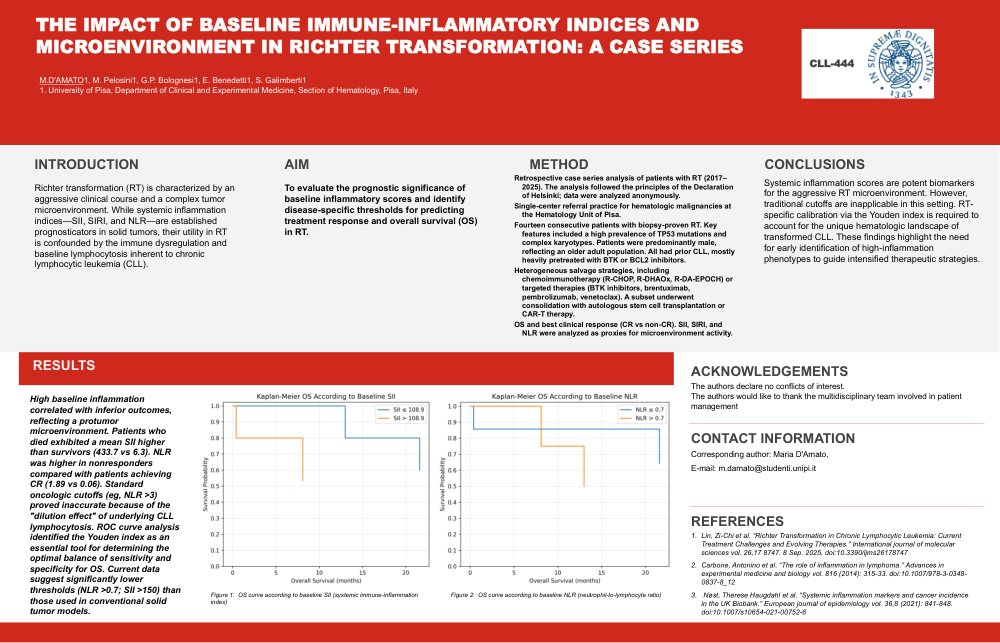
Results: High baseline inflammation correlated with inferior outcomes, reflecting a pro-tumoral microenvironment. Patients who died exhibited a mean SII higher than survivors (433.7 vs. 6.3). The NLR was higher in non-responders compared to those achieving CR (1.89 vs. 0.06). Standard oncological cut-offs (e.g., NLR > 3) proved inaccurate due to the "dilution effect" of underlying CLL lymphocytosis. ROC curve analysis identified the “Youden Index” as an essential tool to determine the optimal balance of sensitivity and specificity for OS. Current data suggest significantly lower thresholds (NLR > 0.7; SII > 150) than those used in conventional solid tumor models.
Conclusions: Systemic inflammation scores are potent biomarkers for the aggressive RT microenvironment. However, traditional cut-offs are inapplicable in this setting. RT-specific calibration via the Youden Index is required to account for the unique hematological landscape of transformed CLL. These findings highlight the need for early identification of high-inflammation phenotypes to guide intensified therapeutic strategies.
The authors declare no external funding.