1,267 posters, 47 videos, 13 topics, 4 sessions, 853 authors
ePostersLive by SciGen Technologies S.A. All rights reserved.
SOHO 2026 Annual Meeting
September 9 - 12, 2026 | George R. Brown Convention Center, Houston, Texas

AML - 414
Menin Inhibitors vs FLT3 Inhibitor-Based Therapy in NPM1-Mutated Relapsed/Refractory AML: Comparative Efficacy, MRD Depth, and Safety Profiles
Poster Presenter
Authors
Part of Topic
Acute Myeloid Leukemia (AML)
MENIN INHIBITORS vs FLT3 INHIBITOR-BASED THERAPY IN NPM1-MUTATED RELAPSED/REFRACTORY AML: COMPARATIVE EFFICACY, MRD DEPTH, AND SAFETY PROFILES
Hashem Haj Ebrahimi¹, Hiam Ghunaim¹, Fakriyeh Abachi Nejad Asl²
¹ Hennepin Healthcare, Minneapolis, MN, USA
² University of Debrecen, Debrecen, Hungary
Background:
NPM1-mutated relapsed/refractory acute myeloid leukemia (AML) is driven by HOXA/MEIS transcriptional addiction and frequent FLT3 co-mutation. Two therapeutic paradigms have emerged: FLT3 inhibitor (FLT3i)-based kinase blockade and menin inhibition (MENi) targeting transcriptional dependency.
Objective:
To compare the efficacy and safety of MENi versus FLT3i-based regimens in NPM1-mutated relapsed/refractory AML using a systematic review of early clinical data.
Methods:
A systematic review of PubMed and Embase was conducted for studies published from 2019–2026 following PRISMA guidelines. Screening was performed using Rayyan.ai. Phase I/II trials and retrospective cohorts reporting NPM1-mutated outcomes were included. Median follow-up ranged from 4–18 months. Data were synthesized using descriptive, study-level aggregation. Included studies were conducted at multicenter academic and tertiary referral centers across North America, Europe, and Asia.
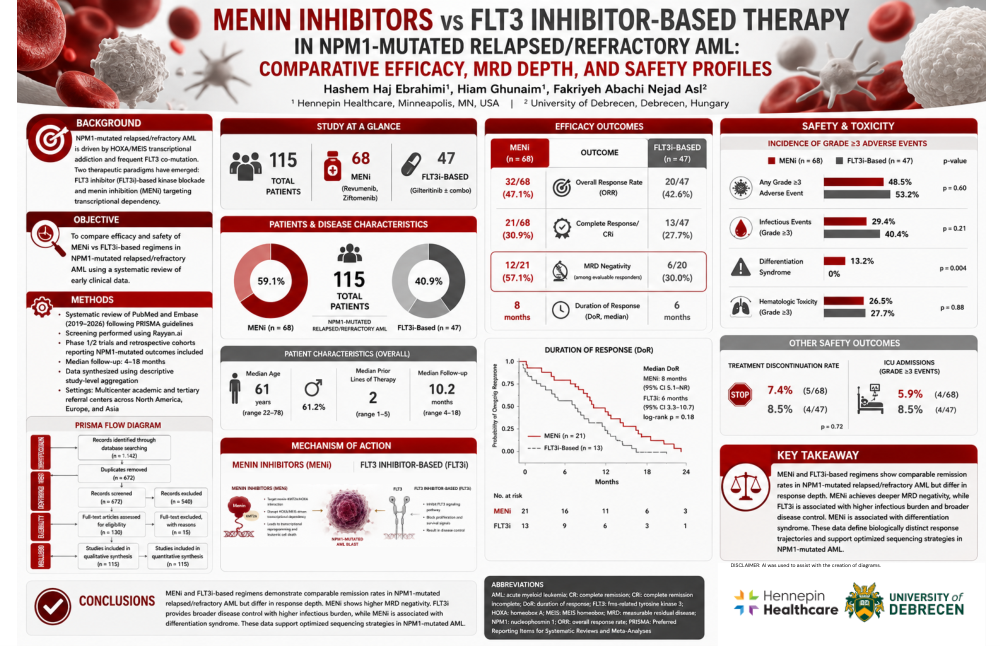
The database search identified 1,142 records. After removal of 672 duplicates, 672 records were screened, of which 540 were excluded. A total of 130 full-text articles were assessed for eligibility, with 15 excluded with reasons. Studies included in the qualitative and quantitative synthesis comprised a total of 115 patients.
Patient and Disease Characteristics:
A total of 115 patients with NPM1-mutated relapsed/refractory AML were included. Sixty-eight patients (59.1%) received MENi therapy, including revumenib and ziftomenib, while 47 patients (40.9%) received FLT3i-based therapy, including gilteritinib with or without combination therapy.
The overall median age was 61 years (range 22–78), 61.2% of patients were male, the median number of prior lines of therapy was 2 (range 1–5), and median follow-up was 10.2 months (range 4–18).
Efficacy Outcomes:
The overall response rate (ORR) was 47.1% (32/68) with MENi compared with 42.6% (20/47) with FLT3i-based therapy.
Complete response/complete response with incomplete count recovery (CR/CRi) occurred in 30.9% (21/68) of MENi-treated patients compared with 27.7% (13/47) of patients treated with FLT3i-based regimens.
Among evaluable responders, measurable residual disease (MRD) negativity was achieved in 57.1% (12/21) of MENi-treated patients versus 30.0% (6/20) of patients receiving FLT3i-based therapy.
Median duration of response (DoR) was 8 months with MENi and 6 months with FLT3i-based treatment. Median DoR for MENi was 8 months (95% CI, 5.1–NR), compared with 6 months for FLT3i-based therapy (95% CI, 3.3–10.7), with a log-rank p-value of 0.18.
Safety and Toxicity:
Grade ≥3 adverse events occurred in 48.5% of patients receiving MENi and 53.2% of those receiving FLT3i-based therapy (p=0.60).
Grade ≥3 infectious events occurred in 29.4% with MENi versus 40.4% with FLT3i-based therapy (p=0.21).
Differentiation syndrome occurred in 13.2% of MENi-treated patients and 0% of patients receiving FLT3i-based therapy (p=0.004).
Grade ≥3 hematologic toxicity occurred in 26.5% of MENi-treated patients and 27.7% of patients receiving FLT3i-based treatment (p=0.88).
Treatment discontinuation rates were 7.4% (5/68) with MENi and 8.5% (4/47) with FLT3i-based therapy (p=0.72). ICU admissions related to grade ≥3 events occurred in 5.9% (4/68) of MENi-treated patients compared with 8.5% (4/47) of FLT3i-treated patients.
Conclusion:
MENi and FLT3i-based regimens demonstrate comparable remission rates in NPM1-mutated relapsed/refractory AML but differ in response depth. MENi shows higher MRD negativity, while FLT3i provides broader disease control with a higher infectious burden, and MENi is associated with differentiation syndrome. These data support optimized sequencing strategies in NPM1-mutated AML.
Key Takeaway:
MENi and FLT3i-based regimens show comparable remission rates in NPM1-mutated relapsed/refractory AML but differ in response depth. MENi achieves deeper MRD negativity, while FLT3i is associated with higher infectious burden and broader disease control. MENi is associated with differentiation syndrome. These data define biologically distinct response trajectories and support optimized sequencing strategies in NPM1-mutated AML.
Disclaimer: AI was used to assist with the creation of diagrams.