1,267 posters, 47 videos, 13 topics, 4 sessions, 853 authors
ePostersLive by SciGen Technologies S.A. All rights reserved.
SOHO 2026 Annual Meeting
September 9 - 12, 2026 | George R. Brown Convention Center, Houston, Texas

MDS - 389
Prognostic Impact of RAS Pathway Mutations in Myelodysplastic Syndromes: A Systematic Review and Meta-Analysis
Poster Presenter
Authors
Part of Topic
Myelodysplastic Syndromes (MDS)
Prognostic Impact of RAS Pathway Mutations in Myelodysplastic Syndromes: A Systematic Review and Meta-Analysis
1Omar Ala' Alajjuri, 2Vikramjit Purewal, 3Medhansh Biradar, 4Fnu Satyajeet, 5Imandi Venkata Lakshmi, 6Fnu Raja
1Montefiore St. Luke's Cornwall Hospital, Newburgh, NY, USA; 2Honorhealth Four Peaks Medical Center, Mesa, Arizona,USA; 3All India Institute of Medical Sciences, Raipur, Chhattisgarh, India; 4CIFC Health, Danbury, CT, USA; 5All India Institute of Medical Sciences, Raipur, Chhattisgarh, India; 6Federal Medical and Dental College, Islamabad, Pakistan.
Keywords: Myelodysplastic Syndrome, RAS, Mutations, Prognosis, Meta-Analysis
Background:
RAS pathway mutations, including NRAS, KRAS, and PTPN11, are frequently identified in myelodysplastic syndromes (MDS), but their prognostic significance remains uncertain. This study aimed to systematically evaluate the association between these mutations and survival outcomes in MDS.
Methods:
A comprehensive search of PubMed, Embase, Scopus, Web of Science, and GEO was performed from database inception to January 10, 2025. Studies including adult patients with MDS that evaluated the impact of RAS pathway mutations on survival outcomes were eligible. Hazard ratios (HRs) for overall survival (OS), leukemia-free survival (LFS), and leukemia transformation were extracted. When HRs were not directly reported, individual patient data were reconstructed from Kaplan–Meier curves. Pooled estimates were calculated using a random-effects model with restricted maximum likelihood.
Results:
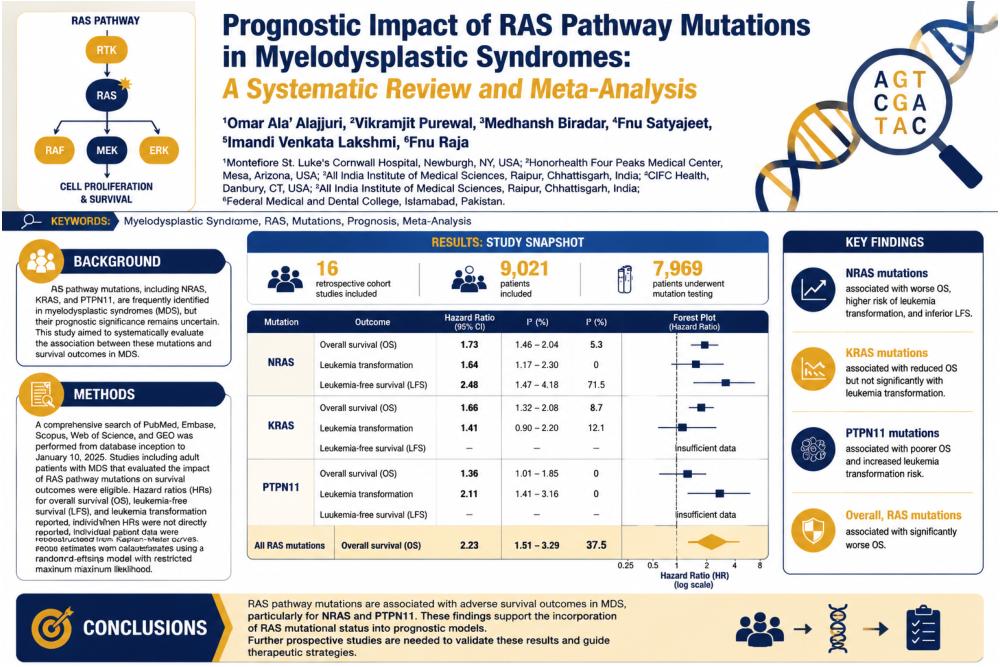
Sixteen retrospective cohort studies comprising 9021 patients were included, of whom 7969 underwent mutation testing. NRAS mutations were significantly associated with worse OS (HR 1.73, 95% CI 1.46–2.04; I² = 5.3%), increased risk of leukemia transformation (HR 1.64, 95% CI 1.17–2.30; I² = 0%), and inferior LFS (HR 2.48, 95% CI 1.47–4.18; I² = 71.5%). KRAS mutations were associated with reduced OS (HR 1.66, 95% CI 1.32–2.08) with minimal heterogeneity, but were not significantly associated with leukemia transformation (HR 1.41, 95% CI 0.90–2.20). Limited data were available for LFS. PTPN11 mutations were associated with poorer OS (HR 1.36, 95% CI 1.01–1.85; I² = 0%) and increased leukemia transformation risk (HR 2.11, 95% CI 1.41–3.16; I² = 0%). Overall, RAS mutations were associated with significantly worse OS (HR 2.23, 95% CI 1.51–3.29; I² = 37.5%).
Conclusions:
RAS pathway mutations are associated with adverse survival outcomes in MDS, particularly for NRAS and PTPN11. These findings support the incorporation of RAS mutational status into prognostic models. Further prospective studies are needed to validate these results and guide therapeutic strategies.