1,267 posters, 47 videos, 13 topics, 4 sessions, 853 authors
ePostersLive by SciGen Technologies S.A. All rights reserved.
SOHO 2026 Annual Meeting
September 9 - 12, 2026 | George R. Brown Convention Center, Houston, Texas

MCL - 322
Real-World Implementation of the TRIANGLE Regimen in Newly Diagnosed Mantle Cell Lymphoma: A Multicenter Analysis of Effectiveness and Safety
Poster Presenter
Authors
Part of Topic
Mantle Cell Lymphoma (MCL)
TITLE
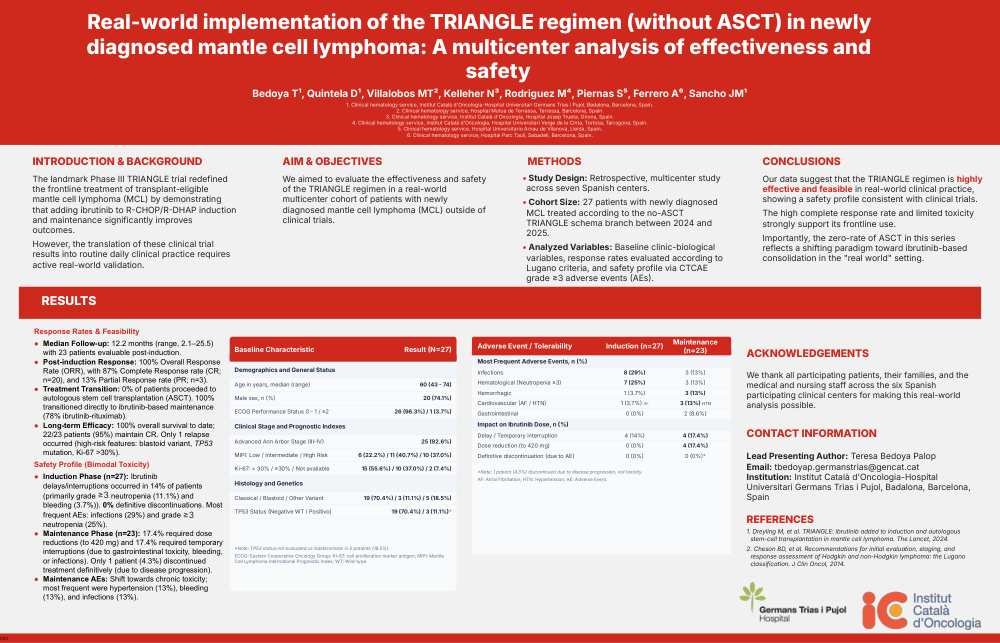
Real-world implementation of the TRIANGLE regimen (without ASCT) in newly diagnosed mantle cell lymphoma: A multicenter analysis of effectiveness and safety
AUTHORS
Bedoya T¹, Quintela D¹, Villalobos MT², Kelleher N³, Rodriguez M⁴, Piernas S⁵, Ferrero A⁶, Sancho JM¹
AFFILIATIONS
-
Clinical hematology service, Institut Català d'Oncologia-Hospital Universitari Germans Trias i Pujol, Badalona, Barcelona, Spain.
-
Clinical hematology service, Hospital Mutua de Terrassa, Terrassa, Barcelona, Spain.
-
Clinical hematology service, Institut Català d'Oncologia, Hospital Josep Trueta, Girona, Spain.
-
Clinical hematology service, Institut Català d'Oncologia, Hospital Universitari Verge de la Cinta, Tortosa, Tarragona, Spain.
-
Clinical hematology service, Hospital Universitario Arnau de Vilanova, Lleida, Spain.
-
Clinical hematology service, Hospital Parc Taulí, Sabadell, Barcelona, Spain.
INTRODUCTION & BACKGROUND
The landmark Phase III TRIANGLE trial redefined the frontline treatment of transplant-eligible mantle cell lymphoma (MCL) by demonstrating that adding ibrutinib to R-CHOP/R-DHAP induction and maintenance significantly improves outcomes. However, the translation of these clinical trial results into routine daily clinical practice requires active real-world validation.
AIM & OBJECTIVES
We aimed to evaluate the effectiveness and safety of the TRIANGLE regimen in a real-world multicenter cohort of patients with newly diagnosed mantle cell lymphoma (MCL) outside of clinical trials.
METHODS
-
Study Design: Retrospective, multicenter study across seven Spanish centers.
-
Cohort Size: 27 patients with newly diagnosed MCL treated according to the no-ASCT TRIANGLE schema branch between 2024 and 2025.
-
Analyzed Variables: Baseline clinic-biological variables, response rates evaluated according to Lugano criteria, and safety profile via CTCAE grade 3 adverse events (AEs).
RESULTS
Response Rates & Feasibility
-
Median Follow-up: 12.2 months (range, 2.1-25.5) with 23 patients evaluable post-induction.
-
Post-induction Response: 100% Overall Response Rate (ORR), with 87% Complete Response rate (CR; n=20), and 13% Partial Response rate (PR; n=3).
-
Treatment Transition: 0% of patients proceeded to autologous stem cell transplantation (ASCT). 100% transitioned directly to ibrutinib-based maintenance (78% ibrutinib-rituximab).
-
Long-term Efficacy: 100% overall survival to date; 22/23 patients (95%) maintain CR. Only 1 relapse occurred (high-risk features: blastoid variant, TP53 mutation, Ki-67 > 30%).
Safety Profile (Bimodal Toxicity)
-
Induction Phase (n=27): Ibrutinib delays/interruptions occurred in 14% of patients (primarily grade $\ge$3 neutropenia (11.1%) and bleeding (3.7%)). 0% definitive discontinuations. Most frequent AEs: infections (29%) and grade $\ge$3 neutropenia (25%).
-
Maintenance Phase (n=23): 17.4% required dose reductions (to 420 mg) and 17.4% required temporary interruptions (due to gastrointestinal toxicity, bleeding, or infections). Only 1 patient (4.3%) discontinued treatment definitively (due to disease progression).
-
Maintenance AEs: Shift towards chronic toxicity: most frequent were hypertension (13%), bleeding (13%), and infections (13%).
CONCLUSIONS
Our data suggest that the TRIANGLE regimen is highly effective and feasible in real-world clinical practice, showing a safety profile consistent with clinical trials. The high complete response rate and limited toxicity strongly support its frontline use. Importantly, the zero-rate of ASCT in this series reflects a shifting paradigm toward ibrutinib-based consolidation in the "real world" setting.
TABLES (For text box insertion if required)
Table 1: Baseline Characteristics
-
Age in years, median (range): 60 (43-74)
-
Male sex, n (%): 20 (74.1%)
-
ECOG Performance Status 0-1 / $\ge$2: 26 (96.3%) / 1 (3.7%)
-
Advanced Ann Arbor Stage (III-IV): 25 (92.6%)
-
MIPI (Low / Intermediate / High Risk): 6 (22.2%) / 11 (40.7%) / 10 (37.0%)
-
Ki-67 (<30% / $\ge$30% / Not available): 15 (55.6%) / 10 (37.0%) / 2 (7.4%)
-
Histology (Classical / Blastoid / Other Variant): 19 (70.4%) / 3 (11.1%) / 5 (18.5%)
-
TP53 Status (Negative WT / Positive): 19 (70.4%) / 3 (11.1%)
Table 2: Adverse Event / Tolerability
-
Infections: Induction 8 (29%) | Maintenance 3 (13%)
-
Hematological (Neutropenia $\ge$3): Induction 7 (25%) | Maintenance 3 (13%)
-
Hemorrhagic: Induction 1 (3.7%) | Maintenance 3 (13%)
-
Cardiovascular (AF/HTN): Induction 1 (3.7%) | Maintenance 3 (13%)
-
Gastrointestinal: Induction 0 (0%) | Maintenance 2 (8.6%)
-
Delay/Temporary interruption: Induction 4 (14%) | Maintenance 4 (17.4%)
-
Dose reduction (to 420 mg): Induction 0 (0%) | Maintenance 4 (17.4%)
-
Definitive discontinuation (due to AE): Induction 0 (0%) | Maintenance 0 (0%)
ACKNOWLEDGEMENTS
We thank all participating patients, their families, and the medical and nursing staff across the six Spanish participating clinical centers for making this real-world analysis possible.
CONTACT INFORMATION
-
Lead Presenting Author: Teresa Bedoya Palop
-
Email: tbedoyap.germanstrias@gencat.cat
-
Institution: Institut Català d'Oncologia-Hospital Universitari Germans Trias i Pujol, Badalona, Barcelona, Spain
REFERENCES
-
Dreyling M, et al. TRIANGLE ibrutinib added to induction and autologous stem-cell transplantation in mantle cell lymphoma. The Lancet, 2024.
-
Cheson BD, et al. Recommendations for initial evaluation, staging, and response assessment of Hodgkin and non-Hodgkin lymphoma: the Lugano classification. J Clin Oncol, 2014.