1,267 posters, 47 videos, 13 topics, 4 sessions, 853 authors
ePostersLive by SciGen Technologies S.A. All rights reserved.
SOHO 2026 Annual Meeting
September 9 - 12, 2026 | George R. Brown Convention Center, Houston, Texas

ALL - 308
Efficacy of Fluoroquinolone Prophylaxis in Reducing Infectious Complications During Induction Chemotherapy in Pediatric ALL: A Meta-Analysis
Poster Presenter
Authors
Part of Topic
Acute Lymphoblastic Leukemia (ALL)
Efficacy of Fluoroquinolone Prophylaxis in Reducing Infectious Complications During Induction Chemotherapy in Pediatric ALL: A Meta-Analysis
1Medhansh Biradar, 2Imandi Venkata Lakshmi, 3Omar Ala' Alajjuri, 4Anid Hassan, 5Momna Nisar, 6Fnu Raja, 7Fnu Someshwar
1All India Institute of Medical Sciences, Raipur, Chhattisgarh, India; 2All India Institute of Medical Sciences, Raipur, Chhattisgarh, India; 3Montefiore St. Luke's Cornwall Hospital, Newburgh, NY, USA; 4Hackensack Meridian Jersey Shore University Medical Center, Neptune, NJ, USA; 5Woodhull medical and mental health center, NYC, NY, USA; 6Federal Medical and Dental College, Islamabad, Pakistan; 7Liaquat National Hospital and Medical College, Karachi, Sindh, Pakistan.
Keywords: Chemotherapy, Acute Lymphoblastic Leukemia, Children, Prophylaxis, Fluoroquinolone
Background:
Infectious complications remain a major contributor to treatment-related mortality during induction chemotherapy for pediatric acute lymphoblastic leukemia (ALL), particularly in resource-limited settings. Fluoroquinolone prophylaxis has shown potential benefit in reducing infections in hematologic malignancies, but its role specifically during induction therapy in children with ALL remains uncertain.
Methods:
PubMed, Scopus, and Cochrane databases were searched for studies evaluating fluoroquinolone prophylaxis (levofloxacin or ciprofloxacin) during induction chemotherapy in children (≤18 years) with ALL. Randomized controlled trials and observational studies were included. The primary outcome was febrile neutropenia (FN), while secondary outcomes included bloodstream infections (BSI), Clostridioides difficile infection (CDI), and all-cause mortality (ACM). Pooled odds ratios (ORs) with 95% confidence intervals (CIs) were calculated using a random-effects model.
Results:
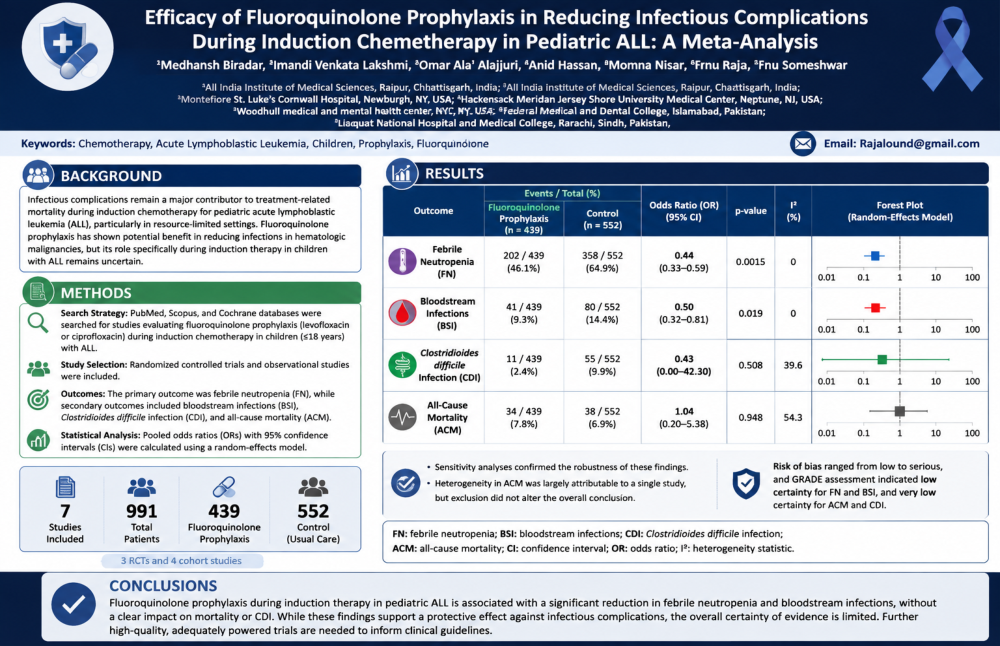
Seven studies (n = 991; 3 RCTs and 4 cohort studies) were included, with 439 patients receiving fluoroquinolone prophylaxis and 552 serving as controls. Prophylaxis was associated with a significant reduction in FN (46.1% vs 64.9%; OR 0.44, 95% CI 0.33–0.59; p = 0.0015; I² = 0%) and BSI (9.3% vs 14.4%; OR 0.50, 95% CI 0.32–0.81; p = 0.019; I² = 0%). Sensitivity analyses confirmed the robustness of these findings. No significant differences were observed in CDI (2.4% vs 9.9%; OR 0.43, 95% CI 0.00–42.30; p = 0.508; I² = 39.6%) or ACM (7.8% vs 6.9%; OR 1.04, 95% CI 0.20–5.38; p = 0.948; I² = 54.3%). Heterogeneity in ACM was largely attributable to a single study, but exclusion did not alter the overall conclusion. Risk of bias ranged from low to serious, and GRADE assessment indicated low certainty for FN and BSI, and very low certainty for ACM and CDI.
Conclusions:
Fluoroquinolone prophylaxis during induction therapy in pediatric ALL is associated with a significant reduction in febrile neutropenia and bloodstream infections, without a clear impact on mortality or CDI. While these findings support a protective effect against infectious complications, the overall certainty of evidence is limited. Further high-quality, adequately powered trials are needed to inform clinical guidelines.