1,267 posters, 47 videos, 13 topics, 4 sessions, 853 authors
ePostersLive by SciGen Technologies S.A. All rights reserved.
SOHO 2026 Annual Meeting
September 9 - 12, 2026 | George R. Brown Convention Center, Houston, Texas

CLL - 250
MRD-Guided vs Fixed-Duration Targeted Therapy in Chronic Lymphocytic Leukemia: A Systematic Review and Meta-Analysis of Progression-Free Survival and Depth of Response
Poster Presenter
Authors
Part of Topic
Chronic Lymphocytic Leukemia (CLL)
Background
Targeted therapies have transformed the management of chronic lymphocytic leukemia (CLL), enabling time-limited regimens that achieve durable disease control. Minimal residual disease (MRD) has emerged as a key biomarker and is increasingly used to guide treatment discontinuation. However, the clinical benefit of MRD-guided strategies compared with fixed-duration therapy remains uncertain.
Methods
We conducted a systematic review and meta-analysis of prospective clinical trials evaluating targeted therapies in CLL. Progression-free survival (PFS) was pooled using inverse-variance random-effects models with restricted maximum likelihood estimation and Hartung-Knapp adjustment. Undetectable MRD (uMRD) rates were pooled using logit-transformed proportions. Subgroup analyses were performed according to treatment strategy: fixed-duration, MRD-guided, and intensified combination regimens.
Results
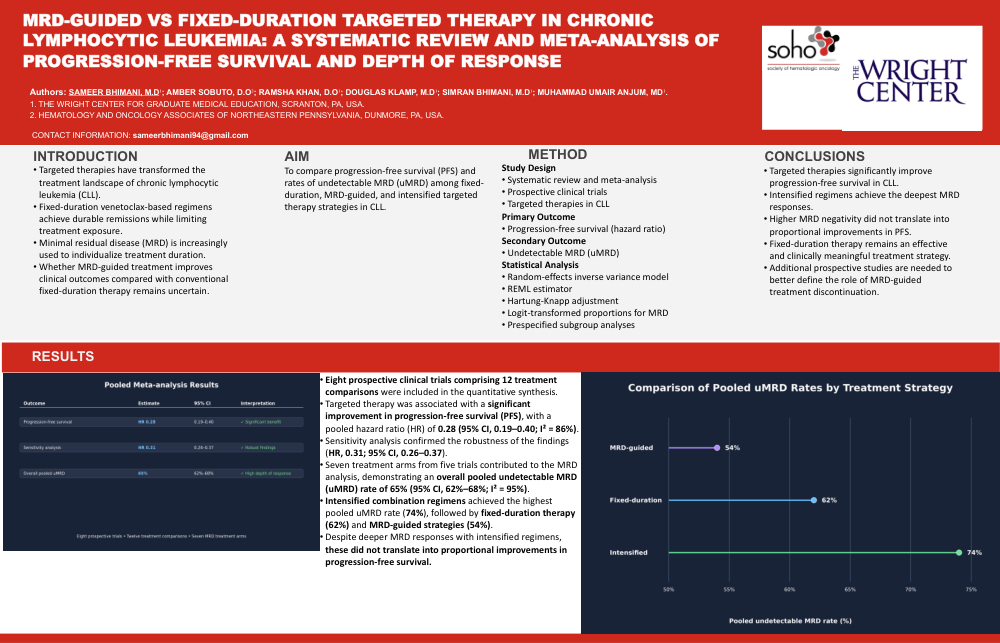
Eight prospective trials comprising 12 treatment comparisons were included. Targeted therapies were associated with a significant reduction in progression risk (hazard ratio [HR], 0.28; 95% confidence interval [CI], 0.19–0.40; I2=86%). Sensitivity analysis confirmed robustness (HR, 0.31; 95% CI, 0.26–0.37). Seven treatment arms across 5 trials contributed to MRD analysis, with a pooled uMRD rate of 65% (95% CI, 62%–68%; I2=95%). Intensified regimens achieved higher MRD negativity (74%) compared with fixed-duration (62%) and MRD-guided strategies (54%).
Conclusions
Fixed-duration targeted therapies provide consistent clinical benefit, whereas intensified regimens achieve deeper responses without proportional improvements in PFS. MRD-guided strategies remain promising but heterogeneous.