1,267 posters, 47 videos, 13 topics, 4 sessions, 853 authors
ePostersLive by SciGen Technologies S.A. All rights reserved.
SOHO 2026 Annual Meeting
September 9 - 12, 2026 | George R. Brown Convention Center, Houston, Texas

CLL - 239
Treatment Landscape of Relapsed/Refractory CLL in Low-Resource Countries
Poster Presenter
Authors
Part of Topic
Chronic Lymphocytic Leukemia (CLL)
Treatment Landscape of Relapsed/Refractory CLL in Low-Resource Countries
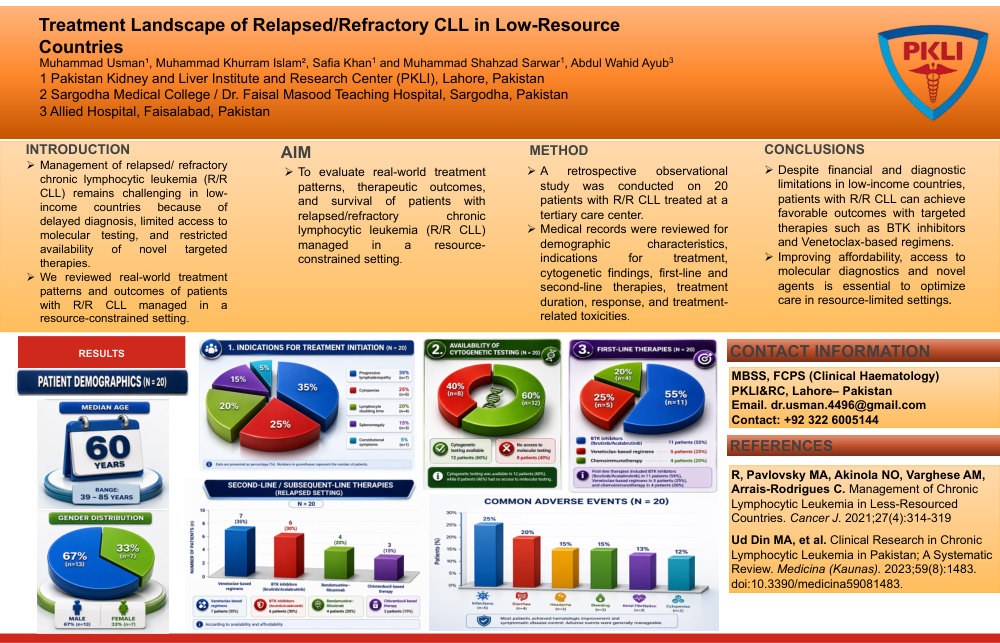
Background: Management of relapsed/refractory chronic lymphocytic leukemia (R/R CLL) remains challenging in low-income countries because of delayed diagnosis, limited access to molecular testing, and restricted availability of novel targeted therapies. We reviewed real-world treatment patterns and outcomes of patients with R/R CLL managed in a resource-constrained setting.
Methods: A retrospective observational study was conducted on 20 patients with R/R CLL treated at a tertiary care center. Medical records were reviewed for demographic characteristics, indications for treatment, cytogenetic findings, first-line and second-line therapies, treatment duration, response, and treatment-related toxicities.
Results: The median age was 60 years (range: 39–85 years), with male predominance (67%). Common indications for treatment initiation included progressive lymphadenopathy (35%), cytopenias (25%), lymphocyte doubling time (20%), splenomegaly (15%), and constitutional symptoms (5%) as shown in figure 1 Cytogenetic testing was available in 12 patients (60%), while 8 patients (40%) had no access to molecular testing. First-line therapies included BTK inhibitors (Ibrutinib/Acalabrutinib) in 11 patients (55%), Venetoclax-based regimens in 5 patients (25%), and chemoimmunotherapy in 4 patients (20%). In the relapsed setting, second-line treatments included Venetoclax-based regimens, BTK inhibitors, bendamustine-rituximab, and chlorambucil-based therapy according to availability and affordability. Median treatment duration was 13 months (range: 6–22 months). Most patients achieved hematologic improvement and symptomatic disease control. Common adverse events included infections, diarrhea, bleeding, headache, atrial fibrillation, and cytopenias, which were generally manageable.
Conclusion: Despite financial and diagnostic limitations in low-income countries, patients with R/R CLL can achieve favorable outcomes with targeted therapies such as BTK inhibitors and Venetoclax-based regimens. Improving affordability and access to molecular diagnostics and novel agents is essential to optimize care in resource-limited settings.
Key words :
R/R CLL,Landscape ,BTK inhibitors