1,267 posters, 47 videos, 13 topics, 4 sessions, 853 authors
ePostersLive by SciGen Technologies S.A. All rights reserved.
SOHO 2026 Annual Meeting
September 9 - 12, 2026 | George R. Brown Convention Center, Houston, Texas

AML - 132
Efficacy and Toxicity of FLAG-IDA-Venetoclax Compared With Other Induction Regimens in Newly Diagnosed and Relapsed AML: A Real-World Single-Center Study
Poster Presenter
Authors
Part of Topic
Acute Myeloid Leukemia (AML)
Efficacy and toxicity of FLAG-IDA-Venetoclax compared with other induction regimens in newly diagnosed and relapsed AML: a real-world single-center study
Rita Ahmad, MD1; Tyler Friesen, DO1; Mackenzie Wild, MD1; Alexandra L Brown, DO2; Arun Rathinam, MD2; Audrey Marjamaa, MS3; Abe Sahmoun, Ph.D., M.S1.; Kayla Geyer, BS4; Seth Maliske, MD5
Affiliations
1University of North Dakota, Internal Medicine, Fargo, ND
2University of North Dakota, Hematology-Oncology, Fargo, ND
3University of North Dakota School of Medicine, Fargo, ND
4Department of Sanford Medical Education, Sanford Health, Fargo, ND
5Sanford Roger Maris Cancer Center, Fargo, ND
Background:
Venetoclax-based intensified induction regimens have demonstrated activity in acute myeloid leukemia (AML), but real-world comparative data across induction strategies are limited. We evaluated efficacy and toxicity outcomes among patients receiving 7+3, FLAG-IDA–venetoclax, or other induction regimens in a single-center AML cohort.
Methods:
We conducted a retrospective analysis of 80 adult patients with newly diagnosed or relapsed AML between 2018-2025 receiving induction chemotherapy at a single community institution. Outcomes included response category, minimal residual disease (MRD) status, duration of neutropenia and thrombocytopenia, febrile neutropenia, and bleeding complications. Continuous variables were summarized as median (IQR) and compared across three induction groups using the Kruskal–Wallis test; categorical variables were analyzed using χ² or Fisher’s exact tests. All tests were two-sided with p<0.05 considered statistically significant.
Results:
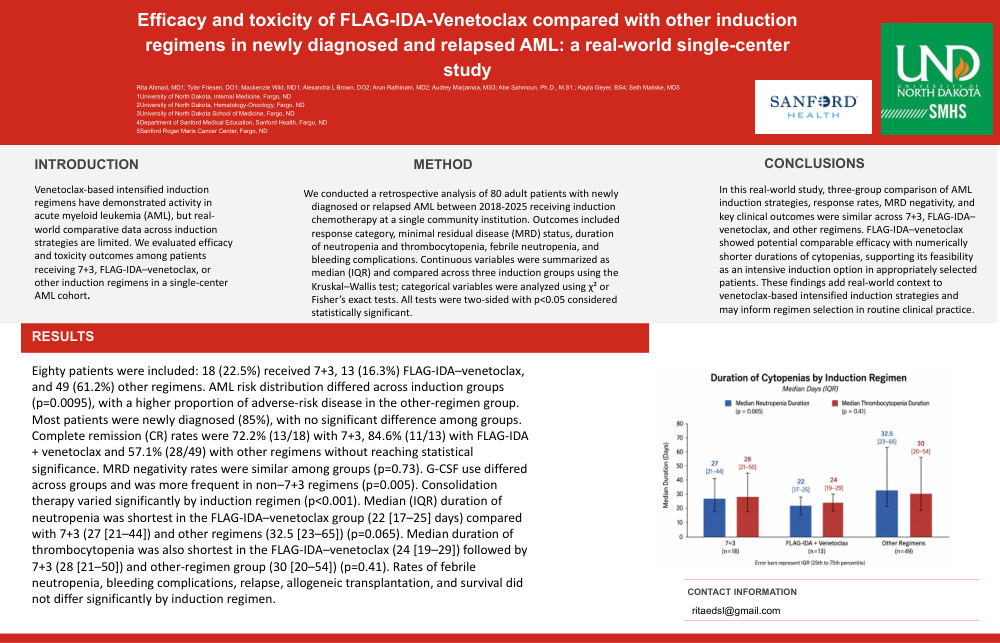
Eighty patients were included: 18 (22.5%) received 7+3, 13 (16.3%) FLAG-IDA–venetoclax, and 49 (61.2%) other regimens. AML risk distribution differed across induction groups (p=0.0095), with a higher proportion of adverse-risk disease in the other-regimen group. Most patients were newly diagnosed (85%), with no significant difference among groups. Complete remission (CR) rates were 72.2% (13/18) with 7+3, 84.6% (11/13) with FLAG-IDA + venetoclax and 57.1% (28/49) with other regimens without reaching statistical significance. MRD negativity rates were similar among groups (p=0.73). G-CSF use differed across groups and was more frequent in non–7+3 regimens (p=0.005). Consolidation therapy varied significantly by induction regimen (p<0.001). Median (IQR) duration of neutropenia was shortest in the FLAG-IDA–venetoclax group (22 [17–25] days) compared with 7+3 (27 [21–44]) and other regimens (32.5 [23–65]) (p=0.065). Median duration of thrombocytopenia was also shortest in the FLAG-IDA–venetoclax (24 [19–29]) followed by 7+3 (28 [21–50]) and other-regimen group (30 [20–54]) (p=0.41). Rates of febrile neutropenia, bleeding complications, relapse, allogeneic transplantation, and survival did not differ significantly by induction regimen.
Conclusions:
In this real-world study, three-group comparison of AML induction strategies, response rates, MRD negativity, and key clinical outcomes were similar across 7+3, FLAG-IDA–venetoclax, and other regimens. FLAG-IDA–venetoclax showed potential comparable efficacy with numerically shorter durations of cytopenias, supporting its feasibility as an intensive induction option in appropriately selected patients. These findings add real-world context to venetoclax-based intensified induction strategies and may inform regimen selection in routine clinical practice.