1,267 posters, 47 videos, 13 topics, 4 sessions, 853 authors
ePostersLive by SciGen Technologies S.A. All rights reserved.
SOHO 2026 Annual Meeting
September 9 - 12, 2026 | George R. Brown Convention Center, Houston, Texas

MM - 127
Association Between Statin Use and Survival in Multiple Myeloma: A Systematic Review and Meta-Analysis
Poster Presenter
Authors
Part of Topic
Multiple Myeloma (MM)
Association Between Statin Use and Survival in Multiple Myeloma: A Systematic Review and Meta-Analysis
Caryn Louise D. Gutierrez, MD.1, April Joy K. Ong, MD.1, Teresita Dumagay, MD.1,2
1Post-Residency Fellow, Department of Internal Medicine - Division of Hematology, Philippine General Hospital
2Consultant, Department of Internal Medicine - Division of Hematology, Philippine General Hospital
Background: Multiple myeloma (MM) remains an incurable plasma cell malignancy despite major therapeutic advances, with most patients eventually relapsing. Statins inhibit the mevalonate pathway and downstream protein prenylation involved in oncogenic Ras signaling and NF-κB activation, providing biologic plausibility for antimyeloma activity. Although population-based studies have suggested improved survival among statin users, the overall magnitude and consistency of this association remain uncertain.
Methods: A PRISMA-compliant systematic review and meta-analysis of observational cohort studies was performed. Adjusted hazard ratios (HRs) were pooled using a random-effects inverse-variance model. The primary outcome was all-cause mortality, and the secondary outcome was MM-specific mortality.
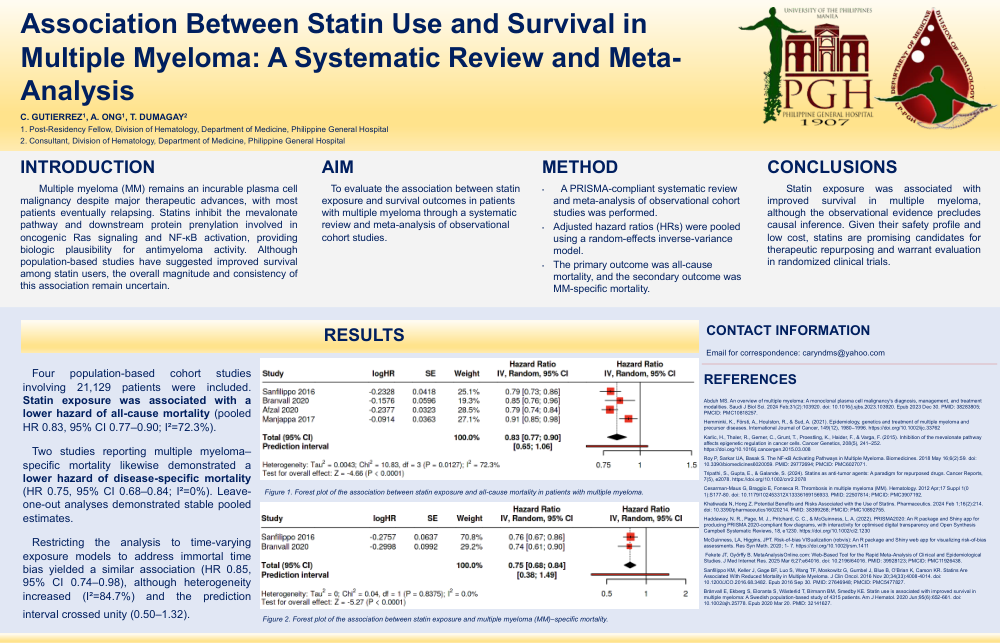
Results: Four population-based cohort studies involving 21,129 patients were included. Statin exposure was associated with a lower hazard of all-cause mortality (pooled HR 0.83, 95% CI 0.77–0.90; I²=72.3%). Two studies reporting multiple myeloma–specific mortality likewise demonstrated a lower hazard of disease-specific mortality (HR 0.75, 95% CI 0.68–0.84; I²=0%). Leave-one-out analyses demonstrated stable pooled estimates. Restricting the analysis to time-varying exposure models to address immortal time bias yielded a similar association (HR 0.85, 95% CI 0.74–0.98), although heterogeneity increased (I²=84.7%) and the prediction interval crossed unity (0.50–1.32).
Conclusions: Statin exposure was associated with improved survival in multiple myeloma, although the observational evidence precludes causal inference. Given their safety profile and low cost, statins are promising candidates for therapeutic repurposing and warrant evaluation in randomized clinical trials.