1,267 posters, 47 videos, 13 topics, 4 sessions, 853 authors
ePostersLive by SciGen Technologies S.A. All rights reserved.
SOHO 2026 Annual Meeting
September 9 - 12, 2026 | George R. Brown Convention Center, Houston, Texas

CLL - 119
Clinical Outcomes and Predictors of Early Inpatient CAR-T Administration Within 48 Hours: A Nationwide Analysis
Part of Topic
Chronic Lymphocytic Leukemia (CLL)
Early inpatient CAR
T within 48 hours was
associated with lower in hospital mortality despite
longer LOS, higher charges, and greater treatment
toxicity. These findings suggest early CAR T
identifies a high acuity, lower mortality subgroup
reflecting patient selection and access to
specialized care.
Summary
Discussion
•
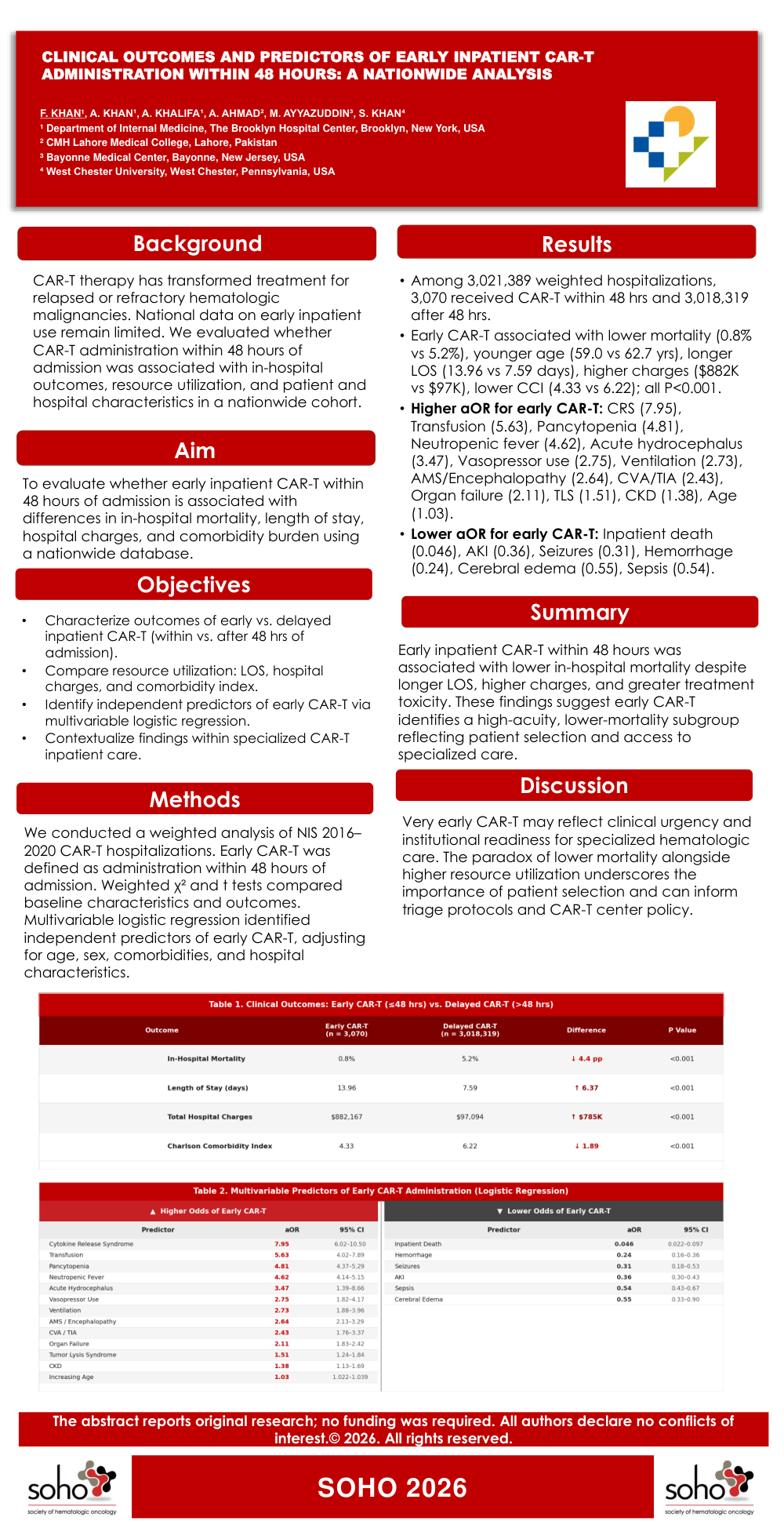
Among 3,021,389 weighted hospitalizations,
3,070 received CAR T within 48 hrs and 3,018,319
after 48 hrs.
•
Early CAR T associated with lower mortality (0.8%
vs 5.2%), younger age (59.0 vs 62.7 yrs), longer
LOS (13.96 vs 7.59 days), higher charges ($882K
vs $97K), lower CCI (4.33 vs 6.22); all P<0.001.
•
Higher aOR for early CAR T: CRS (7.95),
Transfusion (5.63), Pancytopenia (4.81),
Neutropenic fever (4.62), Acute hydrocephalus
(3.47), Vasopressor use (2.75), Ventilation (2.73),
AMS/Encephalopathy (2.64), CVA/TIA (2.43),
Organ failure (2.11), TLS (1.51), CKD (1.38), Age
(
•
Lower aOR for early CAR T: Inpatient death
(0.046), AKI (0.36), Seizures (0.31), Hemorrhage
(0.24), Cerebral edema (0.55), Sepsis (
To evaluate whether early inpatient CAR
T within
48 hours of admission is associated with
differences in in hospital mortality, length of stay,
hospital charges, and comorbidity burden using
a nationwide database.
Aim
CAR
T therapy has transformed treatment for
relapsed or refractory hematologic
malignancies. National data on early inpatient
use remain limited. We evaluated whether
CAR T administration within 48 hours of
admission was associated with in hospital
outcomes, resource utilization, and patient and
hospital characteristics in a nationwide cohort.
Very early CAR
T may reflect clinical urgency and
institutional readiness for specialized hematologic
care. The paradox of lower mortality alongside
higher resource utilization underscores the
importance of patient selection and can inform
triage protocols and CAR T center policy.
Methods
We conducted a weighted analysis of NIS 2016
2020 CAR T hospitalizations. Early CAR T was
defined as administration within 48 hours of
admission. Weighted χ² and t tests compared
baseline characteristics and outcomes.
Multivariable logistic regression identified
independent predictors of early CAR T, adjusting
for age, sex, comorbidities, and hospital
characteristics.
F. KHAN¹
, A. KHAN¹, A. KHALIFA¹, A. AHMAD², M. AYYAZUDDIN³, S. KHAN⁴
¹ Department of Internal Medicine, The Brooklyn Hospital
Center , Brooklyn, New York, USA
² CMH Lahore Medical College, Lahore, Pakistan
³ Bayonne Medical Center, Bayonne, New Jersey, USA
⁴ West Chester University, West Chester, Pennsylvania, USA
CLINICAL OUTCOMES AND PREDICTORS OF EARLY INPATIENT CAR
T
ADMINISTRATION WITHIN 48 HOURS: A NATIONWIDE ANALYSIS
Background
•
Characterize outcomes of early vs. delayed
inpatient CAR T (within vs. after 48 hrs of
admission).
•
Compare resource utilization: LOS, hospital
charges, and comorbidity index.
•
Identify independent predictors of early CAR T via
multivariable logistic regression.
•
Contextualize findings within specialized CAR T
inpatient care.
Results
Objectives
The abstract reports original research; no funding was required. All authors declare no conflicts of
interest.© 2026. All rights reserved.
SOHO2026
SOHO 2026