1,267 posters, 47 videos, 13 topics, 4 sessions, 853 authors
ePostersLive by SciGen Technologies S.A. All rights reserved.
SOHO 2026 Annual Meeting
September 9 - 12, 2026 | George R. Brown Convention Center, Houston, Texas

ALL - 055
Thyroid Profile in Acute Lymphoblastic Leukemia: Prognostic Role of Thyrotropin-Releasing Hormone
Poster Presenter
Authors
Part of Topic
Acute Lymphoblastic Leukemia (ALL)
Thyroid Profile in Acute Lymphoblastic Leukemia: Prognostic Role of Thyrotropin-Releasing Hormone.
Nahed Moawad Ibrahim Rakha, Neviene Nabil Moustafa, Nayera Ibrahim Abdel Murdy, Basma Saeid Mansour Ali, Hebatullah Magdy Mahmoud Fares.
Clinical Haematology, Bone marrow Transplantation unit, Department of Internal Medicine, Ain Shams University, Cairo, Egypt.
Abstract:
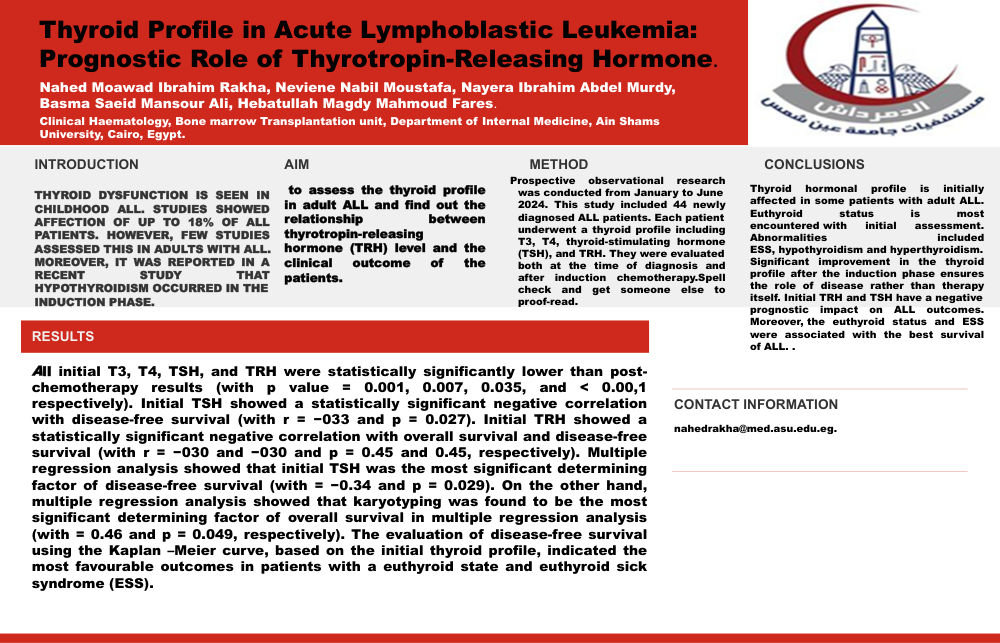
Introduction: Thyroid dysfunction is seen in childhood ALL. Studies showed affection of up to 18% of ALL patients. However, few studies assessed this in adults with ALL. Moreover, it was reported in a recent study that hypothyroidism occurred in the induction phase.
Purpose: to assess the thyroid profile in adult ALL and find out the relationship between thyrotropin-releasing hormone (TRH) level and the clinical outcome of the patients.
Patients and methods: Prospective observational research was conducted from January to June 2024. This study included 44 newly diagnosed ALL patients. Each patient underwent a thyroid profile including T3, T4, thyroid-stimulating hormone (TSH), and TRH. They were evaluated both at the time of diagnosis and after induction chemotherapy.
Results: All initial T3, T4, TSH, and TRH were statistically significantly lower than post-chemotherapy results (with p value = 0.001, 0.007, 0.035, and < 0.00,1 respectively). Initial TSH showed a statistically significant negative correlation with disease-free survival (with r = −033 and p = 0.027). Initial TRH showed a statistically significant negative correlation with overall survival and disease-free survival (with r = −030 and −030 and p = 0.45 and 0.45, respectively). Multiple regression analysis showed that initial TSH was the most significant determining factor of disease-free survival (with = −0.34 and p = 0.029). On the other hand, multiple regression analysis showed that karyotyping was found to be the most significant determining factor of overall survival in multiple regression analysis (with = 0.46 and p = 0.049, respectively). The evaluation of disease-free survival using the Kaplan –Meier curve, based on the initial thyroid profile, indicated the most favourable outcomes in patients with a euthyroid state and euthyroid sick syndrome (ESS).
Conclusions: Thyroid hormonal profile is initially affected in some patients with adult ALL. Euthyroid status is most encountered with initial assessment. Abnormalities included ESS, hypothyroidism and hyperthyroidism. Significant improvement in the thyroid profile after the induction phase ensures the role of disease rather than therapy itself. Initial TRH and TSH have a negative prognostic impact on ALL outcomes. Moreover, the euthyroid status and ESS were associated with the best survival of ALL.
Keywords: ALL • acute lymphoblastic leukemia • TRH • thyrotropin-releasing hormone • thyroid profile • prognosis • prospective study