516 posters, 59 topics, 63 sessions, 1,127 authors, 353 institutions
ePostersLive by SciGen Technologies S.A. All rights reserved.
2026 SOAP Annual Meeting
April 29 - May 3, 2026 | Montreal, Quebec Canada

2339050
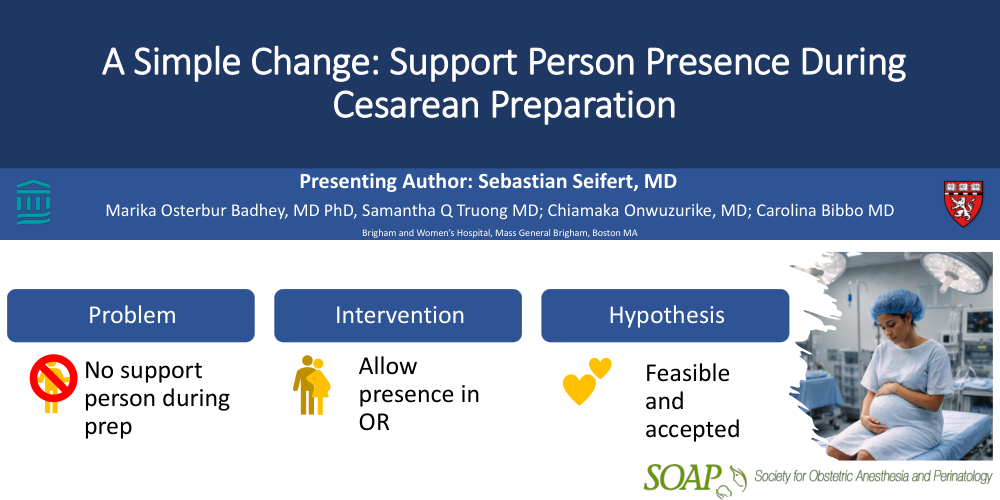
Patient-centered care during neuraxial placement and operating room preparation for cesarean delivery: allowing support people in the operating room
Poster Presenter
Authors
Affiliations
Part of Topic
Patient Voices
Abstract
Introduction: Preparation for cesarean delivery (CD), including neuraxial anesthesia placement and operating room setup, often occurs without the presence of a support person, which may contribute to patient anxiety and psychological distress during a vulnerable time. We implemented a quality improvement (QI) initiative allowing support person presence during neuraxial placement and CD preparation and evaluated its feasibility and acceptability among interdisciplinary staff. We hypothesized that allowing support person presence during neuraxial placement and CD preparation would be feasible, well accepted by staff, and perceived to improve patient-centered care.
Methods: As a QI initiative, support persons accompanied patients brought to the operating room during scheduled and unplanned CDs. Support persons were seated in front of the patient during neuraxial placement and moved to the head of the bed prior to surgical draping, with a blanket hung for privacy (Figure 1). For general anesthesia, support persons waited outside the room. Two years following implementation (average 7,000 deliveries/year at our quaternary center), an anonymous post-intervention Likert-scale survey was distributed to nurses, obstetricians, anesthesiologists, and surgical technicians. Qualitative responses were analyzed using iterative open-coding thematic analysis by two independent reviewers.
Results: Of 364 surveys distributed, 111 responses were received (30%). Overall, 109 respondents (98%) reported being very satisfied or satisfied with the intervention, 102 (92%) perceived a positive impact on care, and 100 (90%) would recommend adoption at other institutions. Qualitative themes highlighted improved patient experience, enhanced emotional support, and alignment with patient- and family-centered care. No adverse events related to support person presence during neuraxial placement or operating room preparation were reported.
Conclusions: Allowing support person presence during neuraxial placement and CD preparation was feasible, strongly supported by interdisciplinary staff, and perceived to enhance patient-centered care. These findings support further evaluation, including patient-reported outcomes, and potential adoption in similar clinical settings.