516 posters, 59 topics, 63 sessions, 1,127 authors, 353 institutions
ePostersLive by SciGen Technologies S.A. All rights reserved.
2026 SOAP Annual Meeting
April 29 - May 3, 2026 | Montreal, Quebec Canada

2340894
Quantra QStat Characteristics in Obstetrics versus a Cardiac Surgery Control Group
Poster Presenter
Authors
Part of Topic
Hemorrhage: Transfusion
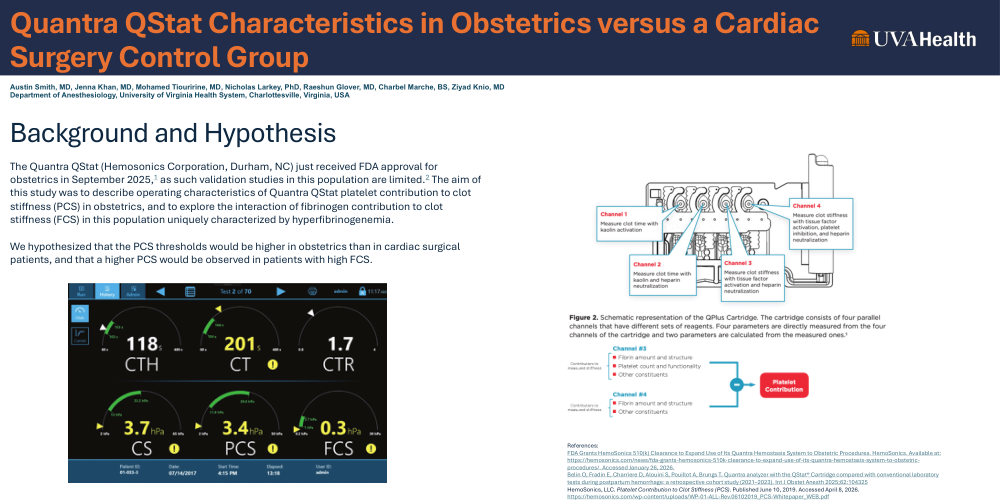
Introduction: The Quantra QStat (Hemosonics Corporation, Durham, NC) just received FDA approval for obstetrics in September 2025,1 as such validation studies in this population are limited.2 The aim of this study was to describe operating characteristics of Quantra QStat platelet contribution to clot stiffness (PCS) in obstetrics, and to explore the interaction of fibrinogen contribution to clot stiffness (FCS) in this population uniquely characterized by hyperfibrinogenemia. We hypothesized that the PCS thresholds would be higher in obstetrics than in cardiac surgical patients, and that a higher PCS would be observed in patients with high FCS.
Methods: This was a single-center retrospective cohort study enrolling 71 consecutive obstetrics patients on admission from November 2023 to March 2025. 11 patients were excluded due to not being third trimester, bleeding, recent anticoagulant use (Enoxaparin), or due to missing Quantra results, leaving 60 patients for analysis. The control group comprised 388 post- cardiopulmonary bypass Quantra QPlus collections from 511 consecutive patients undergoing STS-indexed cardiac surgery from February 2024 to February 2025 (the first year of routine Quantra QPlus application at our institution). Receiver operating characteristics were applied to the experimental group and the control group independently. Obstetrics subgroups were constructed for patients with FCS ≤4.2 hPa and >4.2 hPa.
Results: For cardiac surgical patients, a PCS of 15.70 to 18.05 was able to discriminate platelet levels from <150k/uL to <250k/uL with an area under the curve (AUC) of 0.89 to 0.92. For obstetrics patients, a PCS of 21.55 hPa to 30.15 hPa was able to discriminate these platelet levels (AUC, 0.78 to 0.85). In the subset of obstetric patients with FCS ≤4.2 hPa, a PCS of 21.45 hPa to 22.55 hPa was able to discriminate these platelet levels (AUC, 0.70 to 0.90). In the subset of obstetric patients with FCS >4.2 hPa, a PCS of 22.05 hPa to 30.20 hPa was able to discriminate these platelet levels (AUC, 0.73 to 0.97).
Conclusions: Compared to cardiac surgical controls, obstetrics patients with normal fibrinogen (FCS <4.2 hPa) have PCS thresholds that are approximately 5hPa (range: 4.5 – 5.75 hPa) higher. The inclusion of hyperfibrinogenemic obstetric patients (FCS >4.2) may yield PCS thresholds 10+ hPa higher (range: 6.35 – 12.15 hPa) for the same platelet count. In obstetrics patients, regardless of FCS level, it appears that a PCS of approximately 22hPa is reasonable for discrimination of platelet levels < 150ku/L.