516 posters, 59 topics, 63 sessions, 1,127 authors, 352 institutions
ePostersLive by SciGen Technologies S.A. All rights reserved.
2026 SOAP Annual Meeting
April 29 - May 3, 2026 | Montreal, Quebec Canada

2337644
Blood Transfusion Protocol Significantly Reduces Blood Product Waste
Poster Presenter
Authors
Kristen Harris, Afif Kraitem, Jonathan Tucci, Kaycie Atchison, Holly Ende, Laura Sorabella
Affiliations
Department of Anesthesiology, Vanderbilt University Medical Center, Nashville, Tennessee, Department of Pathology, Microbiology, and Immunology, Vanderbilt University Medical Center, Nashville, Tennessee, Quality, Safety, and Risk Prevention, Vanderbilt University Medical Center, Nashville, Tennessee
Part of Topic
Hemorrhage: Transfusion
Blood Transfusion Protocol Significantly Reduces Blood Product Waste
Kristen Harris,1 Afif Kraitem,1 Jonathan Tucci,2 Kaycie Atchison,3 HollyEnde,1 Laura Sorabella1
1. Department of Anesthesiology, Vanderbilt University Medical Center, Nashville, Tennessee, 2. Department of Pathology, Microbiology, and Immunology, Vanderbilt University Medical Center, Nashville, Tennessee, 3. Quality, Safety, and Risk Prevention, Vanderbilt University
Medical Center, Nashville, Tennessee
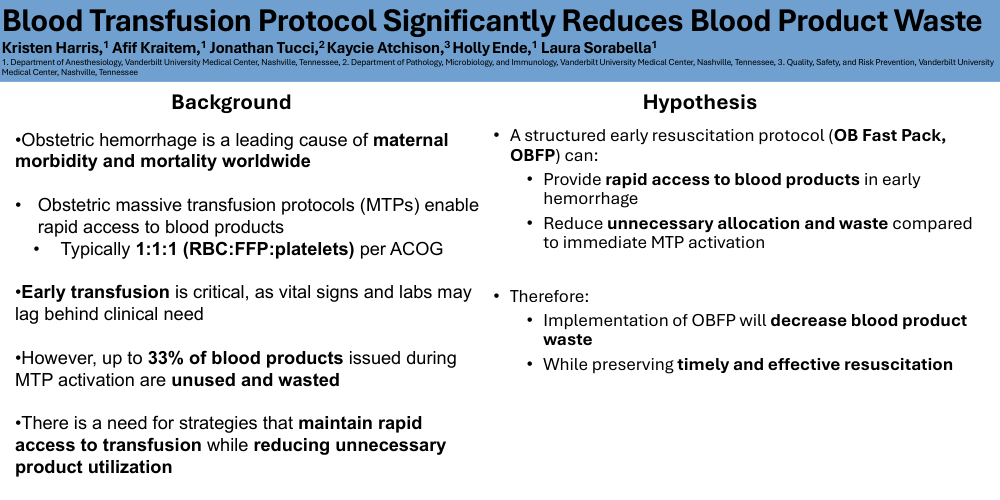
Background Hypothesis
• A structured early resuscitation protocol (OB Fast Pack,
OBFP) can:
• Provide rapid access to blood products in early
hemorrhage
• Reduce unnecessary allocation and waste compared
to immediate MTP activation
• Therefore:
• Implementation of OBFP will decrease blood product
waste
• While preserving timely and effective resuscitation
•Obstetric hemorrhage is a leading cause of maternal
morbidity and mortality worldwide
• Obstetric massive transfusion protocols (MTPs) enable
rapid access to blood products
• Typically 1:1:1 (RBC:FFP:platelets) per ACOG
•Early transfusion is critical, as vital signs and labs may
lag behind clinical need
•However, up to 33% of blood products issued during
MTP activation are unused and wasted
•There is a need for strategies that maintain rapid
access to transfusion while reducing unnecessary
product utilizationStudy Design and Methods
Study Design
• Quality improvement study (pre–post intervention)
• Setting: single-center obstetric service
• Intervention: OB Fast Pack (OBFP) protocol
(implemented December 2024)
• Population:
• Obstetric patients with intrapartum or postpartum
hemorrhage
• Prior to meeting criteria for full OB MTP activation
• Comparison:
• Pre-implementation: standard OB MTP use
• Post-implementation: OBFP + selective escalation
to MTP
Methods
• OBFP protocol:
• Rapid delivery of RBCs, FFP, cryoprecipitate (2:2:1
ratio)
• Optional fibrinogen supplementation
• Patients with ongoing hemorrhage escalated to full OB
MTP
• Blood bank quality team measured:
• Utilization and waste of:
• RBCs, plasma, platelets, cryoprecipitate
• Number of OB MTP activations
• Timeframe:
• First year post-implementation compared to pre-
implementation baselineResults: OB Fast Pack Reduces Obstetric MTP ActivationConclusion and Discussion
• 52% decrease in OB MTP activations following OBFP implementation
•100% reduction in OB MTP-associated blood product waste
•Driven by elimination of platelet and cryoprecipitate waste
•79% lower blood product waste with OBFP compared to pre-implementation MTP use
•Maintained rapid access to transfusion during obstetric hemorrhage
•OBFP provides a structured alternative to immediate MTP activation in early hemorrhage
•Promotes more judicious blood product utilization without compromising safety
•Use of pathogen-reduced cryoprecipitate improves flexibility and reduces waste
•Represents a cost-conscious, scalable approach to optimizing obstetric hemorrhage management