516 posters, 59 topics, 63 sessions, 1,127 authors, 353 institutions
ePostersLive by SciGen Technologies S.A. All rights reserved.
2026 SOAP Annual Meeting
April 29 - May 3, 2026 | Montreal, Quebec Canada

2341926
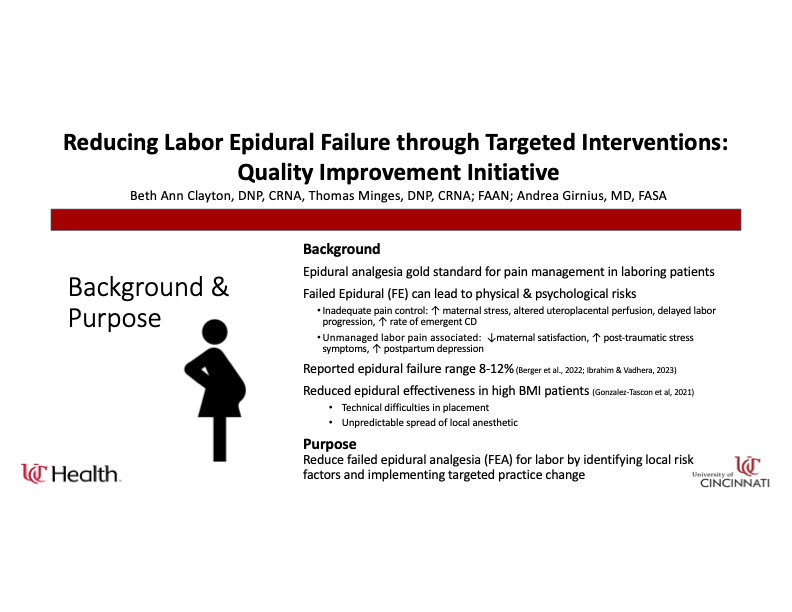
Reducing Labor Epidural Failure Through Targeted Interventions: A Quality Improvement Initiative
Poster Presenter
Authors
Affiliations
Part of Topic
Making Epidurals Better
Purpose
To reduce failed epidural analgesia (FEA) for labor by identifying local risk factors and implementing targeted practice change, including the dural puncture epidural (DPE) technique, pre-procedural neuraxial ultrasound, enhanced reassessment, and electronic medical record (EMR) documentation, using iterative Plan‑Do‑Study‑Act (PDSA).
Setting
This quality improvement project was conducted at an 800-bed academic Level IV Maternal Care Center that houses a 13-bed Labor and Delivery unit, with over 3,000 deliveries per year. The center serves a demographically diverse, high-risk obstetric population and is staffed by a multidisciplinary anesthesia team including anesthesiologists, CRNAs, anesthesiology residents, and student registered nurse anesthetists.
Purpose
To reduce failed epidural analgesia (FEA) for labor by identifying local risk factors and implementing targeted practice change, including the dural puncture epidural (DPE) technique, pre-procedural neuraxial ultrasound, enhanced reassessment, and electronic medical record (EMR) documentation, using iterative Plan‑Do‑Study‑Act (PDSA).
Setting
This quality improvement project was conducted at an 800-bed academic Level IV Maternal Care Center that houses a 13-bed Labor and Delivery unit, with over 3,000 deliveries per year. The center serves a demographically diverse, high-risk obstetric population and is staffed by a multidisciplinary anesthesia team including anesthesiologists, CRNAs, anesthesiology residents, and student registered nurse anesthetists.
Methods
This quality improvement project compared pre- and post-intervention data through retrospective chart reviews to evaluate and improve labor epidural performance. An initial review of 200 labor epidural cases from 2023–2024 identified predictors of epidural failure and helped develop targeted interventions. Failure of epidural analgesia (FEA) was defined as catheters needing replacement during labor. Based on baseline findings, several strategies were implemented, including the use of dural puncture epidural technique (DPE) for higher-risk patients (e.g., obesity, difficult anatomy), performing selective pre-procedural neuraxial ultrasound, employing a structured EMR template to standardize reassessment (pain scores, dermatomes, motor block, boluses/infusions, adjuncts), and applying a replacement protocol involving catheter adjustment and/or replacement after 2–3 ineffective boluses. After these changes, a second retrospective review of 118 cases was conducted to evaluate their effectiveness. Descriptive statistics, Chi-square tests, and Fisher’s exact tests (α = .05) were used to assess associations and outcomes. Balancing measures included accidental dural puncture, hypotension, and post-dural puncture headache. The University of Cincinnati IRB reviewed the project and classified it as non-human subjects’ research.
Results
The baseline FEA was 15%, surpassing the reported national average of 8-12%. Cycle 1 identified obesity (BMI > 35 kg/m²), chorioamnionitis, gestational hypertension, and frequent epidural boluses as significant predictors of FEA (p < .05). After implementing the DPE technique and the reassessment/documentation bundle in Cycle 2, DPE use was associated with lower epidural failure rates (p = .0217), and the overall FEA rate decreased to 7.3%. EMR-driven reassessment and documentation completeness improved. Neuraxial ultrasound adoption was limited by equipment downtime but appeared beneficial for anticipated difficult placements.
Conclusion
A structured QI approach that integrates DPE and standardized EMR-guided reassessment can effectively reduce FEA in a high-risk obstetric unit. Future steps include increasing ultrasound availability, strengthening the replacement protocol, and continuing PDSA cycles to maintain and expand improvements.