516 posters, 59 topics, 63 sessions, 1,127 authors, 352 institutions
ePostersLive by SciGen Technologies S.A. All rights reserved.
2026 SOAP Annual Meeting
April 29 - May 3, 2026 | Montreal, Quebec Canada

2337180
The Effect of Painful Contractions on Time Perception during Epidural Placement for Labor Analgesia
Poster Presenter
Authors
Katherine Hatter, Jessi Stockinger, Haley Nitchie, Courtney Condon, Latha Hebbar
Affiliations
null,
Part of Topic
Making Epidurals Better
The effect of painful contractions on time perception during epidural placement for labor analgesiaKatie Hatter, MD, Jessi Stockinger, MD, Haley Nitchie, MHA, Courtney Condon, BS, & Latha Hebbar, MD
Background
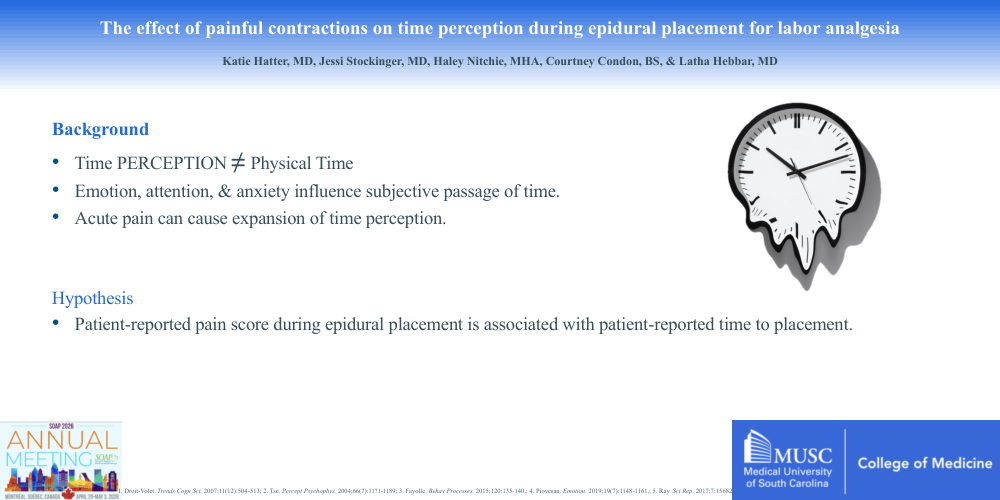
Time PERCEPTION ≠ Physical Time
Emotion, attention, & anxiety influence subjective passage of time.
Acute pain can cause expansion of time perception.
Hypothesis
Patient-reported pain score during epidural placement is associated with patient-reported time to placement.
Methods
Pain score during epidural placement with or without contraction was not associated with perceived time to epidural placement.
Only observed time to epiduralplacement and having a prior epidural was associated with perceived time.
111/295 (37.6%) estimated placement time was larger than the observed placement timeI
Discussion/Conclusion
In the setting of acute cyclical pain of labor and pain associated with labor epidural placement, retrospective temporal sensitivityand subjectiveperceptionof therate of passageof time is not altered.
Limitations
•Did not account for confounding variables – BMI, ADHD, anxiety, depression •Exclusion of patients in severe pain •Prospective study design with retrospective question
Clinical Implications •Patient education by anesthesia team •Encouraging earlier request of labor epidural
Future Directions •Comparing patient satisfaction with time perception •Comparing time perception or patient satisfaction with or without variables: music, provider narration