875 posters, 25 topics, 3,440 authors, 1,061 institutions
ePostersLive by SciGen Technologies S.A. All rights reserved.
SAGES 2026 Annual Meeting Emerging Technology Session
March 25-28, 2026 | Tampa, FL, USA

P754
PANCREATIC INCIDENTALOMA ON TRAUMA IMAGING: PREVALENCE AND CLINICAL SIGNIFICANCE
Poster Presenter
Authors
Yukiko Suzuki, Rachel Orlowski, Cristina Botero Fonnegra, William Hardy, Prashant Sukharamwala
Affiliations
Part of Topic
Pancreas
Pancreatic Incidentaloma on Trauma Imaging: Prevalence and Clinical Significance
Yukiko Suzuki, MD1, Rachel Orlowski, MPH1, Cristina Botero Fonnegra, MD1, William Hardy, MD1, Prashant Sukharamwala, MD1
Introduction
1 St. Joseph’s Hospital, BayCare Health System, Tampa, FL
- Trauma patients frequently undergo multiple imaging, which can identify previously undiagnosed conditions.
- Pancreatic incidentalomas occur in 0.2–40% of the general population, but their incidence in trauma patients is unknown.
- Aim: determine the prevalence of pancreatic incidentalomas in trauma patients and outline an approach for management.
Methods and Procedures
- A retrospective cohort study was conducted to identify cases of pancreatic incidentalomas among adult trauma patients who underwent abdominal imaging studies between 2021 and 2024 using trauma registry data from a Level II Trauma Center.
- Chart reviews were performed for these patients to determine lesion characteristics, follow up, and treatment.
- Patient demographics and injury characteristics were compared by lesion status using the Wilcoxon rank-sum test, Pearson’s chi-squared test, and Fisher’s exact test, and descriptive statistics were used to evaluate lesion characteristics and follow-up outcomes.
Results
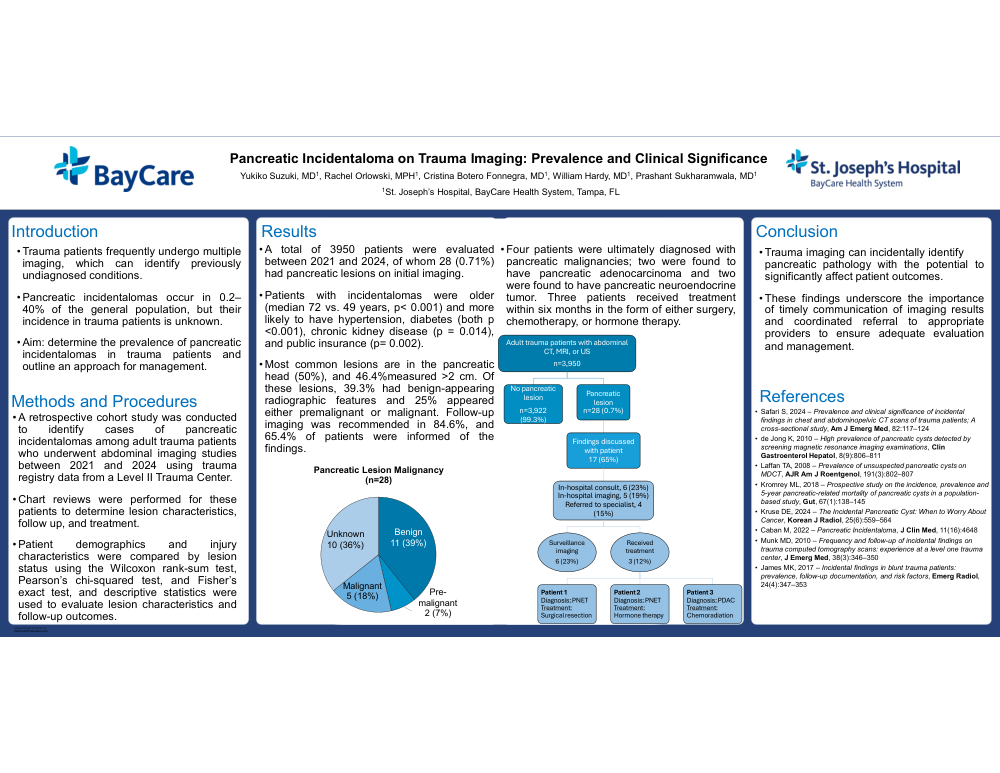
- A total of 3950 patients were evaluated between 2021 and 2024, of whom 28 (0.71%)had pancreatic lesions on initial imaging.
- Patients with incidentalomas were older(median 72 vs. 49 years, p< 0.001) and more likely to have hypertension, diabetes (both p<0.001), chronic kidney disease (p = 0.014), and public insurance (p= 0.002).
- Most common lesions are in the pancreatic head (50%), and 46.4%measured >2 cm. Of these lesions, 39.3% had benign-appearing radiographic features and 25% appeared either premalignant or malignant. Follow-up imaging was recommended in 84.6%, and 65.4% of patients were informed of the findings.
- Four patients were ultimately diagnosed with pancreatic malignancies; two were found to have pancreatic adenocarcinoma and two were found to have pancreatic neuroendocrine tumor. Three patients received treatment within six months in the form of either surgery, chemotherapy, or hormone therapy.
Conclusion
- Trauma imaging can incidentally identify pancreatic pathology with the potential to significantly affect patient outcomes.
- These findings underscore the importance of timely communication of imaging results and coordinated referral to appropriate providers to ensure adequate evaluation and management.