816 posters, 24 topics, 3,314 authors, 1,012 institutions
ePostersLive by SciGen Technologies S.A. All rights reserved.
SAGES 2026 Annual Meeting Emerging Technology Session
March 25-28, 2026 | Tampa, FL, USA

P750
National Trends In Minimally Invasive Approaches To Pancreatic Resections In The United States
Poster Presenter
Authors
Khaled Y Omar, Filipe Kunzler, Levan Tsamalaidze, Horacio J Asbun, Domenech Asbun
Affiliations
Part of Topic
Pancreas
Introduction: Minimally invasive surgery (MIS) has demonstrated promising outcomes in pancreatic procedures; however, open surgery remains the dominant approach, particularly for pancreaticoduodenectomy (Whipple) and distal pancreatectomy (DP). National trends and utilization rates of MIS in these procedures remain underreported. This study aims to evaluate the adoption of MIS techniques for Whipple and DP using a national database.
Methods: A retrospective analysis of the National Cancer Database (NCDB) was conducted to assess MIS utilization for pancreatic resections. Patients undergoing Whipple or DP between 2010 and 2022 were included. Cases from 2004–2009 were excluded due to incomplete data on surgical approach. Procedures were categorized as open, laparoscopic, robotic, or converted to open. Trends in surgical approach over time were assessed using regression modeling.
Results: A total of 78,917 patients met inclusion criteria.
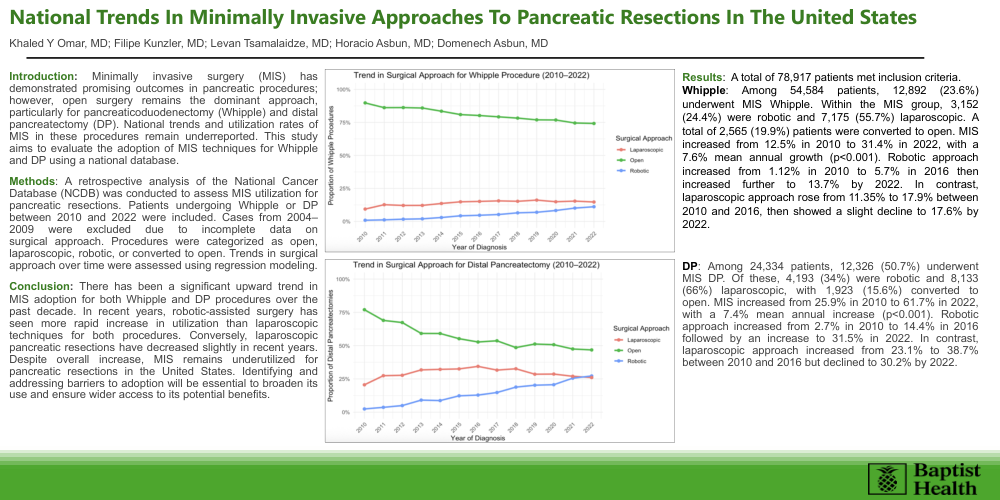
Whipple: Among 54,584 patients, 12,892 (23.6%) underwent MIS Whipple. Within the MIS group, 3,152 (24.4%) were robotic and 7,175 (55.7%) laparoscopic. A total of 2,565 (19.9%) patients were converted to open. MIS increased from 12.5% in 2010 to 31.4% in 2022, with a 7.6% mean annual growth (p<0.001). Robotic approach increased from 1.12% in 2010 to 5.7% in 2016 then increased further to 13.7% by 2022. In contrast, laparoscopic approach rose from 11.35% to 17.9% between 2010 and 2016, then showed a slight decline to 17.6% by 2022.

DP: Among 24,334 patients, 12,326 (50.7%) underwent MIS DP. Of these, 4,193 (34%) were robotic and 8,133 (66%) laparoscopic, with 1,923 (15.6%) converted to open. MIS increased from 25.9% in 2010 to 61.7% in 2022, with a 7.4% mean annual increase (p<0.001). Robotic approach increased from 2.7% in 2010 to 14.4% in 2016 followed by an increase to 31.5% in 2022. In contrast, laparoscopic approach increased from 23.1% to 38.7% between 2010 and 2016 but declined to 30.2% by 2022.

Conclusion: There has been a significant upward trend in MIS adoption for both Whipple and DP procedures over the past decade. In recent years, robotic-assisted surgery has seen more rapid increase in utilization than laparoscopic techniques for both procedures. Conversely, laparoscopic pancreatic resections have decreased slightly in recent years. Despite overall increase, MIS remains underutilized for pancreatic resections in the United States. Identifying and addressing barriers to adoption will be essential to broaden its use and ensure wider access to its potential benefits.