875 posters, 25 topics, 3,440 authors, 1,061 institutions
ePostersLive by SciGen Technologies S.A. All rights reserved.
SAGES 2026 Annual Meeting Emerging Technology Session
March 25-28, 2026 | Tampa, FL, USA

P656
An Institutional Review: Evaluating the Effectiveness of Novel Regenerative Medicine Techniques in a Multidisciplinary Approach for the Treatment of Enterocutaneous Fistulae
Poster Presenter
Authors
Affiliations
Part of Topic
Image Guided Interventions (Including Combined Radiologic / Endoscopic / Surgical Procedures)
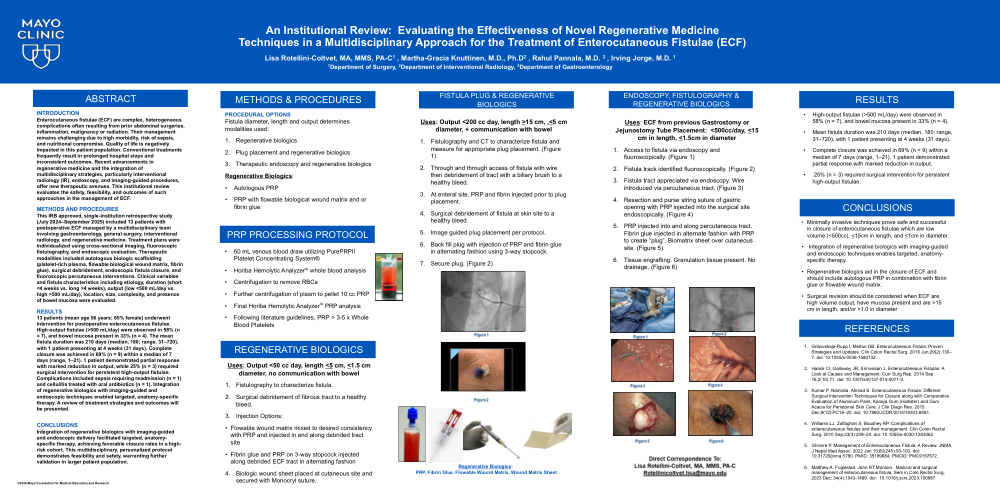
An Institutional Review: Evaluating the Effectiveness of Novel Regenerative Medicine Techniques in a Multidisciplinary Approach for the Treatment of Enterocutaneous Fistulae (ECF)
INTRODUCTION
Enterocutaneous fistulae (ECF) are complex, heterogeneous complications often resulting from prior abdominal surgeries, inflammation, malignancy or radiation. Their management remains challenging due to high morbidity, risk of sepsis, and nutritional compromise. Quality of life is negatively impacted in this patient population. Conventional treatments frequently result in prolonged hospital stays and inconsistent outcomes. Recent advancements in regenerative medicine and the integration of multidisciplinary strategies, particularly interventional radiology (IR), endoscopy, and imaging-guided procedures, offer new therapeutic avenues. This institutional review evaluates the safety, feasibility, and outcomes of such approaches in the management of ECF.
METHODS AND PROCEDURES
This IRB approved, single-institution retrospective study (July 2024–September 2025) included 13 patients with postoperative ECF managed by a multidisciplinary team involving gastroenterology, general surgery, interventional radiology, and regenerative medicine. Treatment plans were individualized using cross-sectional imaging, fluoroscopic fistulography, and endoscopic evaluation. Therapeutic modalities included autologous biologic scaffolding (platelet-rich plasma, flowable biological wound matrix, fibrin glue), surgical debridement, endoscopic fistula closure, and fluoroscopic percutaneous interventions. Clinical variables and fistula characteristics including etiology, duration (short <4 weeks vs. long >4 weeks), output (low <500 mL/day vs. high >500 mL/day), location, size, complexity, and presence of bowel mucosa were evaluated.
RESULTS 13 patients (mean age 56 years; 65% female) underwent intervention for postoperative enterocutaneous fistulae. High-output fistulae (>500 mL/day) were observed in 58% (n = 7), and bowel mucosa present in 33% (n = 4). The mean fistula duration was 210 days (median, 180; range, 31–720), with 1 patient presenting at 4 weeks (31 days). Complete closure was achieved in 69% (n = 9) within a median of 7 days (range, 1–21). 1 patient demonstrated partial response with marked reduction in output, while 25% (n = 3) required surgical intervention for persistent high-output fistulae. Complications included sepsis requiring readmission (n = 1) and cellulitis treated with oral antibiotics (n = 1). Integration of regenerative biologics with imaging-guided and endoscopic techniques enabled targeted, anatomy-specific therapy. A review of treatment strategies and outcomes will be presented.
CONCLUSIONS
Integration of regenerative biologics with imaging-guided and endoscopic delivery facilitated targeted, anatomy-specific therapy, achieving favorable closure rates in a high-risk cohort. This multidisciplinary, personalized protocol demonstrates feasibility and safety, warranting further validation in larger patient population.