875 posters, 25 topics, 3,440 authors, 1,061 institutions
ePostersLive by SciGen Technologies S.A. All rights reserved.
SAGES 2026 Annual Meeting Emerging Technology Session
March 25-28, 2026 | Tampa, FL, USA

P382
Critical View of Safety in Mini-Laparoscopic Cholecystectomy with Percutaneous Instruments: Updated Prospective Outcomes
Part of Topic
Biliary
Introduction:
Laparoscopic cholecystectomy (LC) remains the gold standard for symptomatic cholelithiasis, offering superior outcomes compared with open surgery, including reduced pain, shorter recovery, and improved cosmetic results. Mini-laparoscopic cholecystectomy (MLC), employing trocars <5 mm, has been validated as safe and feasible. However, evidence is limited regarding its effectiveness in achieving the Critical View of Safety (CVS), particularly in complex cases.
Our group previously presented preliminary data, demonstrating the feasibility of MLC with percutaneous 2 mm instruments. The present study reports updated results from a larger prospective cohort, with a specific focus on the relationship between intraoperative complexity and the achievement of CVS.
Methods:
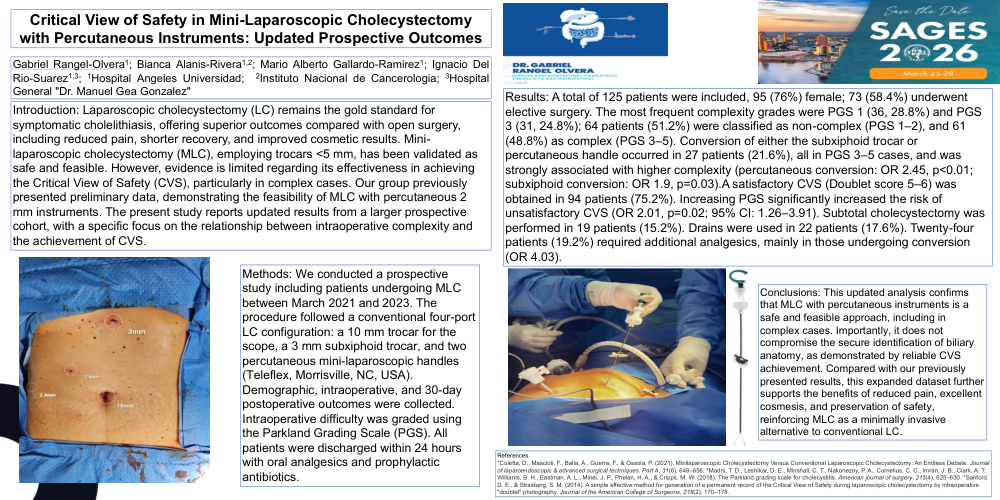
We conducted a prospective study including patients undergoing MLC between March 2021 and 2023. The procedure followed a conventional four-port LC configuration: a 10 mm trocar for the scope, a 3 mm subxiphoid trocar, and two percutaneous mini-laparoscopic handles (Teleflex, Morrisville, NC, USA). Demographic, intraoperative, and 30-day postoperative outcomes were collected. Intraoperative difficulty was graded using the Parkland Grading Scale (PGS). All patients were discharged within 24 hours with oral analgesics and prophylactic antibiotics.
Results:
A total of 125 patients were included, 95 (76%) female; 73 (58.4%) underwent elective surgery. The most frequent complexity grades were PGS 1 (36, 28.8%) and PGS 3 (31, 24.8%); 64 patients (51.2%) were classified as non-complex (PGS 1–2), and 61 (48.8%) as complex (PGS 3–5). Conversion of either the subxiphoid trocar or percutaneous handle occurred in 27 patients (21.6%), all in PGS 3–5 cases, and was strongly associated with higher complexity (percutaneous conversion: OR 2.45, p<0.01; subxiphoid conversion: OR 1.9, p=0.03).
A satisfactory CVS (Doublet score 5–6) was obtained in 94 patients (75.2%). Increasing PGS significantly increased the risk of unsatisfactory CVS (OR 2.01, p=0.02; 95% CI: 1.26–3.91). Subtotal cholecystectomy was performed in 19 patients (15.2%). Drains were used in 22 patients (17.6%). Twenty-four patients (19.2%) required additional analgesics, mainly in those undergoing conversion (OR 4.03).
Conclusions:
This updated analysis confirms that MLC with percutaneous instruments is a safe and feasible approach, including in complex cases. Importantly, it does not compromise the secure identification of biliary anatomy, as demonstrated by reliable CVS achievement. Compared with our previously presented results, this expanded dataset further supports the benefits of reduced pain, excellent cosmesis, and preservation of safety, reinforcing MLC as a minimally invasive alternative to conventional LC.