875 posters, 25 topics, 3,440 authors, 1,061 institutions
ePostersLive by SciGen Technologies S.A. All rights reserved.
SAGES 2026 Annual Meeting Emerging Technology Session
March 25-28, 2026 | Tampa, FL, USA

P365
PEBL (Percutaneous Endoscopic Biliary Lithectomy): Outcomes and Initial Experience of Surgeon-led Endoscopic Management of Gallstone Disease in the Non-Surgical Candidate.
Poster Presenter
Authors
Affiliations
Part of Topic
Biliary
BACKGROUND
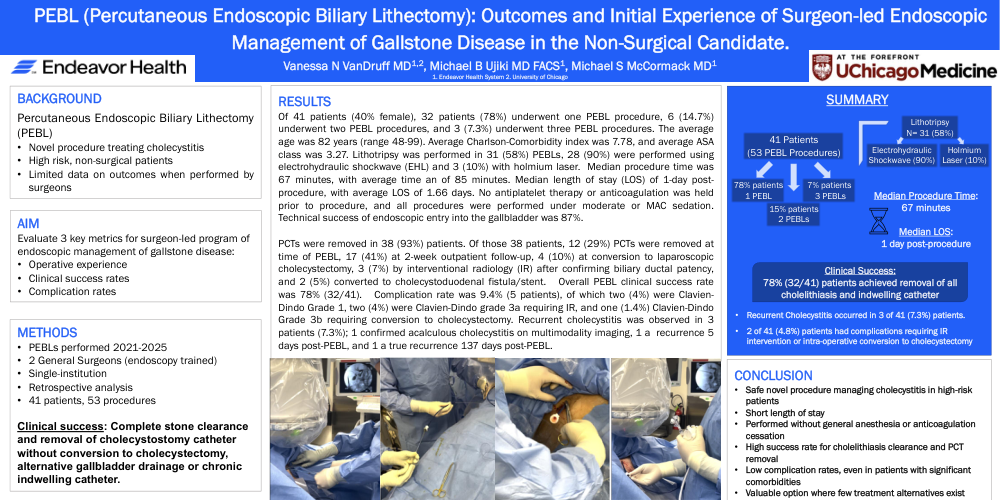
Percutaneous Endoscopic Biliary Lithectomy (PEBL) is a novel intervention for cholecystitis in high-risk, non-surgical candidates. However, there is limited data regarding outcomes of this technique among surgical endoscopists. We aimed to evaluate the operative experience, clinical success, and complication rates among a surgeon-led program for the endoscopic management of gallstone disease.
AIM
We aimed to evaluate the operative experience, clinical success, and complication rates among a surgeon-led program for the endoscopic management of gallstone disease.
METHODS
A single institution retrospective analysis was performed including 41 high-risk non-surgical candidates with cholecystitis who underwent PEBL procedures between 2021-2025 by two general surgeons trained in surgical endoscopy.
Clinical success was defined as cholelithiasis clearance and removal of percutaneous cholecystostomy tube (PCT) without conversion to cholecystectomy, endoscopic gallbladder drainage, or chronic indwelling PCT.
RESULTS
Of 41 patients (40% female), 32 patients (78%) underwent one PEBL procedure, 6 (14.7%) underwent two PEBL procedures, and 3 (7.3%) underwent three PEBL procedures. The average age was 82 years (range 48-99). Average Charlson-Comorbidity index was 7.78, and average ASA class was 3.27. Lithotripsy was performed in 31 (58%) PEBLs, 28 (90%) were performed using electrohydraulic shockwave (EHL) and 3 (10%) with holmium laser. Median procedure time was 67 minutes, with average time an of 85 minutes. Median length of stay (LOS) of 1-day post-procedure, with average LOS of 1.66 days. No antiplatelet therapy or anticoagulation was held prior to procedure, and all procedures were performed under moderate or MAC sedation. Technical success of endoscopic entry into the gallbladder was 87%.
PCTs were removed in 38 (93%) patients. Of those 38 patients, 12 (29%) PCTs were removed at time of PEBL, 17 (41%) at 2-week outpatient follow-up, 4 (10%) at conversion to laparoscopic cholecystectomy, 3 (7%) by interventional radiology (IR) after confirming biliary ductal patency, and 2 (5%) converted to cholecystoduodenal fistula/stent. Overall PEBL clinical success rate was 78% (32/41). Complication rate was 9.4% (5 patients), of which two (4%) were Clavien-Dindo Grade 1, two (4%) were Clavien-Dindo grade 3a requiring IR, and one (1.4%) Clavien-Dindo Grade 3b requiring conversion to cholecystectomy. Recurrent cholecystitis was observed in 3 patients (7.3%); 1 confirmed acalculous cholecystitis on multimodality imaging, 1 a recurrence 5 days post-PEBL, and 1 a true recurrence 137 days post-PEBL.
CONCLUSION
PEBL is a safe, novel approach to cholecystitis management in high-risk patients that can be performed without general anesthesia or cessation of anticoagulation with a short LOS. The high success rate of cholelithiasis clearance resulting in PCT removal, and low complication rates in patients with profound comorbidities renders this technique an invaluable intervention among few alternatives.