875 posters, 25 topics, 3,440 authors, 1,061 institutions
ePostersLive by SciGen Technologies S.A. All rights reserved.
SAGES 2026 Annual Meeting Emerging Technology Session
March 25-28, 2026 | Tampa, FL, USA

P353
Trends And Disparities in Sepsis-related Mortality in US Adults among Pancreatic Cancer Patients, 1999-2020
Part of Topic
Biliary
TRENDS AND DISPARITIES IN SEPSIS-RELATED MORTALITY IN US ADULTS AMONG PANCREATIC CANCER PATIENTS, 1999-2020
Muhammad Ibtisam1; Kinza Asghar1; Rafay Haseeb2; Farah Noor Kashif1; Syed Muneeb Ahmad1; Husnain Bashir1; Muhammad Muqarrab Hussain Shah1; Fiza Nazir1; Sadia Javed1; 1Nishtar Medical University, Multan, Punjab, Pakistan; 2UCLA Ronald Reagan Medical Center
Introduction: Pancreatic cancer and sepsis represent significant health burdens, often overlapping due to advanced disease, immune dysfunction, and treatment-related complications. Assessing their relationship is essential for recognising temporal patterns, identifying disparities, and guiding preventive strategies, ultimately informing health care planning and improving survival outcomes across diverse demographic and regional populations.
Methodology: We analyzed CDC WONDER data (1999-2020) for adults ≥25 with sepsis (A41.9) and pancreatic carcinoma (C25). We categorized age-adjusted mortality rates (AAMRs) per 100,000 by demographic and regional distribution. Joinpoint regression analysis was performed to calculate annual percent changes (APCs) stratified by year, sex, race/ethnicity, urbanization, and geographic region with 95% confidence intervals.
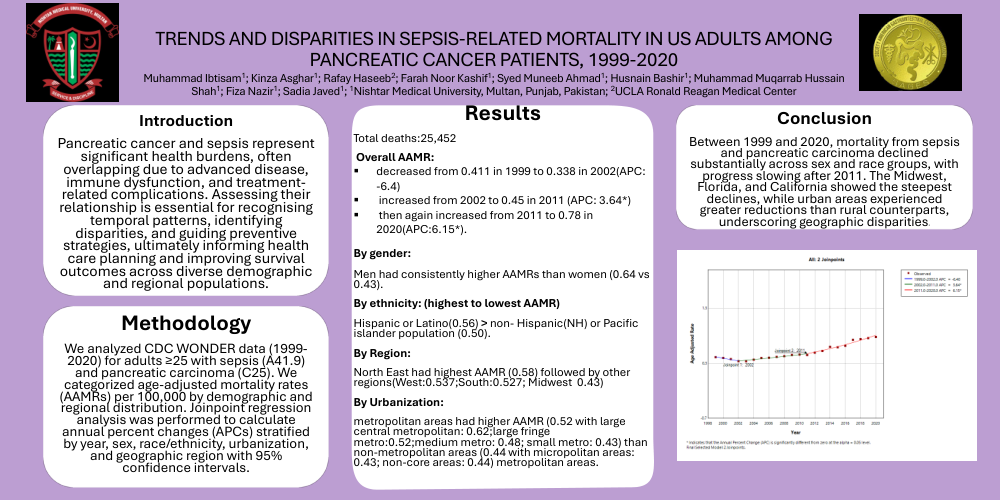
Results: Between 1999 and 2020, a total of 25,452 documented deaths were attributed to pancreatic cancer and sepsis. The AAMR for Pancreatic cancer and sepsis decreased in the US from 0.411 in 1999 to 0.338 in 2002(APC: -6.4; 95% CI: -13.04 to 0.75), after that it increased from 2002 to 0.45 in 2011 (APC: 3.64*; 95% CI: 2.10-5.21) and then again increased from 2011 to 0.78 in 2020(APC:6.15*;95%CI:5.19-7.12).Men had consistently higher AAMRs than women (0.64 vs 0.43). The AAMR in U.S. men increased from (0.49) in 1999 to (0.92) in 2020 and the AAMR in U.S women increased from (0.38) in 1999 to (0.61) in 2020. The Hispanic or Latino population has the greatest AAMR (0.56), followed by non- Hispanic(NH) or Pacific islander population (0.50). The low-risk population was Midwest with AAMR (0.43). North East had highest AAMR (0.58) followed by other regions(West:0.537;South:0.527) and metropolitan areas had higher AAMR (0.52 with large central metropolitan: 0.62;large fringe metro:0.52;medium metro: 0.48; small metro: 0.43) than non-metropolitan areas (0.44 with micropolitan areas: 0.43; non-core areas: 0.44) metropolitan areas.
Conclusion: Between 1999 and 2020, mortality from sepsis and pancreatic carcinoma declined substantially across sex and race groups, with progress slowing after 2011. The Midwest, Florida, and California showed the steepest declines, while urban areas experienced greater reductions than rural counterparts, underscoring geographic disparities.