875 posters, 25 topics, 3,440 authors, 1,061 institutions
ePostersLive by SciGen Technologies S.A. All rights reserved.
SAGES 2026 Annual Meeting Emerging Technology Session
March 25-28, 2026 | Tampa, FL, USA

P348
Benchmarking surgical videos of laparoscopic cholecystectomy in a multi-institutional cohort
Poster Presenter
Authors
Shangdi Wu, Lingli Wu, Pan Gao, He Cai, Yongbin Li, Yunqiang Cai, Xin Wang, Bing Peng
Affiliations
Part of Topic
Biliary
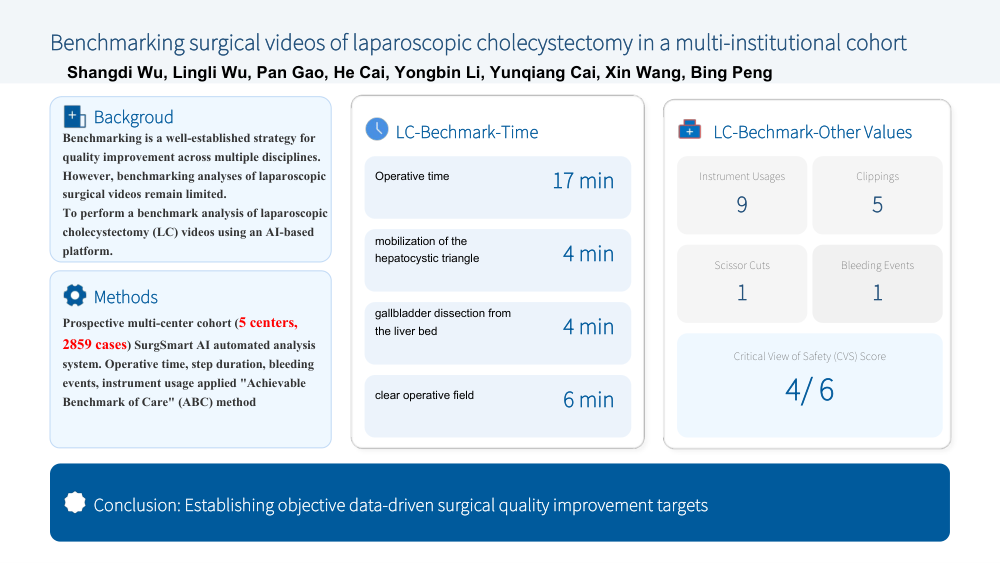
Background: Benchmarking is a well-established strategy for quality improvement across multiple disciplines. However, benchmarking analyses of laparoscopic surgical videos remain limited. This study aimed to apply a benchmarking approach to laparoscopic cholecystectomy (LC) videos using an artificial intelligence (AI)–based platform.
Methods: We prospectively established a multicenter dataset of LC videos. The SurgSmart AI platform was employed to analyze multidimensional parameters, including operative time, duration of critical surgical steps, frequency of intraoperative bleeding events, instrument usage, number of clippings, and scissor cutting events. The Achievable Benchmark of Care (ABC) methodology was applied to determine benchmark values.
Results: A total of 2,859 LC videos were analyzed from 5 centers. The ABC-derived benchmark for operative time was 17 minutes. Benchmarks for critical surgical steps were 4 minutes for mobilization of the hepatocystic triangle, 4 minutes for gallbladder dissection from the liver bed, and 6 minutes for achieving a clear operative field. Benchmark values also included a one intraoperative bleeding event, nine instrument usages, five clippings, and one scissor cutting event. Also, critical view of safety (CVS) score was 4 point (6 points full score) in benchmark.
Conclusion: This study is the first to propose benchmark values for LC procedures. These findings provide hepatopancreatobiliary surgeons with objective, data-driven targets to identify performance gaps, facilitate feedback, and promote continuous improvement in surgical quality.