875 posters, 25 topics, 3,440 authors, 1,061 institutions
ePostersLive by SciGen Technologies S.A. All rights reserved.
SAGES 2026 Annual Meeting Emerging Technology Session
March 25-28, 2026 | Tampa, FL, USA

P339
LITHIASIS IN ACCESSORY HEPATIC DUCT; A CASE REPORT AND A REVIEW OF THE LITERATURE
Poster Presenter
Part of Topic
Biliary
Introduction
• Identifying an accessory hepatic duct (AHD) is important to ensuring patient safety during laparoscopic cholecystectomy (LC).
• Magnetic resonance cholangiopancreatography (MRCP) is the preferred method for evaluating the biliary tract, but intraoperative cholangiography (IOC) is also employed to prevent complications.
• While lithiasis in the common hepatic duct is a described condition, reports of lithiasis in AHD and its management are limited.
Case Presentation
• A 18y old female presented with a 2 day history of epigastric colic-type pain radiated to the right hypochondrium with nausea.
• Laboratory tests revealed preserved liver function. US found normal intrahepatic bile ducts, a 7 mm common bile duct, and a gallbladder with a 4.2 mm thickened wall.
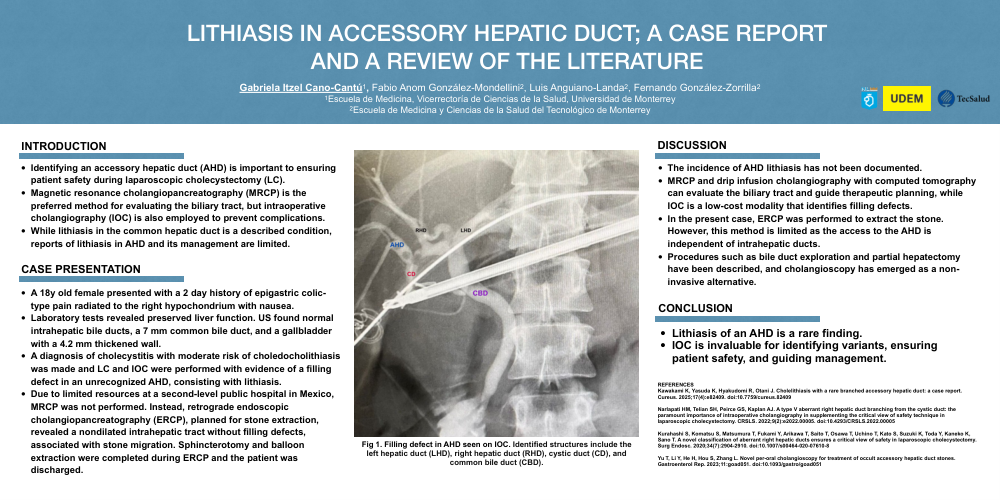
• A diagnosis of cholecystitis with moderate risk of choledocholithiasis was made and LC and IOC were performed with evidence of a filling defect in an unrecognized AHD, consisting with lithiasis.
• Due to limited resources at a second-level public hospital in Mexico, MRCP was not performed. Instead, retrograde endoscopic cholangiopancreatography (ERCP), planned for stone extraction, revealed a nondilated intrahepatic tract without filling defects, associated with stone migration. Sphincterotomy and balloon extraction were completed during ERCP and the patient was discharged.
Discussion
• The incidence of AHD lithiasis has not been documented.
• MRCP and drip infusion cholangiography with computed tomography can evaluate the biliary tract and guide therapeutic planning, while IOC is a low-cost modality that identifies filling defects.
• In the present case, ERCP was performed to extract the stone. However, this method is limited as the access to the AHD is independent of intrahepatic ducts.
• Procedures such as bile duct exploration and partial hepatectomy have been described, and cholangioscopy has emerged as a non-invasive alternative.
Conclusion
• Lithiasis of an AHD is a rare finding.
• IOC is invaluable for identifying variants, ensuring patient safety, and guiding management.