816 posters, 24 topics, 3,314 authors, 1,012 institutions
ePostersLive by SciGen Technologies S.A. All rights reserved.
SAGES 2026 Annual Meeting Emerging Technology Session
March 25-28, 2026 | Tampa, FL, USA

P314
ANEMIA AND 30-DAY OUTCOMES FOLLOWING ELECTIVE BARIATRIC SURGERY: AN ANALYSIS OF 640,985 MBSAQIP PATIENTS
Poster Presenter
Authors
Juan Aulestia, Valentin Mocanu, Melissa Wills, Anibal La Riva, Jerry Dang, Andrew Strong, Yung Lee, Juan Barajas Gamboa, Ricard Corcelles, Matthew Kroh, Salvador Navarrete
Affiliations
Cleveland Clinic, Digestive Disease & Surgery Institute, Department of General Surgery, Cleveland Clinic Abu Dhabi, Digestive Disease Institute, Cleveland Clinic Foundation, Digestive Disease & Surgery Institute, Department of General Surgery
Part of Topic
Bariatric
ANEMIA AND 30-DAY OUTCOMES FOLLOWING ELECTIVE BARIATRIC SURGERY: AN ANALYSIS OF 640,985 MBSAQIP PATIENTS
Juan Aulestia MD1, Valentin Mocanu MD, PhD1 , Melissa Wills MD1, Anibal La Riva MD1, Jerry Dang MD, PhD1, Andrew Strong MD1, Yung Lee, MD1, Juan S Barajas-Gamboa MD2, Ricard Corcelles MD1, Matthew Kroh MD1, Salvador Navarrete MD1
1Cleveland Clinic Foundation, Digestive Disease Institute, Department of General Surgery, Cleveland, OH, USA
2Cleveland Clinic Abu Dhabi, Digestive Disease Institute, Abu Dhabi, United Arab Emirates
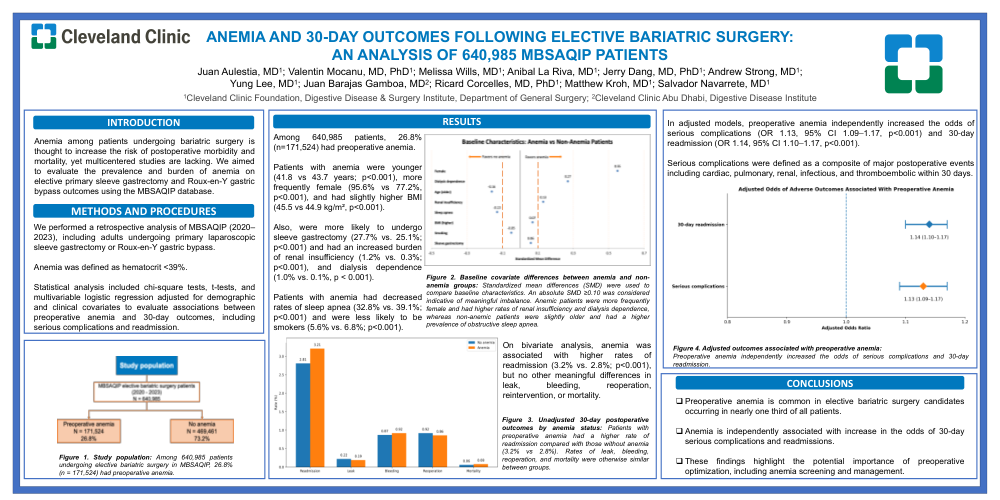
INTRODUCTION: Anemia among patients undergoing bariatric surgery is thought to increase the risk of postoperative morbidity and mortality, yet multicentered studies are lacking. We aimed to evaluate the prevalence and burden of anemia on elective primary sleeve gastrectomy and Roux-en-Y gastric bypass outcomes using the MBSAQIP database.
METHODS AND PROCEDURES: We performed a retrospective analysis of MBSAQIP (2020–2023), including adults undergoing primary laparoscopic sleeve gastrectomy or Roux-en-Y gastric bypass. Anemia was defined as hematocrit <39%. Statistical analysis included chi-square tests, t-tests, and multivariable logistic regression adjusted for demographic and clinical covariates to evaluate associations between preoperative anemia and 30-day outcomes, including serious complications and readmission.
RESULTS: Among 640,985 patients, 26.8% (n=171,524) had preoperative anemia. Patients with anemia were younger (41.8 vs 43.7 years; p<0.001), more frequently female (95.6% vs 77.2%, p<0.001), and had slightly higher BMI (45.5 vs 44.9 kg/m², p<0.001). Patients with anemia were more likely to undergo sleeve gastrectomy (27.7% vs. 25.1%; p<0.0001) and had an increased burden of renal insufficiency (1.2% vs. 0.3%; p<0.0001), and dialysis dependence (1.0% vs. 0.1%, p < 0.0001).
Overall, metabolic burden was similar between patients with anemia. Patients had decreased rates of sleep apnea (32.8% vs. 39.1%; p<0.0001) and were less likely to be smokers (5.6% vs. 6.8%; p<0.0001). On bivariate analysis, anemia was associated with higher rates of readmission (3.2% vs. 2.8%; p<0.0001), but no other meaningful differences in leak, bleeding, reoperation, reintervention or mortality.
In adjusted models, preoperative anemia independently increased the odds of serious complications (OR 1.13, 95% CI 1.09–1.17, p<0.001) and 30-day readmission (OR 1.14, 95% CI 1.10–1.17, p<0.001).
CONCLUSIONS: Preoperative anemia is common in elective bariatric surgery candidates occurring in nearly one third of all patients. Anemia is independently associated with a small but significant increase in the odds of 30-day serious complications and readmissions. These findings highlight the potential importance of preoperative optimization, including anemia screening and management.