816 posters, 24 topics, 3,314 authors, 1,012 institutions
ePostersLive by SciGen Technologies S.A. All rights reserved.
SAGES 2026 Annual Meeting Emerging Technology Session
March 25-28, 2026 | Tampa, FL, USA

P189
Critical View of Safety and Technical Considerations to Prevent Early Leak in SADI-S
Poster Presenter
Authors
Affiliations
Part of Topic
Bariatric
Introduction:
Single Anastomosis Duodeno-Ileostomy with Sleeve Gastrectomy (SADI-S) has gained interest by demonstrating superior weight loss and diabetes resolution compared to traditional sleeve gastrectomy and gastric bypass. However, its technical complexity, particularly in duodenal mobilization, has limited widespread adoption. A rare but severe complication in SADI-S is the development of early anastomotic leak.
Case Presentation:
A 47-year-old female patient with BMI 53, hypertension and type II diabetes underwent an uneventful primary robot assisted SADI-S.
Sleeve gastrectomy was performed with firings of blue load staplers oversewn with absorbable suture. Duodenum was divided with a blue load staple cartridge. A two layered loop duodenoileal anastomosis was made with absorbable barbed suture with a negative intra-operative leak test.
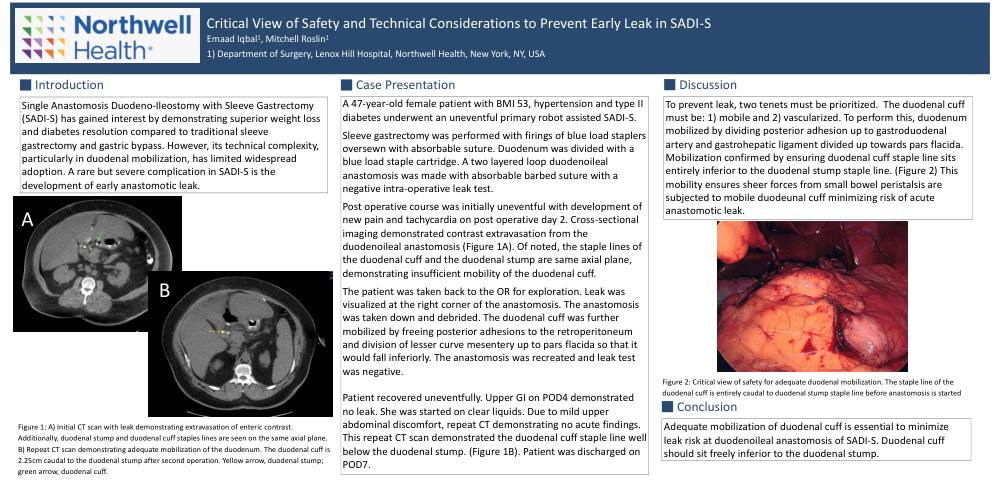
Post operative course was initially uneventful with development of new pain and tachycardia on post operative day 2. Cross-sectional imaging demonstrated contrast extravasation from the duodenoileal anastomosis (Figure 1A). Of noted, the staple lines of the duodenal cuff and the duodenal stump are same axial plane, demonstrating insufficient mobility of the duodenal cuff.
The patient was taken back to the OR for exploration. Leak was visualized at the right corner of the anastomosis. The anastomosis was taken down and debrided. The duodenal cuff was further mobilized by freeing posterior adhesions to the retroperitoneum and division of lesser curve mesentery up to pars flacida so that it would fall inferiorly. The anastomosis was recreated and leak test was negative.
Patient recovered uneventfully. Upper GI on POD4 demonstrated no leak. She was started on clear liquids. Due to mild upper abdominal discomfort, repeat CT demonstrating no acute findings. This repeat CT scan demonstrated the duodenal cuff staple line well below the duodenal stump. (Figure 1B). Patient was discharged on POD7.
Discussion
To prevent leak, two tenets must be prioritized. The duodenal cuff must be: 1) mobile and 2) vascularized. To perform this, duodenum mobilized by dividing posterior adhesion up to gastroduodenal artery and gastrohepatic ligament divided up towards pars flacida. Mobilization confirmed by ensuring duodenal cuff staple line sits entirely inferior to the duodenal stump staple line. (Figure 2) This mobility ensures sheer forces from small bowel peristalsis are subjected to mobile duodeunal cuff minimizing risk of acute anastomotic leak.
Conclusion
Adequate mobilization of duodenal cuff is essential to minimize leak risk at duodenoileal anastomosis of SADI-S. Duodenal cuff should sit freely inferior to the duodenal stump.