816 posters, 24 topics, 3,314 authors, 1,012 institutions
ePostersLive by SciGen Technologies S.A. All rights reserved.
SAGES 2026 Annual Meeting Emerging Technology Session
March 25-28, 2026 | Tampa, FL, USA

P293
Pharmacologic Obesity Management After Metabolic and Bariatric Surgery: Real-World Utilization Trends and Clinical Outcomes
Poster Presenter
Part of Topic
Bariatric
Pharmacologic Obesity Management After Metabolic and Bariatric Surgery: Real-World Utilization Trends and Clinical Outcomes
Nicole L. Petcka, Victoria Delgado, Isabella Amaniera, Katherine Fay, Jamil Stetler, Colin Johnson, Huda Hayyeh, Chelsea Yost, Abhineet Uppal, Elizabeth Hechenbleikner
INTRODUCTION
•The use of obesity management medications (OMM) has increased markedly
•Real-world integration of OMM following metabolic and bariatric surgery (MBS) remains poorly understood
Hypothesis: MBS patients taking glucagon-like-peptide-1 (GLP-1) receptor agonist medications will experience more weight loss compared to patients taking non-GLP-1 medications
METHODS
•Retrospective analysis of prospectively collected data from 11/2021 to 07/2025
•Patients who underwent a sleeve gastrectomy (SG) or Roux-en-Y gastric bypass (RYGB) and were subsequently started on OMM were included
•Patients were categorized into non-GLP-1 and GLP-1 groups and were followed longitudinally for total body weight loss (%TBWL)
•Data were compared using a mixed effects linear regression model (fixed intercept and random slope to account for individual variability)
RESULTS
•149 patients were included (120 after SG and 29 after RYGB)
•Suboptimal clinical response (n=56, 37.6%) and recurrent weight gain (n=36, 24.2%) were the most common reasons for starting OMM
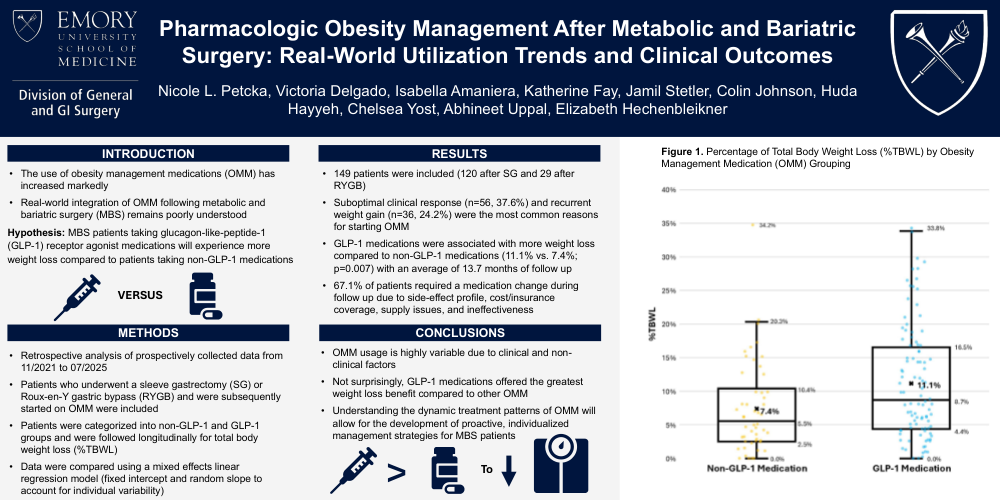
•GLP-1 medications were associated with more weight loss compared to non-GLP-1 medications (11.1% vs. 7.4%; p=0.007) with an average of 13.7 months of follow up
•67.1% of patients required a medication change during follow up due to side-effect profile, cost/insurance coverage, supply issues, and ineffectiveness
CONCLUSIONS
•OMM usage is highly variable due to clinical and non-clinical factors
•Not surprisingly, GLP-1 medications offered the greatest weight loss benefit compared to other OMM
•Understanding the dynamic treatment patterns of OMM will allow for the development of proactive, individualized management strategies for MBS patients