816 posters, 24 topics, 3,314 authors, 1,012 institutions
ePostersLive by SciGen Technologies S.A. All rights reserved.
SAGES 2026 Annual Meeting Emerging Technology Session
March 25-28, 2026 | Tampa, FL, USA

P291
Safety and feasibility of conversion of Roux-en-Y gastric bypass to BPD/DS versus SADI: An Analysis of MBSAQIP database.
Poster Presenter
Part of Topic
Bariatric
Abstract
Background: Recurrent weight gain (RWG) after Roux-en-Y gastric bypass (RYGB) is an increasingly common challenge.
Biliopancreatic diversion with duodenal switch (BPD/DS) and single anastomosis duodeno-ileal bypass with sleeve gastrectomy
(SADI-S) are surgical options available for achieving optimal clinical response in these patients.
Objectives This study aimed to compare the characteristics and outcomes of patients who underwent either BPD/DS or
SADI-S following RYGB.
Methods: An analysis of the Metabolic and Bariatric Surgery Accreditation and Quality Improvement Program (MBSAQIP)
database was conducted, focusing on patients from 2020 to 2022 who underwent BPD/DS or SADI-S following a primary
RYGB. Postoperative bariatric outcomes, complication rates, and weight loss metrics—including percentage of excess weight
loss (%EWL), total weight loss (%TWL), and excess BMI loss (%EBMIL) at 30 days—were evaluated. A stratified analysis
was also performed to assess differences between the procedures.
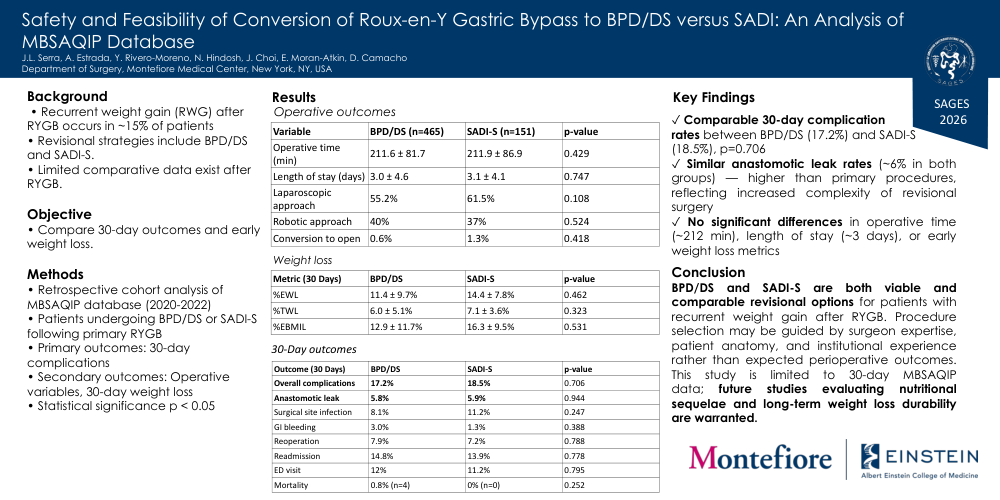
Results: A total of 616 patients were included. 75.5% (n = 465) underwent BPD/DS and 24.5% (n = 151) SADI after RYGB.
The majority of patients were female (90.7%, n = 559), with a mean age of 48.2 ± 9.1 years. The mean preoperative body
mass index (BMI) was 47.5 ± 8.3 for patients undergoing BPD/DS and 44.5 ± 6.8 for those undergoing SADI (p < 0.001).
Patients who underwent BPD/DS had a higher prevalence of hypertension (47% vs. 33.7%, p = 0.004) and ASA IV classification
(12.2% vs. 1.3%, p < 0.001), but a lower rate of drain placement compared to those who underwent SADI (31.8% vs.
45%, p = 0.003). There was no statistically significant difference in terms of length of stay, operative time, or intraoperative/
postoperative complications in the first 30 days. Weight loss outcomes at 30 days were comparable between the BPD/DS
and SADI approaches.
Conclusions: Among patients undergoing conversion after RYGB, BPD/DS and SADI demonstrated comparable short-term
bariatric outcomes, with similar 30-day postoperative complication rates.
Keywords: Bariatric surgery · Roux-en-Y gastric bypass · Biliopancreatic diversion with duodenal switch · Single
anastomosis duodeno-ileal bypass · MBSAQIP