816 posters, 24 topics, 3,314 authors, 1,012 institutions
ePostersLive by SciGen Technologies S.A. All rights reserved.
SAGES 2026 Annual Meeting Emerging Technology Session
March 25-28, 2026 | Tampa, FL, USA

P269
Robotic vs Laparoscopic Sleeve Gastrectomy in Adolescents and Younger Adults: A National Analysis of Complications and Utilization Trends (2015-2023)
Poster Presenter
Part of Topic
Bariatric
BACKGROUND
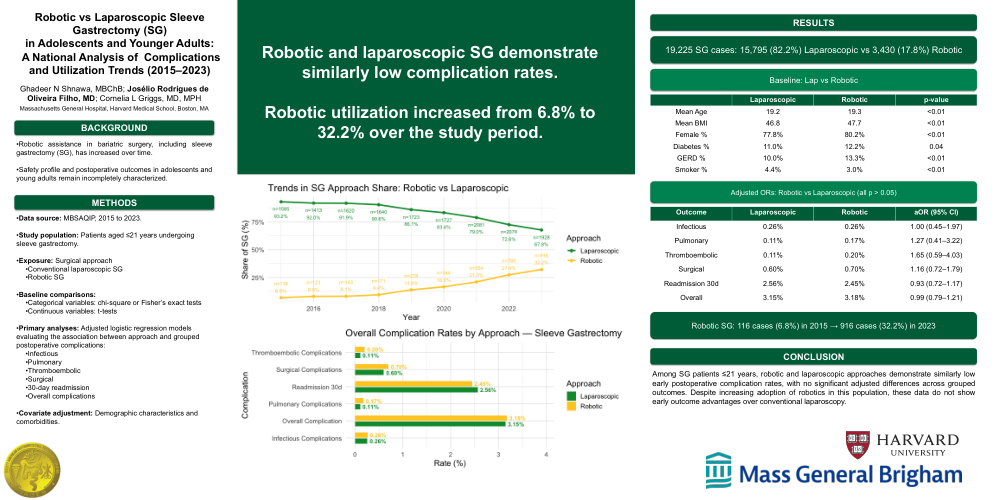
Robotic assistance in bariatric surgery, including sleeve gastrectomy (SG), has increased over time. Safety profile and postoperative outcomes in adolescents and young adults remain incompletely characterized.
METHODS
Data source: MBSAQIP, 2015 to 2023. Study population: Patients aged ≤ 21 years undergoing sleeve gastrectomy. Exposure: Surgical approach -- Conventional laparoscopic SG and Robotic SG. Baseline comparisons: Categorical variables (chi-square or Fisher's exact tests), Continuous variables (t-tests). Primary analyses: Adjusted logistic regression models evaluating the association between approach and grouped postoperative complications (Infectious, Pulmonary, Thromboembolic, Surgical, 30-day readmission, Overall complications). Covariate adjustment: Demographic characteristics and comorbidities.
RESULTS
19,225 SG cases: 15,795 (82.2%) Laparoscopic vs 3,430 (17.8%) Robotic. Robotic and laparoscopic SG demonstrate similarly low complication rates. Robotic utilization increased from 6.8% to 32.2% over the study period. Baseline: Mean Age 19.2 vs 19.3 (p<0.01), Mean BMI 46.8 vs 47.7 (p<0.01), Female 77.8% vs 80.2% (p<0.01), Diabetes 11.0% vs 12.2% (p=0.04), GERD 10.0% vs 13.3% (p<0.01), Smoker 4.4% vs 3.0% (p<0.01). Adjusted ORs (Robotic vs Laparoscopic, all p>0.05): Infectious 1.00 (0.45–1.97), Pulmonary 1.27 (0.41–3.22), Thromboembolic 1.65 (0.59–4.03), Surgical 1.16 (0.72–1.79), Readmission 30d 0.93 (0.72–1.17), Overall 0.99 (0.79–1.21). Robotic SG: 116 cases (6.8%) in 2015 to 916 cases (32.2%) in 2023.
CONCLUSION
Among SG patients ≤ 21 years, robotic and laparoscopic approaches demonstrate similarly low early postoperative complication rates, with no significant adjusted differences across grouped outcomes. Despite increasing adoption of robotics in this population, these data do not show early outcome advantages over conventional laparoscopy.