816 posters, 24 topics, 3,314 authors, 1,012 institutions
ePostersLive by SciGen Technologies S.A. All rights reserved.
SAGES 2026 Annual Meeting Emerging Technology Session
March 25-28, 2026 | Tampa, FL, USA

P247
Complications in Bariatric Surgery: A12-year Retrospective, Observational Study by a Single Surgeon
Poster Presenter
Part of Topic
Bariatric
Complications in Bariatric Surgery: a 12-year Retrospective, Observational Study by a Single Surgeon
Narita Yimcharoen Bmedsci, M.D., Natchanon Kitcharoen Bmedsci, M.D., Setthasiri Pantanakul M.D.,Panot Yimcharoen M.D.
Department of Surgery, Bhumibol Adulyadej Hospital, RTAF
ABSTRACT
Background Over the past decade, weight loss surgery has drastically increased in popularity globally, despite a temporary decline during COVID-19 pandemic. As these surgeries became more accessible in Thailand, reports of complications began to emerge. Although uncommon, such complications can substantially increase in morbidity and mortality.
Methods We conducted a retrospective observational study of bariatric surgery patients (LSG with/without PJB, and RYGB) from August 2013 to August 2025 at Bhumibol Adulyadej Hospital, RTAF, Thailand, all performed by a single surgeon. Data collected included demographics (age,sex, BMI), metabolic comorbidities (diabetes mellitus, hyperlipidemia,hypertension), OSA, hospital stay, and 30-day readmission. Complications were classified as early (≤ 30 days: leakage, hemorrhage, cardiorespiratory, thromboembolic, wound, abscess, death) or late (> 30 days: fistula, marginal ulcer, stricture, internal hernia, death). All patients underwent upper GI study before discharge to exclude anastomotic leakage.
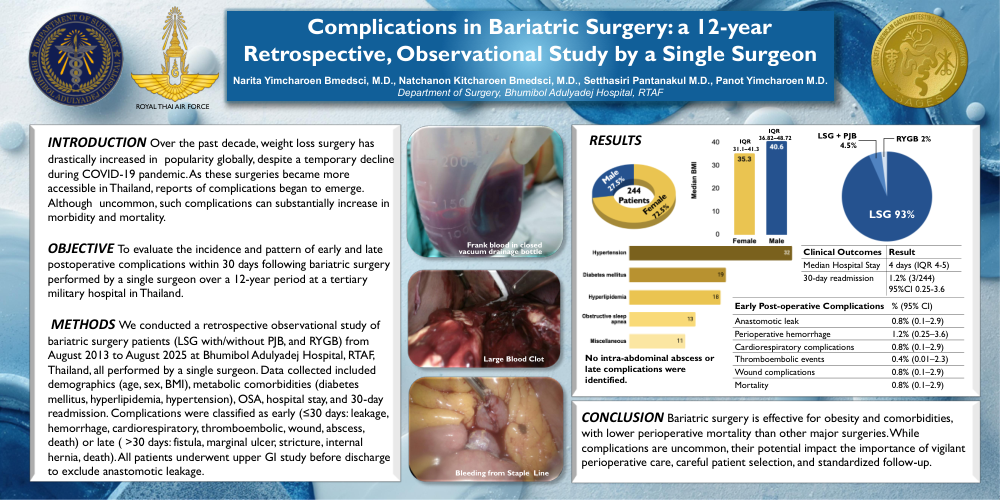
Results Two hundred forty-four patients received bariatric surgery from August 2013 to August 2025. Of these patients, 27%(n=67) were male and 72%(n=177) were female, with a median age of 36 years (IQR 29-43) and median BMI of 37 kg/m2 (IQR 32-43). Their underlying medical conditions were collected: diabetes mellitus (7.7% n= 19); Hyperlipidemia (7.3% n= 18); hypertension (13.1% n= 32); obstructive sleep apnea (5.3% n=13); Miscellaneous (4.5% n=11). Most of the patients (93% n= 228) underwent LSG, while 4.5% ( n=11) underwent LSG with PJB and 2% (n=5) underwent RYBG. The median hospital stay was 4 days (IQR =4-5) . The 30-day readmission occurred in 3 of 244 patients (1.2%; 95% CI 0.25-3.6%).Early complications included early anastomosis leakage (0.8%; 95% CI, 0.1–2.9), perioperative hemorrhage (1.2%; 95% CI, 0.25–3.6), cardiorespiratory complications(0.8%; 95% CI, 0.1–2.9), thromboembolic events (0.4%; 95% CI, 0.01–2.3)
, wound complications (0.8%; 95% CI, 0.1–2.9) and death(0.8%; 95% CI, 0.1–2.9). No intra-abdominal abscess, or late complications were identified.
Conclusion Bariatric surgery is effective for obesity and comorbidities, with lower perioperative mortality than other major surgeries. While complications are uncommon, their potential impact the importance of vigilant perioperative care, careful patient selection, and standardized follow-up.