816 posters, 24 topics, 3,314 authors, 1,012 institutions
ePostersLive by SciGen Technologies S.A. All rights reserved.
SAGES 2026 Annual Meeting Emerging Technology Session
March 25-28, 2026 | Tampa, FL, USA

P239
Short-term safety and efficacy of robot-assisted metabolic and bariatric surgery in adolescents: an analysis of the MBSAQIP database
Poster Presenter
Authors
Karanbir Brar, Ranjan Sudan, Keri A Seymour, Shaina R Eckhouse, Jacob A Greenberg, James J Jung
Affiliations
Part of Topic
Bariatric
Short-term safety and efficacy of robot-assisted metabolic and bariatric surgery in adolescents: an analysis of the MBSAQIP database
●The usage of robotic systems in metabolic and bariatric surgery (MBS) is increasing rapidly
●Despite the recent rapid increase in MBS in adolescent patients, analyses of outcomes of robot-assisted MBS in the adolescent population are lacking
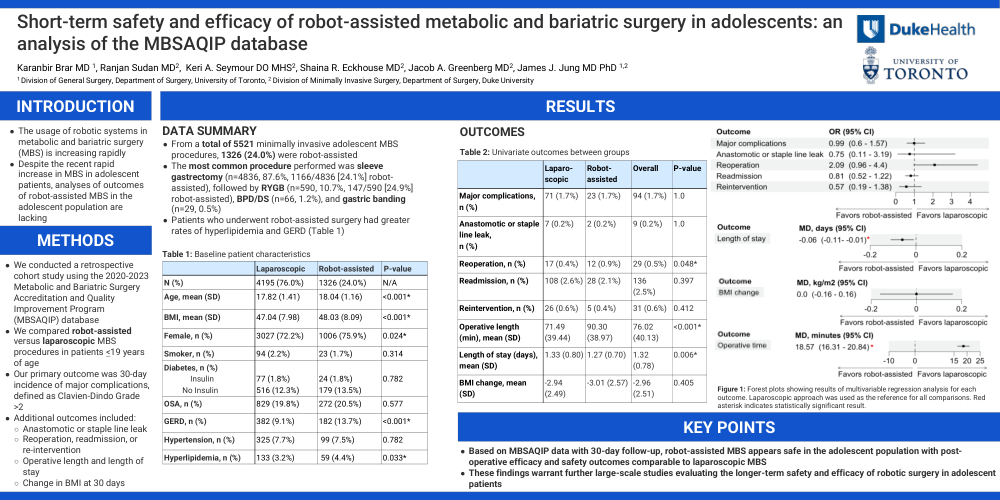
●We conducted a retrospective cohort study using the 2020-2023 Metabolic and Bariatric Surgery Accreditation and Quality Improvement Program (MBSAQIP) database
●We compared robot-assisted versus laparoscopic MBS procedures inpatients <19 years of age
●Our primary outcome was 30-day incidence of major complications, defined as Clavien-Dindo Grade >2
●Additional outcomes included:
○Anastomotic or staple line leak
○Reoperation, readmission, or re-intervention
○Operative length and length of stay
○Change in BMI at 30 days
DATA SUMMARY
●From a total of 5521 minimally invasive adolescent MBS procedures, 1326 (24.0%) were robot-assisted
●The most common procedure performed was sleeve gastrectomy (n=4836, 87.6%, 1166/4836 [24.1%] robot-assisted), followed by RYGB(n=590, 10.7%, 147/590 [24.9%] robot-assisted), BPD/DS (n=66, 1.2%), and gastric banding (n=29, 0.5%)
●Patients who underwent robot-assisted surgery had greater rates of hyperlipidemia and GERD (Table 1)
●Based on MBSAQIP data with 30-day follow-up, robot-assisted MBS appears safe in the adolescent population with post-operative efficacy and safety outcomes comparable to laparoscopic MBS
●These findings warrant further large-scale studies evaluating the longer-term safety and efficacy of robotic surgery in adolescent patients
●