816 posters, 24 topics, 3,314 authors, 1,012 institutions
ePostersLive by SciGen Technologies S.A. All rights reserved.
SAGES 2026 Annual Meeting Emerging Technology Session
March 25-28, 2026 | Tampa, FL, USA

P237
Surgical Management and Outcomes of Gastroesophageal Reflux Disease after Sleeve Gastrectomy: a Systematic Review and Meta-Analysis
Poster Presenter
Authors
Ruben D. Salas-Parra, Raquel Nogueira, Mariana Torves, Katerina Jou, Camila Oliveira, Diego Laurentino Lima, Joel Frieder, Erin Moran-Atkin, Diego R Camacho
Affiliations
Montefiore Medical Center, Northwell Health, New Hyde Park, USA, Vale do Rio dos Sinos University, Cristo Rei, São Leopoldo, Rio Grande do Sul, Brazil
Part of Topic
Bariatric
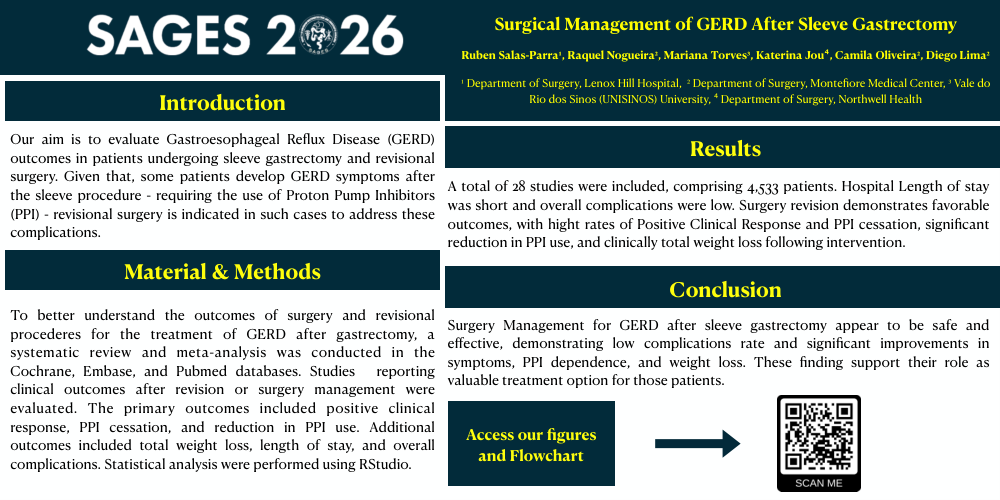
Surgical Management of GERD After Sleeve Gastrectomy
Ruben Salas-Parra¹, Raquel Nogueira², Mariana Torves³, Katerina Jou⁴, Camila Oliveira², Diego Lima²
¹ Department of Surgery, Lenox Hill Hospital, ² Department of Surgery, Montefiore Medical Center, ³ Vale do Rio dos Sinos (UNISINOS) University, ⁴ Department of Surgery, Northwell Health
Introduction: Our aim is to evaluate Gastroesophageal Reflux Disease (GERD) outcomes in patients undergoing sleeve gastrectomy and revisional surgery. Given that, some patients develop GERD symptoms after the sleeve procedure - requiring the use of Proton Pump Inhibitors (PPI) - revisional surgery is indicated in such cases to address these complications.
Material & Methods: To better understand the outcomes of surgery and revisional procederes for the treatment of GERD after gastrectomy, a systematic review and meta-analysis was conducted in the Cochrane, Embase, and Pubmed databases. Studies reporting clinical outcomes after revision or surgery management were evaluated. The primary outcomes included positive clinical response, PPI cessation, and reduction in PPI use. Additional outcomes included total weight loss, length of stay, and overall complications. Statistical analysis were performed using RStudio.
Results: A total of 28 studies were included, comprising 4,533 patients. Hospital Length of stay was short and overall complications were low. Surgery revision demonstrates favorable outcomes, with hight rates of Positive Clinical Response and PPI cessation, significant reduction in PPI use, and clinically total weight loss following intervention.
Conclusion: Surgery Management for GERD after sleeve gastrectomy appear to be safe and effective, demonstrating low complications rate and significant improvements in symptoms, PPI dependence, and weight loss. These finding support their role as valuable treatment option for those patients.
Access our figures and Flowchart: https://pdfs-of-qr-codes.s3.amazonaws.com/DE40Xm.pdf