816 posters, 24 topics, 3,314 authors, 1,012 institutions
ePostersLive by SciGen Technologies S.A. All rights reserved.
SAGES 2026 Annual Meeting Emerging Technology Session
March 25-28, 2026 | Tampa, FL, USA

P229
Bariatric Surgery Reduces All-cause Mortality in the Obese Population: A Meta-Analysis of Long-Term Morbidity and Mortality Outcomes
Poster Presenter
Authors
Affiliations
Part of Topic
Bariatric
Introduction
Bariatric surgery has been associated with improved survival among patients with obesity; however, long-term mortality data stratified by procedure type, diabetes status, and severity of obesity (BMI >50 kg/m²) remain incompletely characterized. We performed a timepoint-specific meta-analysis to evaluate mortality following Roux-en-Y gastric bypass (RYGB) and sleeve gastrectomy compared with non-operative management, and to assess effect modification by type 2 diabetes (T2D) and BMI >50.
Methods
A systematic review and meta-analysis were conducted in accordance with PRISMA guidelines and prospectively registered in PROSPERO. Randomized and observational studies published between 2000 and 2025 reporting survival outcomes after RYGB or sleeve gastrectomy with comparator control groups were included. Timepoint-specific mortality proportions were pooled using random-effects models with restricted maximum likelihood estimation after logit transformation. Mixed-effects meta-regression models were constructed at each follow-up interval to evaluate differences by treatment arm and to test interaction effects for diabetes status and BMI category.
Results
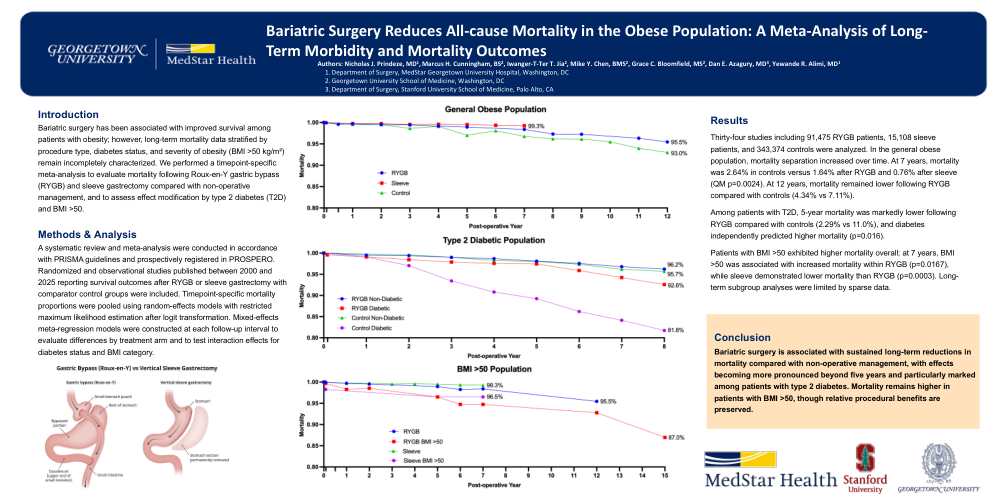
Thirty-four studies including 91,475 RYGB patients, 15,108 sleeve patients, and 343,374 controls were analyzed. In the general obese population, mortality separation increased over time. At 7 years, mortality was 2.64% in controls versus 1.64% after RYGB and 0.76% after sleeve (QM p=0.0024). At 12 years, mortality remained lower following RYGB compared with controls (4.34% vs 7.11%).
Among patients with T2D, 5-year mortality was markedly lower following RYGB compared with controls (2.29% vs 11.0%), and diabetes independently predicted higher mortality (p=0.016).
Patients with BMI >50 exhibited higher mortality overall; at 7 years, BMI >50 was associated with increased mortality within RYGB (p=0.0167), while sleeve demonstrated lower mortality than RYGB (p=0.0003). Long-term subgroup analyses were limited by sparse data.
Conclusion
Bariatric surgery is associated with sustained long-term reductions in mortality compared with non-operative management, with effects becoming more pronounced beyond five years and particularly marked among patients with type 2 diabetes. Mortality remains higher in patients with BMI >50, though relative procedural benefits are preserved.