816 posters, 24 topics, 3,314 authors, 1,012 institutions
ePostersLive by SciGen Technologies S.A. All rights reserved.
SAGES 2026 Annual Meeting Emerging Technology Session
March 25-28, 2026 | Tampa, FL, USA

P224
DOES ZYNRELEF DECREASE POST-OPERATIVE NARCOTIC USE AFTER BARIATRIC SURGERY?
Poster Presenter
Authors
Shelley Gabel, Alec Fitzsimmons, Eric Jagim, Barb Miller, Katelyn Mellion, Joshua Pfeiffer, Brandon Grover
Affiliations
Part of Topic
Bariatric
INTRODUCTION: The use of opioids after surgery has contributed to a significant health crisis. Reduction of opioid use after bariatric surgery is a key component in optimizing patient care. Zynrelef, ‘a proprietary mixture of bupivacaine and meloxicam in biochronomer time-controlled release solution’ provides localized analgesia beginning 6 hours postoperatively, with effects lasting up to 72 hours. In efforts to decrease narcotic use, CMS reimburses this medication at a higher rate than cost. This study evaluates the impact of intraoperative administration of Zynrelef on post-operative narcotic consumption in bariatric surgery patients.
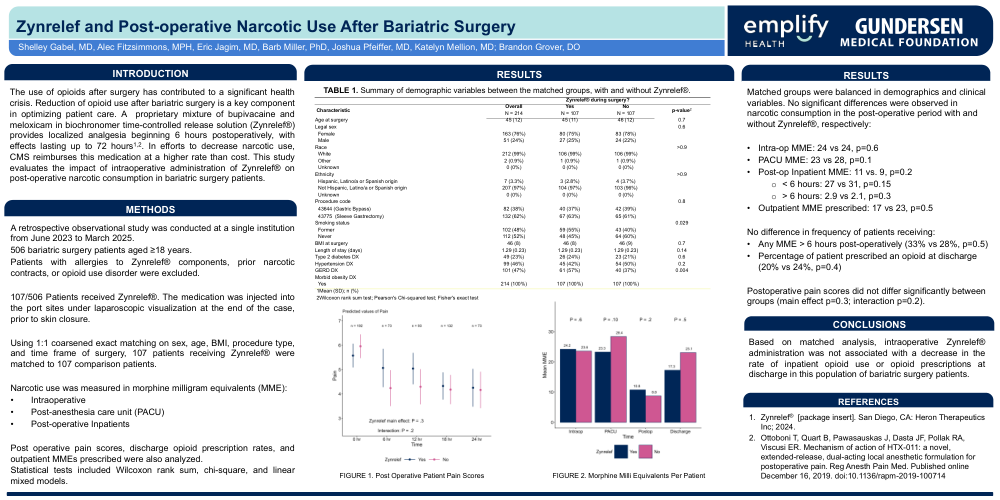
METHODS AND PROCEDURES: A retrospective observational study was conducted at a single institution from June 2023 to March 2025, including 506 bariatric surgery patients aged ≥18 years, of whom 107 received Zynrelef. The medication was injected into the port sites under laparoscopic visualization at the end of the case, prior to skin closure. Patients with allergies to Zynrelef components, prior narcotic contracts, or opioid use disorder were excluded. Using 1:1 coarsened exact matching on sex, age, BMI, procedure type, and time frame of surgery, 107 patients receiving Zynrelef were matched to 107 comparison patients. Narcotic use was measured in morphine milligram equivalents (MME) during intraoperative, post-anesthesia care unit (PACU), and postoperative periods. Discharge opioid prescription rates and postoperative pain scores (0, 6, 12, 24 hours) were analyzed. Statistical tests included Wilcoxon rank sum, chi-square, and linear mixed models.
RESULTS:
Matched groups were balanced in demographics and clinical variables. No significant differences were observed in narcotic consumption in the post-operative period with and without Zynrelef®, respectively:(intra-op MME: 24 ± 18 vs. 24± 20, p=0.6; PACU MME: 23 ± 16 vs. 28 ± 20, p=0.1; post-op MME: 11 ±13 vs. 9 ± 12, p=0.2).
We found no difference in hospital opioid consumption, frequency of patients receiving a prescription at discharge (20% vs 24%, p=0.4) or outpatient MME prescribed (mean 17 ± 43 vs. 23 ± 71 , p=0.5). Postoperative pain scores also did not differ significantly between groups (main effect p=0.3; interaction p=0.11).
CONCLUSION(S):Based on matched analysis, intraoperative Zynrelef® administration was not associated with a decrease in the rate of inpatient opioid use or opioid prescriptions at discharge in this population of bariatric surgery patients.