816 posters, 24 topics, 3,314 authors, 1,012 institutions
ePostersLive by SciGen Technologies S.A. All rights reserved.
SAGES 2026 Annual Meeting Emerging Technology Session
March 25-28, 2026 | Tampa, FL, USA

P220
Indocyanine Green Versus Conventional Assessment for Leak Prevention in Bariatric Surgery: A Systematic Review and Meta-Analysis
Poster Presenter
Part of Topic
Bariatric
INTRODUCTION
Staple-line or anastomotic leaks after bariatric
surgery are uncommon but severe postoperative
complications leading to sepsis, prolonged
hospitalization, reoperation, and mortality
- Indocyanine green (ICG) fluorescence imaging
offers real-time assessment of tissue perfusion and
has been proposed to detect leaks compared to
conventional assessment
- High-quality comparative evidence on the
effectiveness of ICG versus conventional methods is
lacking
- This study aims to systematically review and meta-
analyze comparative cohorts to evaluate ICG versus
conventional assessment for leak prevention in
bariatric surgery
METHODS
Conducted a PRISMA-compliant
systematic review and meta-analysis of
comparative cohorts published after 2019
- Included adult patients undergoing
bariatric surgery comparing ICG versus
conventional assessment for leak prevention
- Primary endpoint was 30-day leak rate;
secondary endpoints included reoperation,
bleeding, operative time, length of stay, and
mortality
- Risk of bias assessed using ROBINS-I tool
- Certainty of evidence evaluated with
GRADE methodology
RESULTS
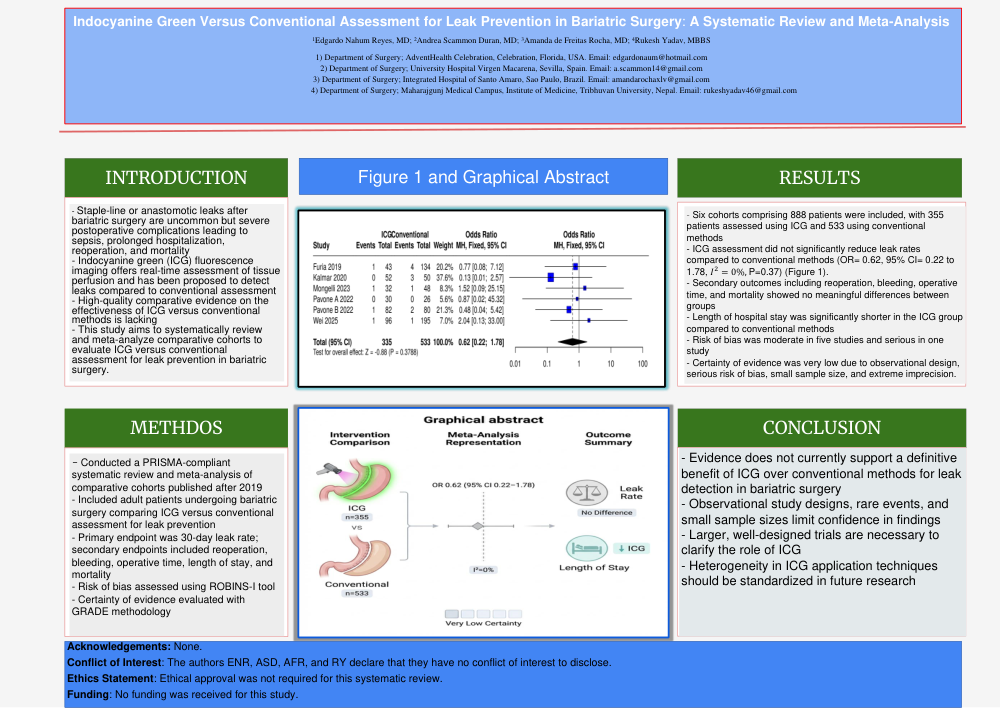
Six cohorts comprising 888 patients were included, with 355
patients assessed using ICG and 533 using conventional
methods
- ICG assessment did not significantly reduce leak rates
compared to conventional methods (OR= 0.62, 95% CI= 0.22 to
1.78, I2=0%, P=0.37)
- Secondary outcomes including reoperation, bleeding, operative
time, and mortality showed no meaningful differences between
groups
- Length of hospital stay was significantly shorter in the ICG group
compared to conventional methods
- Risk of bias was moderate in five studies and serious in one
study
- Certainty of evidence was very low due to observational design,
serious risk of bias, small sample size, and extreme imprecision.
CONCLUSIONS
Evidence does not currently support a definitive
benefit of ICG over conventional methods for leak
detection in bariatric surgery
- Observational study designs, rare events, and small
sample sizes limit confidence in findings
- Larger, well-designed trials are necessary to clarify
the role of ICG
- Heterogeneity in ICG application techniques should
be standardized in future research.