816 posters, 24 topics, 3,314 authors, 1,012 institutions
ePostersLive by SciGen Technologies S.A. All rights reserved.
SAGES 2026 Annual Meeting Emerging Technology Session
March 25-28, 2026 | Tampa, FL, USA

P217
Metabolic and Bariatric Surgery Needs Assessment: How do Patient Variables and Patient Experience Influence Outcomes?
Poster Presenter
Part of Topic
Bariatric
Introduction:
Metabolic and Bariatric Surgery (MBS) is the most effective treatment for severe obesity but requires extensive patient education and lifelong engagement. Although many patients achieve durable weight loss, some experience weight recurrence or adverse effects. This retrospective cohort study aimed to evaluate how patient experience and social determinants influence MBS outcomes.
Methods:
After Institutional Review Board approval, an anonymous electronic survey was distributed to patients who underwent Sleeve Gastrectomy or Roux-en-Y Gastric Bypass at a single academic institution between 2018–2024. Survey domains included preoperative access to care, inpatient experience, and postoperative recovery. Survey responses were linked to patient demographics, comorbidities, procedure type, percent total body weight loss (%TBWL), and 30-day complications. Spanish-language surveys and telephone completion options were available.
Results:
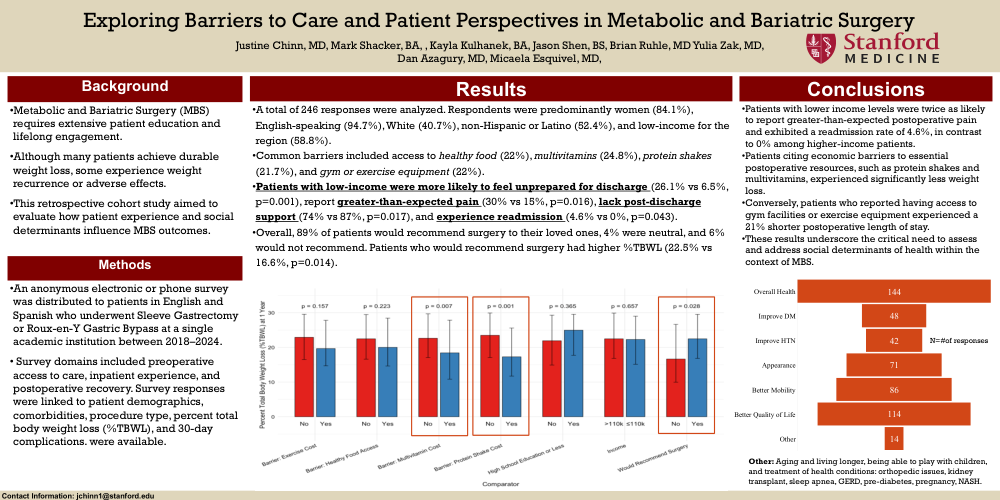
A total of 246 responses were analyzed. Respondents were predominantly women (84.1%), English-speaking (94.7%), White (40.7%), non-Hispanic or Latino (52.4%), and low-income for the region (58.8%). Common barriers included access to healthy food (22%), multivitamins (24.8%), protein shakes (21.7%), and gym or exercise equipment (22%). Patients with low-income were more likely to feel unprepared for discharge (26.1% vs 6.5%, p=0.001), report greater-than-expected pain (30% vs 15%, p=0.016), lack post-discharge support (74% vs 87%, p=0.017), and experience readmission (4.6% vs 0%, p=0.043). Overall, 89% of patients would recommend surgery to their loved ones, 4% were neutral, and 6% would not recommend. Patients who would recommend surgery had higher %TBWL (22.5% vs 16.6%, p=0.014). Barriers to affording protein shakes or multivitamins were associated with lower 12-month %TBWL (17.3% vs 23.5%, p=0.001 and 18.4% vs 22.6%, p=0.007), while limited access to exercise equipment was associated with longer length of stay (1.9 vs 1.5 days, p=0.009).
Conclusion:
This study demonstrates that social determinants of health significantly influence patient experience and postoperative outcomes after MBS, underscoring the importance of identifying and addressing these barriers to improve recovery and weight loss outcomes.