816 posters, 24 topics, 3,314 authors, 1,012 institutions
ePostersLive by SciGen Technologies S.A. All rights reserved.
SAGES 2026 Annual Meeting Emerging Technology Session
March 25-28, 2026 | Tampa, FL, USA

P195
COMPARISON OF VERTICAL SLEEVE GASTRECTOMY VS. ROUX-EN-Y GASTRIC BYPASS SURGERY FOR FACILITATING EXCESS WEIGHT LOSS IN PATIENTS WITH MONOGENIC OBESITY
Poster Presenter
Authors
Emma Clary, John Hermansen, Jason Obermark, Stacey Kubovec, Zhamak Khorgami, Jesse Richards, Geoffrey Chow
Affiliations
University of Oklahoma School of Community Medicine, Tulsa, OK, USA, Oklahoma State University, Stillwater, OK, USA, Department of Surgery, University of Oklahoma School of Community Medicine, Tulsa, OK, USA, Department of Internal Medicine, University of Oklahoma School of Community Medicine, Tulsa, Oklahoma, USA
Part of Topic
Bariatric
Introduction
The increasing prevalence of obesity over recent decades necessitates further evaluation of the complex pathogenesis of obesity and potential treatments. Genetic factors play a major yet insufficiently understood role in obesity and may complicate weight loss for patients with pathogenic gene variants. Monogenic obesity is an umbrella term for mutations in a single gene which leads to obesity, hyperphagia, and early onset of obesity. Bariatric surgery is recognized as the gold standard for treating obesity refractory to lifestyle interventions and anti-obesity medication treatment. However, there is insufficient knowledge about the effectiveness of bariatric surgery in patients with monogenic obesity, especially at a higher body mass index (BMI).
This study aims to address the lack of knowledge on how patients with genetic obesity respond to bariatric surgery. We examine total weight loss (TWL) and percent excess weight loss (%EWL) at one-year post surgery in patients with monogenic obesity who underwent primary Roux-en-Y (RNY) or primary vertical sleeve gastrectomy (VSG). Additionally, a secondary goal of the study was to examine whether VSG or RNY is more suitable for weight loss in patients with monogenic obesity at more extreme BMI since BMI > 50 kg/m² is associated with greater post-op weight gain and surgery failure. To examine the potential effects of BMI on TWL and %EWL in patients with monogenic obesity, we stratify results by BMI ≤ 50 and BMI > 50.
Methods
Retrospective chart review was performed for patients who received primary bariatric surgery from March 2019 – August 2024 at a single bariatric surgery center. Patients were included based on clinical suspicion for monogenic variants or genetic positivity. Patients received multidisciplinary bariatric treatment including anti-obesity medications, dietary interventions, and bariatric surgery. Inclusion criteria was based on whether a patient received primary RNY or VSG. Revisional surgeries and single anastomosis duodeno-ileal switch were excluded due to small sample size. One-year postoperative data was included if available within one month of the one-year post operative date.
The 146 patients included in the study were further stratified based on their starting BMI obtained at their new patient visit. Patients were grouped into starting BMI ≤ 50 kg/m² or starting BMI < 50 kg/m². An independent samples T-test was performed to assess statistical significance in TWL and %EWL between RNY and VSG within the BMI ≤ 50 and BMI > 50 groups. Statistical differences are reported using p-values with significance determined as p < 0.05.
Results
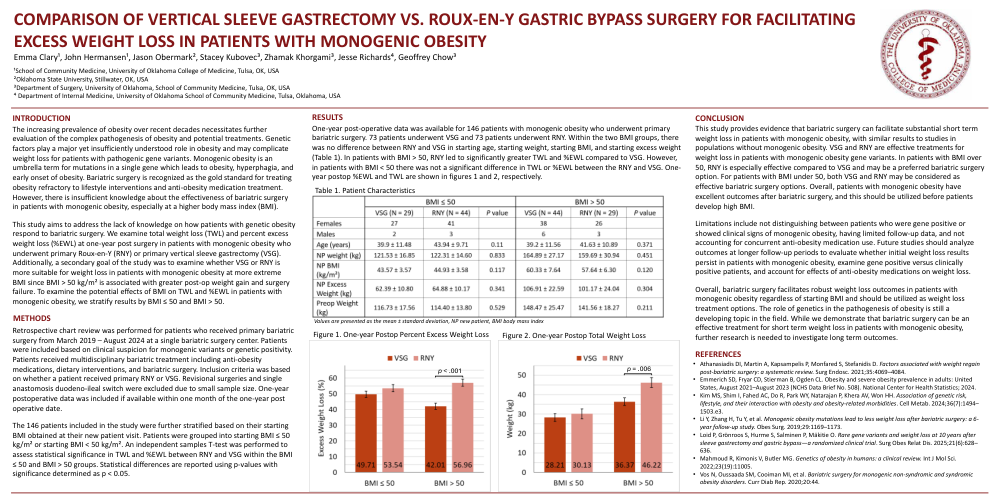
One-year post-operative data was available for 146 patients with monogenic obesity who underwent primary bariatric surgery. 73 patients underwent VSG and 73 patients underwent RNY. Within the two BMI groups, there was no difference between RNY and VSG in starting age, starting weight, starting BMI, and starting excess weight (Table 1). In patients with BMI > 50, RNY led to significantly greater TWL and %EWL compared to VSG. However, in patients with BMI < 50 there was not a significant difference in TWL or %EWL between the RNY and VSG. One-year postop %EWL and TWL are shown in figures 1 and 2, respectively.
Conclusion
This study provides evidence that bariatric surgery can facilitate substantial short term weight loss in patients with monogenic obesity, with similar results to studies in populations without monogenic obesity. VSG and RNY are effective treatments for weight loss in patients with monogenic obesity gene variants. In patients with BMI over 50, RNY is especially effective compared to VSG and may be a preferred bariatric surgery option. For patients with BMI under 50, both VSG and RNY may be considered as effective bariatric surgery options. Overall, patients with monogenic obesity have excellent outcomes after bariatric surgery, and this should be utilized before patients develop high BMI.
Limitations include not distinguishing between patients who were gene positive or showed clinical signs of monogenic obesity, having limited follow-up data, and not accounting for concurrent anti-obesity medication use. Future studies should analyze outcomes at longer follow-up periods to evaluate whether initial weight loss results persist in patients with monogenic obesity, examine gene positive versus clinically positive patients, and account for effects of anti-obesity medications on weight loss.
Overall, bariatric surgery facilitates robust weight loss outcomes in patients with monogenic obesity regardless of starting BMI and should be utilized as weight loss treatment options. The role of genetics in the pathogenesis of obesity is still a developing topic in the field. While we demonstrate that bariatric surgery can be an effective treatment for short term weight loss in patients with monogenic obesity, further research is needed to investigate long term outcomes.