816 posters, 24 topics, 3,314 authors, 1,012 institutions
ePostersLive by SciGen Technologies S.A. All rights reserved.
SAGES 2026 Annual Meeting Emerging Technology Session
March 25-28, 2026 | Tampa, FL, USA

P193
Limited Predictive Value of Preoperative Symptoms and Manometry for Postoperative Complications in Bariatric Surgery Patients with Abnormal Upper Gastrointestinal Findings
Poster Presenter
Part of Topic
Bariatric
Limited Predictive Value of Preoperative Symptoms and Manometry for Postoperative Complications in Bariatric Surgery Patients with Abnormal Upper Gastrointestinal Findings
Authors
B. Schultz1, N. Kelhofer1, B. Rowitz1,2, N. Rawson1,2
1Carle Illinois College of Medicine , University of Illinois Urbana-Champaign, Urbana, IL; 2General Surgery, Carle Health, Urbana, IL
INTRODUCTION
Preoperative evaluation for bariatric surgery typically includes an upper gastrointestinal (UGI) series to check for hiatal hernia and other abnormalities
Dysmotility and tertiary contractions are identified on UGI in a subset of bariatric patients, prompting concern about postoperative risk
When abnormal UGI findings are present, many centers proceed with additional preoperative manometry even for asymptomatic patients
It remains unclear whether this additional testing affects patient outcomes, particularly in asymptomatic individuals
Despite existing evidence suggesting that diagnosing esophageal dysmotility may influence the choice of bariatric procedure, there remains a lack of consensus on the routine use of manometry in patients with incidentally found UGI findings suggestive of dysmotility but no overt symptoms
METHOD
Design: Retrospective cohort study
Setting: Carle Foundation Hospital, October 2013 – October 2023
Participants: Patients aged 18+ who underwent primary sleeve gastrectomy with dysmotility or tertiary contractions on preoperative UGI series
Cohorts: Patients classified as symptomatic or asymptomatic based on preoperative presence of dysphagia, regurgitation, GERD, PPI use, odynophagia, or food intolerance; further stratified by whether preoperative manometry was performed
Primary outcome: Any postoperative complication within 1 year of surgery
Statistics:
Risk ratios (RR) with 95% confidence intervals (CI) were calculated to compare complication rates between groups
Baseline demographics, preoperative symptoms and weight loss outcomes were compared using t-test for continuous variable and chi-square or Fisher’s exact test for categorical variables
Significance threshold p < 0.05
RESULTS
Study Population
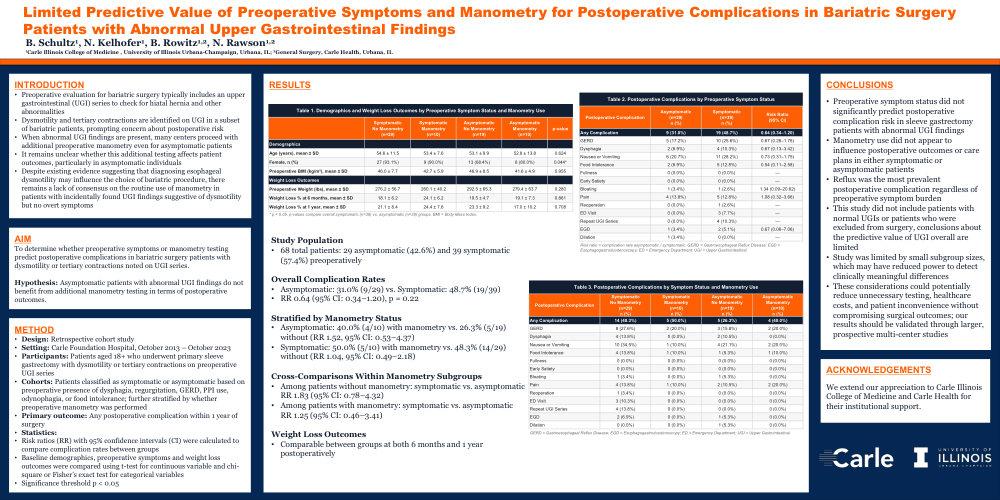
68 total patients: 29 asymptomatic (42.6%) and 39 symptomatic (57.4%) preoperatively
Overall Complication Rates
Asymptomatic: 31.0% (9/29) vs. Symptomatic: 48.7% (19/39)
RR 0.64 (95% CI: 0.34–1.20), p = 0.22
Stratified by Manometry Status
Asymptomatic: 40.0% (4/10) with manometry vs. 26.3% (5/19) without (RR 1.52, 95% CI: 0.53–4.37)
Symptomatic: 50.0% (5/10) with manometry vs. 48.3% (14/29) without (RR 1.04, 95% CI: 0.49–2.18)
Cross-Comparisons Within Manometry Subgroups
Among patients without manometry: symptomatic vs. asymptomatic RR 1.83 (95% CI: 0.78–4.32)
Among patients with manometry: symptomatic vs. asymptomatic RR 1.25 (95% CI: 0.46–3.41)
Weight Loss Outcomes
Comparable between groups at both 6 months and 1 year postoperatively
CONCLUSIONS
Preoperative symptom status did not significantly predict postoperative complication risk in sleeve gastrectomy patients with abnormal UGI findings
Manometry use did not appear to influence postoperative outcomes or care plans in either symptomatic or asymptomatic patients
Reflux was the most prevalent postoperative complication regardless of preoperative symptom burden
This study did not include patients with normal UGIs or patients who were excluded from surgery, conclusions about the predictive value of UGI overall are limited
Study was limited by small subgroup sizes, which may have reduced power to detect clinically meaningful differences
These considerations could potentially reduce unnecessary testing, healthcare costs, and patient inconvenience without compromising surgical outcomes; our results should be validated through larger, prospective multi-center studies
ACKNOWLEDGEMENTS
We extend our appreciation to Carle Illinois College of Medicine and Carle Health for their institutional support.