875 posters, 25 topics, 3,440 authors, 1,061 institutions
ePostersLive by SciGen Technologies S.A. All rights reserved.
SAGES 2026 Annual Meeting Emerging Technology Session
March 25-28, 2026 | Tampa, FL, USA

P168
QUANTIFYING THE USE OF LARGE LANGUAGE MODELS IN PUBLISHED SURGICAL ABSTRACTS
Poster Presenter
Part of Topic
Artificial Intelligence
Background
Large Language Models (LLMs) have revolutionized scientific writing with human-like text generation capabilities. The use of LLMs threatens the integrity of surgical research if not properly disclosed. It is becoming increasingly evident that LLMs are being used to publish scientific papers with disclosure potentially lagging behind actual use.
We aimed to quantify the use of LLMs among published abstracts across leading international surgical conferences and assess changes over time and across submission categories
Methods
Study Design: Retrospective analysis of consecutively published abstracts in British Journal of Surgery between March 2022 and May 2025.
LLM Detection: A transformer based binary text classifier distinguishing human vs LLM-generated text. Model validated on 100 abstracts from 2015 paired with LLM-generated synthetic abstracts with identical titles achieving 100% accuracy.
Results
8797 abstracts across 34 conferences analyzed.
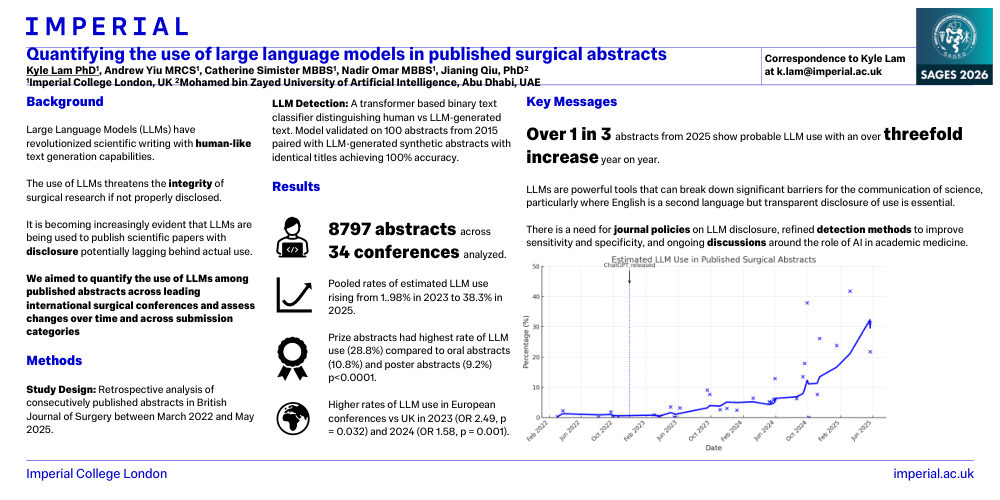
Pooled rates of estimated LLM use rising from 1..98% in 2023 to 38.3% in 2025.
Prize abstracts had highest rate of LLM use (28.8%) compared to oral abstracts (10.8%) and poster abstracts (9.2%) p<0.0001.
Higher rates of LLM use in European conferences vs UK in 2023 (OR 2.49, p = 0.032) and 2024 (OR 1.58, p = 0.001).
Key Messages
Over 1 in 3 abstracts from 2025 show probable LLM use with an over threefold increase year on year.
LLMs are powerful tools that can break down significant barriers for the communication of science, particularly where English is a second language but transparent disclosure of use is essential.
There is a need for journal policies on LLM disclosure, refined detection methods to improve sensitivity and specificity, and ongoing discussions around the role of AI in academic medicine.